字體:小 中 大
 |
|
|
|
| 2026/04/22 21:31:11瀏覽273|回應0|推薦0 | |
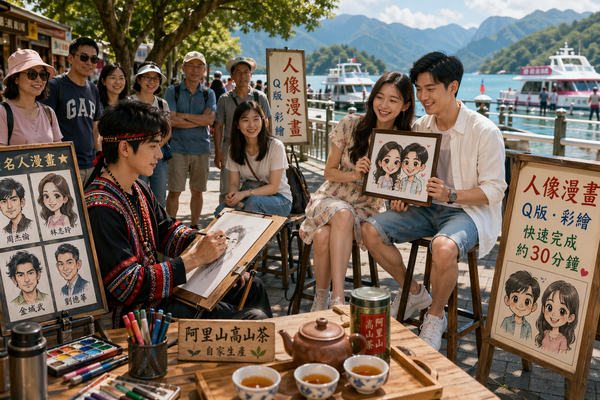
A Love Letter from Lhasa2(1) Chapter One: The Portrait Artist at Shuishe Pier, Sun Moon Lake 1 After cross-strait tourism was opened, Sun Moon Lake and Alishan became two of the most popular destinations for visitors from mainland China. Located in Yuchi Township, Nantou County, Sun Moon Lake lies nestled among rolling mountains. Its shimmering waters reflect the surrounding peaks like a brilliant sapphire hidden within the forest, drawing travelers from near and far. Sightseeing boats glide between Shuishe, Ita Thao, Xuanguang Temple, and Chaowu Pier, while visitors wander through the bustling lakeside streets, sampling local delicacies. At a corner of Shuishe Pier stood a young man named Tang Huai-min. With his deep-set features and dignified presence, he wore traditional Tsou tribal attire and ran a small portrait stand. Using a lively cartoon style, he attracted tourists from all directions. Visitors strolling along the pier paused to admire his work, pointing at caricatures of famous figures and chatting animatedly. A young couple sat on tall stools, posing while Huai-min sketched them. Beneath the shade of nearby trees, several tourists waited patiently for their turn. Huai-min worked swiftly and confidently. He first outlined the figures with charcoal, then added color. Within half an hour, the couple’s chibi-style portrait was complete. Laughing, they took the framed drawing, paid happily, and walked away hand in hand. The next visitors took their seats. Huai-min took a few sips of his homegrown Alishan high-mountain tea and continued working. Near noon, a tall young woman in a floral blouse and jeans approached. Her hair was styled in a chic Audrey Hepburn cut. Her name was Tang Meng-ying. Carrying two lunch boxes, she sat on a low stool and waited for Huai-min to finish his drawing. Ten minutes later, Huai-min stood up, framed the completed portrait for an elderly couple, accepted a five-hundred-dollar bill, and then placed a sign that read “Break—Back in One Hour.” He bowed politely to the waiting tourists, inviting them to return after lunch. Meng-ying opened the lunch boxes. One contained handmade sushi rolls; the other held stir-fried vegetables and anchovies with dried tofu. “I made the sushi myself,” she said with a satisfied smile. “The vegetables and anchovies were cooked by the chefs at the hotel—I asked them to help.” “Meng-ying, you didn’t have to go through all this trouble,” Huai-min said as he wiped his hands with a damp towel and picked up a piece of sushi. “I’m not picky.” “This is the only way I can help,” she replied lightly. “You won’t even let me wash your clothes.” “Of course not. If your dad found out, he’d never stop lecturing you.” “I’m not worried,” she said cheerfully. “My mom always says a woman should take good care of her man.” “But I don’t want you putting so much effort into making meals every day.” “It doesn’t take that long. I just change the dishes a bit so you won’t get tired of them.” “Maybe next year,” he said. “I’m still saving money.” “Money isn’t a problem. I have enough savings for both of us to study in Paris.” “No,” Huai-min replied firmly. “I can’t use your money.” “You’re my fiancé. Why not?” “I said no, and that’s final.” “But you’ll be wasting an entire year!” “I don’t think being a street artist is a waste of time.” “Well… fine,” she sighed helplessly. “I guess I’ll go along with you. My dad will be thrilled to know I’m delaying my trip abroad.” “You can help him manage the hotel this year.” She gave a bitter smile. “Right—working like a slave for a salary.” 2 Tang Meng-ying carried the empty lunch boxes back to the hotel lobby. A receptionist approached her respectfully. “Manager Tang, the chairman is waiting for you in his office.” “Alright. Please wash these and put them back in my office.” She took the elevator upstairs and entered the chairman’s office. Tang Yun-fei rose from his chair. “Sweetheart, your father has two things to tell you.” “What is it, Dad?” “First, in three days I’ll be leading a hotel industry delegation to the mainland—Shanghai, Beijing, Chongqing. We’ll be gone about two weeks. During that time, you’ll need to manage the hotel.” She gave a wry smile. “So you’re squeezing more labor out of me again?” He laughed. “Second, some tour leaders from the mainland suggested replacing the Western oil paintings in the rooms and hallways with Taiwanese ink or watercolor landscapes. Ask Huai-min to paint some local scenery and have them framed.” “Dad, you’ll have to pay market rates. Otherwise, I can’t bring it up with him.” “Of course,” he replied. Then he asked, “When are you and Huai-min going to Paris?” “He says he wants to save enough money first and apply next year.” “Good,” Tang Yun-fei said approvingly. “A young man should stand on his own feet. You can wait another year—let me finish setting things up on the mainland first.” She sighed. “I knew you had your own agenda, Dad.” He smiled and patted her shoulder. “One day this hotel business will be yours and Huai-min’s anyway.” She looked worried. “But Dad, that’s a heavy burden. I’m afraid Huai-min doesn’t want this kind of life—he’s always been a free spirit.” “Then you’ll have to find a way to change him,” her father said calmly. 3 Back at Shuishe Pier, Huai-min was sketching portraits for two sisters while a small crowd gathered to watch. Among them stood an elderly monk with a shaved head, dressed in maroon robes. He watched Huai-min intently, never taking his eyes off him. When the portrait was finished, the monk stepped forward, pressed his palms together, and bowed deeply. Huai-min and the onlookers were taken aback. The monk spoke in a calm, enigmatic tone. Huai-min shook his head. “Have you heard of King Songtsen Gampo?” “I’ve heard of him from my grandfather.” “You were him,” the monk said gently. “I recognized your spirit the moment I saw you.” Confused, Huai-min asked, “Venerable one, why are you telling me this?” “You must return to Lhasa as soon as possible. Princess Wencheng will appear there. Together, you must complete a great mission, and only then will you remain together.” Huai-min stared at him in disbelief. “How do you know I have Tibetan ancestry?” “I saw your original soul,” the monk replied. “I revealed this to form a karmic connection with you. Please remember my words. My name is Gongga Sonam. When you reach Lhasa, come find me at Jokhang Temple. I am the monastery’s steward.” The onlookers murmured among themselves as the monk turned and walked away. Huai-min watched his retreating figure, his heart restless and unsettled. 4 As night fell and the city lights gradually came on, Tang Huai-min sat at his desk and opened his laptop. He searched online for portraits of Songtsen Gampo and Princess Wencheng. Staring intently at the images of Songtsen Gampo, he felt a jolt of shock ripple through him. Murmuring to himself, he said, Leaning against the window, Huai-min gazed out at the lake, recalling the old lama’s words earlier that day: “Your previous life was Songtsen Gampo… You must return to Lhasa as soon as possible. Princess Wencheng will appear there. Together, you must complete a great mission, and afterward, you will remain together for eternity.” “If I really am the reincarnation of Songtsen Gampo,” Huai-min muttered, “then why was I born on the island of Taiwan? How could that lama, a complete stranger, know that I am of Tibetan descent? And if I really do return to Lhasa and meet the reincarnation of Princess Wencheng… how am I supposed to explain all this to Meng-ying? How can she possibly accept a past-life bond like this?” His mind filled with unanswered questions, he sighed inwardly. A knock sounded at the door. Tang Meng-ying entered, carrying a wooden tray with two cups of coffee and some fruit. “Thought I’d keep you company with a cup of coffee,” she said, setting the tray down. Huai-min folded his arms and looked at her, trying to figure out how to explain the lama he had met that afternoon. “My dad says he wants you to paint several dozen landscape ink and watercolor paintings for the hotel,” she said. “You can name your price. That way, you won’t have to worry about money for studying in Paris.” She expected him to be delighted, but he showed little reaction. Her intuition immediately sensed something was wrong. “What’s the matter? Something on your mind?” “Meng-ying… if I changed my mind and couldn’t go to Paris with you… would you—” “What? You don’t want to go to Paris anymore?” she exclaimed. “Studying art in Paris has always been your dream! You’d better give me a convincing reason!” “I’ve prepared for this dream for three years,” he said slowly. “But today, by the lake, I met a lama from Tibet. He knew I was of Tibetan descent—and he said I’m the reincarnation of King Songtsen Gampo. He said I must return to Tibet to fulfill a mission.” “Really?” Meng-ying asked, restraining her temper. “Do you even know that lama?” “No.” “And you believe what a complete stranger tells you?” “I think… there must be a deeper meaning behind his words. Unless I go to Tibet, I’ll never understand what’s happening inside me.” “That’s ridiculous!” she snapped. “A stranger spouts some nonsense, and suddenly you want to abandon everything and run off to Tibet? Then tell me—what does our relationship mean? We’ve grown up together!” Her emotions surged uncontrollably. “Please calm down, Meng-ying,” Huai-min tried to soothe her. “How am I supposed to calm down?” she cried. “All these years, I’ve always given in to you, supported you in everything. And now, with just a few words, you want to walk away from me? Where’s your conscience?” She jabbed a finger into his chest. Huai-min stood there helplessly, unable to respond. 5 Early the next morning, Huai-min left a letter for Meng-ying on the desk. Quietly, he shouldered his travel bag, left the Tang household, mounted his motorcycle, and headed toward Alishan. At breakfast time, Meng-ying knocked on his door. There was no response. She entered the room and found the bed neatly made and a letter waiting for her on the desk. After reading it, tears welled in her eyes. She went downstairs, where her parents were already at the table. “What happened, sweetheart?” Tang Yun-fei asked anxiously, standing up. “Huai-min… he says he’s going to Tibet. He’s not going to Paris with me anymore.” Her mother, Zhao Ya-yun, walked over and wrapped her in a hug. “No… I didn’t argue with him. I just asked why he suddenly changed his plans,” Meng-ying said through sobs. “Then I’ll go with you to Alishan,” her mother decided at once. “We’ll talk to him face to face.” “Then hurry back,” Tang Yun-fei added. “I still have my schedule to keep.” Zhao Ya-yun shot him an annoyed look. Tang Yun-fei sighed. Chapter Two – The Tang Family of Alishan 1 Near noon, the roar of a motorcycle echoed through Dabang Village, drawing the villagers’ attention. Seeing Huai-min, they waved in greeting, and he waved back. He parked in the courtyard of his family home. Hearing the engine, his father, Degé Losang, and his younger sister, Tang Ai-yu, came outside. Removing his helmet, Huai-min walked toward them. “Brother, why are you back so suddenly?” Ai-yu asked in surprise. “I came to talk to Mom and Dad about something.” “You could’ve at least called first,” his father muttered, then asked, “What is it you want to discuss?” “Dad, I want to go to Tibet—for a while.” Ai-yu blinked in disbelief. At that moment, their father’s expression darkened. He let out a long sigh. Ai-yu stared at him, confused. “Let’s talk inside,” he said. “Ai-yu, go prepare a few more dishes.” They went into the living room. Just then, the phone rang. Tang Mei-lan answered. “Ya-yun? Huai-min just got home. You’re coming up the mountain later? That’s wonderful—we haven’t seen each other in ages.” “Well, look at that,” Ai-yu joked. “Future mother-in-law is already on the move.” She headed into the kitchen. Seated at the long table, Mei-lan turned to Huai-min. “Did you two argue?” Losang asked. Huai-min nodded. “Changed what decision?” Mei-lan asked. “I want to go to Tibet—for a while.” A flicker of tension passed between Mei-lan and Losang as their eyes met. “At last, what was meant to come has come,” Losang said quietly. Mei-lan asked, “Who did you meet recently?” “Yesterday, while I was painting by the lake, a lama stopped by and spoke to me.” “What did he say?” Losang asked. Huai-min recounted the entire encounter. When he finished, his parents exchanged another heavy glance. Losang sighed. Mei-lan looked troubled. Losang paused before replying. “I want to go to Tibet,” Huai-min replied calmly. “Not just to verify what the lama said, but because Tibet is our ancestral homeland. I’ve never truly lived there.” Losang nodded slowly. Mei-lan said anxiously, “That’s true,” Losang said. “But think of it this way—if the prophecy turns out to be false, Huai-min will return to Taiwan and be with her again.” Mei-lan asked nervously, Huai-min shook his head. Losang exhaled in relief. Mei-lan sighed. “We’ll take things one step at a time,” Losang said calmly. 2 Zhao Ya-yun and her daughter, Tang Meng-ying, appeared in the Tang family’s living room. Everyone in the Tang household was present. When Tang Huai-min saw the sorrowful expression on Meng-ying’s face, a pang of guilt rose within him. Tang Ai-yu brought out bowls of aiyu jelly, while Mei-lan warmly greeted their guests. Ai-yu handed a bowl to each of them. After taking a few spoonfuls, Zhao Ya-yun paused and said, Mei-lan responded carefully, Losang added, “But this all happened so suddenly,” Zhao Ya-yun replied. “It’s only natural that Meng-ying feels unsettled. And even if he wants to go to Tibet, there’s no need to rush. Why not wait until after they return from studying in Paris and then go together?” Her reasoning was sound. Mei-lan and Losang turned to Huai-min, waiting for him to speak. Understanding their gaze, Huai-min spoke sincerely. Zhao Ya-yun sensed his determination and thought for a moment before saying, Meng-ying’s tightly knit brows finally relaxed into a faint smile. Huai-min never expected such a sudden proposal. He froze, awkwardly scratching his forehead. The elderly couple exchanged uneasy glances. Losang quickly intervened, Zhao Ya-yun considered this and turned to her daughter. After a moment’s thought, Meng-ying replied, Mei-lan smiled politely. 3 That evening, Tang Ai-yu accompanied Tang Meng-ying on a walk near the performance grounds by the Kuba (Note 1) in the village. “Ai-yu, do you know why your brother suddenly insists on going to Tibet?” Meng-ying asked. “I’m not really sure,” Ai-yu replied. “Before my grandfather passed away, he did tell my brother to return to our homeland someday. So when he brought it up this time, my parents agreed.” “Yesterday, your brother met a wandering lama from across the strait at Sun Moon Lake. That lama said he was the reincarnation of King Songtsen Gampo and told him to return to Tibet.” “I only heard about that from my parents earlier,” Ai-yu said. “I don’t know the details either. But I understand how worried you must feel.” “I actually want to go with him to Tibet,” Meng-ying admitted softly. “I’m not afraid of hardship. But I can’t abandon my father and the hotel business. He’s already overwhelmed, and my younger brother just started college. There’s no one else to help him manage things.” “Our situation is similar,” Ai-yu sighed. “I help with the coffee and tea plantations, and with household chores. Originally, my brother planned to stay in Sun Moon Lake to save money so he could go to Paris with you. I was barely holding things together. Now that he’s going to Tibet, it’ll be even harder during harvest season.” “Our families have lived together for generations,” Meng-ying said quietly. “You know how I feel about your brother. I always believed I would one day become his wife.” Ai-yu looked at her with compassion. “Thank you, Ai-yu,” Meng-ying said softly, tears glistening in her eyes. 4 After listening to his wife, Tang Yun-fei fell silent for a long moment before speaking. “Sweetheart, if you marry into the Tang family now and have to follow Huai-min to Tibet to suffer hardship, I’d rather you stay home and help me manage the hotel.” “Hey, Mr. Tang,” Zhao Ya-yun snapped, “could you be a little more considerate? For our daughter’s happiness, I’d rather she marry Huai-min and go to Tibet with him. She only hesitated because she couldn’t bear to leave you alone running the business.” Hearing this, Tang Yun-fei’s stern expression softened. “At least you still think of your old man,” he said gently, pulling Meng-ying into his arms. “You know what worries your daughter most, don’t you?” Zhao Ya-yun asked. “Of course,” he replied. “She’s afraid that distance will change their relationship, and that Huai-min won’t be back anytime soon.” “Well, at least you understand her,” Zhao Ya-yun said, somewhat relieved. “If he’s meant to be yours, he won’t leave no matter what. If he’s not, no amount of forcing will make him stay,” Tang Yun-fei said calmly. “If you want to wait for him, I’ll support you. If you want to go to Paris, I’ll work harder to make it happen. But I don’t want you following him to some remote place to suffer.” “Dad…” Meng-ying murmured, knowing his temperament—once he felt respected, he became surprisingly open-minded. “That boy Huai-min is too romantic,” Tang Yun-fei continued. “You artists are all like that—dreamy, detached from reality. Frankly, he’s not cut out for business. Unlike you, who can handle social dealings and manage the hotel. I’d rather you marry someone with a business background—like Lin Jun-liang from my operations department—” “Dad!” Meng-ying interrupted sharply. “That’s not fair. Huai-min didn’t grow up in business, so of course he lacks experience. But he built his own brand and marketed his family’s coffee and high-mountain tea online—successfully, I might add. We’ve all seen that. As for me, I learned business because I grew up watching you. Back when we lived in Alishan, all I knew was how to pick tea leaves and roast coffee beans.” “You’re right,” Zhao Ya-yun added firmly. “What you just said wasn’t fair at all. The Tang family has always treated us like family. When you first came here years ago to build your hotel and ran short of funds, it was my sister Mei-lan who bought the tea factory and coffee plantation and even guaranteed your bank loan. Without her help, you wouldn’t be where you are today. One must remember kindness.” Tang Yun-fei gave a wry smile.
|
|
| ( 創作|連載小說 ) |