字體:小 中 大
 |
|
|
|
| 2017/12/13 21:52:51瀏覽1778|回應0|推薦0 | |
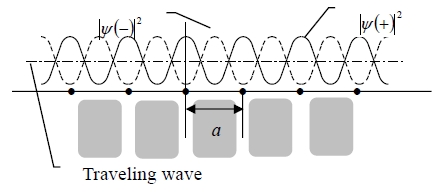
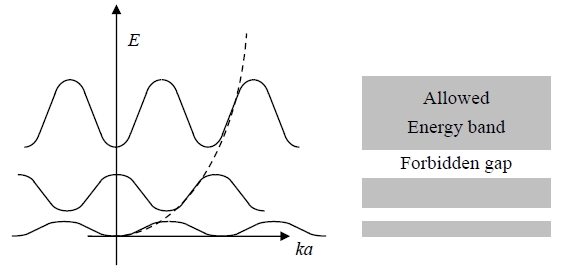
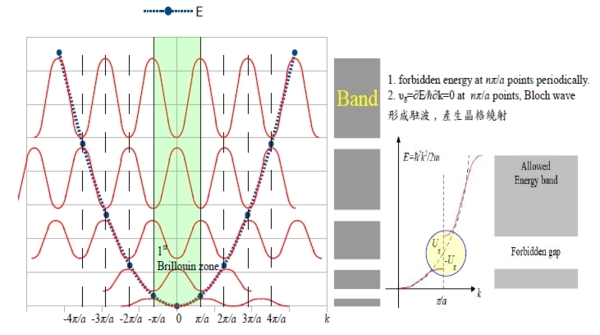
Chap. 7 Energy Gap Two different standing waves, k=±π/a ψ(+)=2cos(πx/a), ψ(-)=2isin(πx/a) in 1-D Charge probability density, ρ(+)=|ψ(+)|² cos²(πx/a) at x=0, a, 2a, 3a…能量最低 ρ(-)=|ψ(-)|² sin²(πx/a) at x= a/2, 3a/2, 5a/2…能量較高
Normalized standing wave: ∫|ψ(+)|²dx=1 → A²∫₀acos²(πx/a)dx=1 → A²a/π∫₀πcos²ydy=1 → A²a/π(y/2+sin2y/4)|₀π=1 → A²a/2=1, A=(2/a)1/2 ⸫ ψ(+)=(2/a)1/2cos(πx/a) 同理, ψ(-)=(2/a)1/2sin(πx/a) potential energy, U(x)=U₀cos(2πx/a) → U(+)=∫ψ*(+)Uψ(+)dx, U(-)=∫ψ*(-)Uψ(-)dx Eg=U(-) - U(+)=U₀ Bloch theorem Hψₙ=Eψₙ, (ℏ²k²/2m+U)ψₙ=Eψₙ ⸪晶格為週期性排列→ ψₙ亦為週期性函數 the solution of Schrödinger equation for a periodic potential, ψk(r)=eik∙r∙uk(r) where uk(r)=uk(r+T) T: translation vector → ψk(r)=ψk(r+T) 表示相位相同即起始條件一樣 Free electron model: ψk(r)=eik∙r, 平面波,自由電子沒有位能存在 Nearly free electron model: ψk(r)=eik∙r∙uk(r) Bloch function(描述理想晶體時) Kronig-Penny model(1-D)
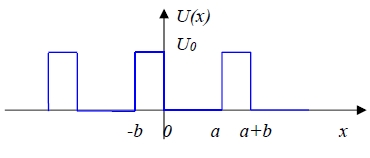
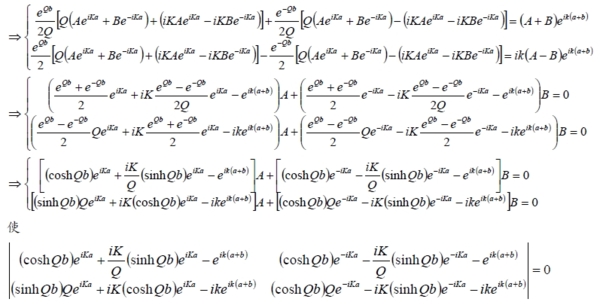
(-ℏ²/2m)d²ψ∕dx²+Uψ=Eψ, H=(-ℏ²/2m)d²/dx²+U in the region 0<x<a, U=0 d²ψ∕dx²+2mEψ/ℏ²=0, K²= 2mE/ℏ² ψ₁(x)=AeiKx+Be-iKx in the region a<x<a+b, U=U0 d²ψ∕dx²-2m(U0-E)ψ/ℏ²=0, let Q²= 2m(U0-E)/ℏ² ψ₂(x)=CeQx+De-Qx Boundary conditions: ψ₁(a)=ψ₂(a) and dψ₁/dx|x=a=dψ₂/dx|x=a when x=a → AeiKa+Be-iKa=CeQa+De-Qa, iKAeiKa-iKBe-iKa =QCeQa-QDe-Qa 解C, D C=e-Qa/2Q[Q(AeiKa+Be-iKa)+(iKAeiKa-iKBe-iKa )], D=eQa/2Q[Q(AeiKa+Be-iKa)-(iKAeiKa-iKBe-iKa )] ⸫ ψ₁(x)=AeiKx+Be-iKx, ψ₂(x)=eQ(x-a)/2Q[Q(AeiKa+Be-iKa)+(iKAeiKa-iKBe-iKa )]+e-Q(x-a)/2Q[Q(AeiKa+Be-iKa)-(iKAeiKa-iKBe-iKa )]代入 bloch function ψ(x+a+b)=u(x+a+b)eik(x+a+b)=u(x)eikxeik(a+b)=ψ(x)eik(a+b), 令x=0 ψ₂(a+b)=ψ₁(0)eik(a+b), and dψ₂(a+b)/dx=[dψ₁(0)/dx]eik(a+b) 將ψ₁, ψ₂代入解A, B
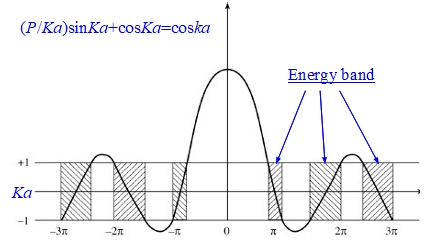
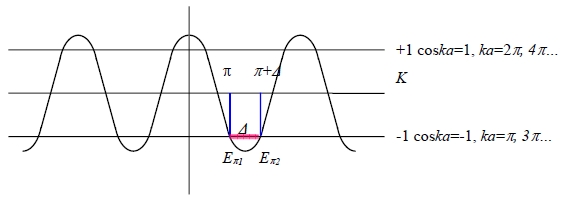
得 [(Q²-K²)/2QK](sinhQb)sinKa+(coshQb)cosKa=cosk(a+b)…(a), Q²= 2m(U0-E)/ℏ², K²= 2mE/ℏ², k=2π/λ in the limiting case: b→0, U0→ and define P=Q²ba/2 a finite quantity. sinhQb=(eQb-e-Qb)/2≈1/2[(1+Qb+Q²b²/2+...)-(1-Qb+Q²b²/2-...)]=Qb, coshQb=(eQb+e-Qb)/2≈1 (a)簡化為(Q/2K)QbsinKa+cosKa=coska ⸫ (P/Ka)sinKa+cosKa=coska
Quantum mechanics of electrons in crystal lattices R. De L. Kronig and William George Penney published: Proc. Roy. Soc. 03 Feb. 1931 vol. 130 Issue 814Solutions of Kronig-Penney Models by the T-Matrix Method William J. Titus American Journal of Physics 41, 512 (1973)
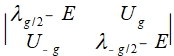
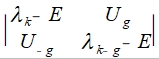
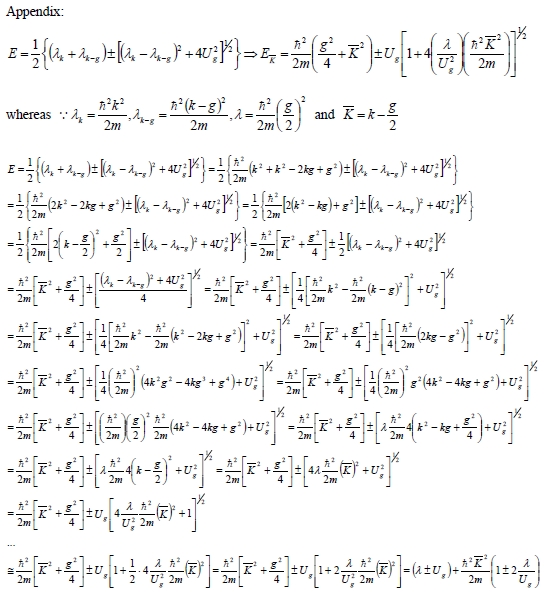
Kronig-Penney model: electron in a periodic field of a crystal I: d²ψ/dx²+(2mE/ℏ²)ψ(x)=0 α²=2mE/ℏ² II: d²ψ/dx²+(2m/ℏ²)(E-V₀)ψ(x)=0 γ²=(2m/ℏ²)(V₀-E) Bloch wave: ψ(x)=u(x)eikx u(x): periodic function, different for various directions in crystal. 代入I, II方程式 d²ψ/dx²= d²(u(x)eikx)/dx²=d/dx[(du/dx)eikx+iku(x)eikx] =(d²u/dx²)eikx+ik(du/dx)eikx+ik[(du/dx)eikx+iku(x)eikx ]=[(d²u/dx²)+2ik(du/dx)-k²u(x)]eikx ⸫ I (d²u/dx²)+2ik(du/dx)-k²u(x)+α²u(x)=0 → D²u+2ikDu+(α²—k²)u=0 → D=-ik±iα u(x)=(Aeiαx+Be⁻iαx)e⁻ikx II (d²u/dx²)+2ik(du/dx)-k²u(x)-γ²u(x)=0 → D=-ik±γ u(x)=(Ceγx+De⁻γx)e⁻ikx Schrödinger eq. -ℏ²/2m(d²ψ/dx²)+U(x)ψ(x)=Eψ(x) potential in periodic crystal U(x+a)=U(x) a: lattice constant expanding wave function and potential function by Fourier series ψ(x)=∑ₖC(k)eikx, U(x)=∑GU(G)eiGx where G =2πn/a is the reciprocal lattice vector and U(G)=UG =1/a∫₀ₐdxU(x)e-iGx (7.69) Because U(x) is real, it is easy to show that UG* = U-G. UG* =[1/a∫₀ₐdxU(x)e-iGx]*=1/a∫₀ₐdxU(x)eiGx= 1/a∫₀ₐdxU(x)e-i(-G)x= U-G (7.70) We can use these plan waves as our basis, and therefore we can write any wavefunction in the following form ψ(x)=∑ₖC(k)eikx (7.71), C(k)=1/a∫₀ₐdxψ(x)e-ikx (7.72) Consider a system with size L and periodic boundary conditions, ψ(x + L) = ψ(x). With such a boundary condition, we know that the wavevector for plan waves can only take discrete values k =2πn/L (7.73) with n = … - 3, -2, -1, 0, 1, 2, 3… 代入Schrödinger eq. -ℏ²/2m(d²∑ₖC(k)eikx/dx²)+∑G U(G)eiGx ∑ₖC(k)eikx=E∑ₖC(k)eikx → -ℏ²/2m∙(ik)²∑ₖC(k)eikx+∑G U(G)eiGx ∑ₖC(k)eikx-E∑C(k)eikx=0 → (ℏ²k²/2m-E)∑ₖC(k)eikx+∑ₖ∑G U(G) C(k)ei(k+G)x=0 The second term on the l.h.s. has two sums ∑ₖ∑G . Define k = G + k and change the sum over k into the sum of k . As a result, this term becomes ∑ₖ∑G U(G) C(k)ei(k+G)x= ∑ₖ∑G U(G) C(k-G)eikx =∑ₖ∑G U(G) C(k-G)eikx (7.77) So ∑ₖ[(ℏ²k²/2m-E)C(k)+∑G U(G) C(k-G)]eikx=0 (7.78) For plane waves, if I have a equation ∑ₖa(k)eikx=0 (7.80) the only solution to this equation is a(k)=0 for every k. This is because plane waves with different wave-vectors are linear independent <k|k >=0 .Therefore, if the sum over planes with different k is zero, every term in the sum must be zero. For the Schrodinger equation we considered above, this means that (ℏ²k²/2m-E)C(k)+∑G U(G) C(k-G)=0 (7.81) In our text book, it is defined λk = ℏ²k²/2m, so we get (λk -E)C(k)+∑G U(G) C(k-G)=0 (7.82) This equation is known as the central equation. It is just the Schrodinger equation rewritten in the plane wave basis. The central equation implies that C(k) is coupled with C(k+G), which includes C(k±π/a), C(k ±2 π/a), C(k ±3π/a), … In the same time, it is easy to notice that if k - k ≠G, C(k) and C(k ) decouple from each other. C(k ) never appears in any equation of C(k) and vice versa. In other words, the value of C(k) doesn’t care about the value of C(k ). U(x)=∑GU(G)eiGx=A∙a∙∑ₛδ(x-sa) i.e. delta function ∫₀ₐδ(x-sa)dx=1 → ∫₀ₐδ(x-a)f(x)dx=f(a) U(G)==1/a∫₀ₐdxU(x)e-iGx=1/a∫₀ₐdxA∙a∙∑ₛδ(x-sa)e-iGx=A∑ₛ∫₀ₐ δ(x-sa)e-iGx dx=A∑ₛ e-iGsa=A∑ₛ e-i2πns G=±2πn/a reciprocal vector, 某一個UG對應一個s值, UG= A 代入central eq. → (λk -E)C(k)+∑ₙ AC(k-2πn/a)=0 define: f(k)=∑ₙ C(k-2πn/a), and f(k)=f(k-2πn/a) → C(k)=-Af(k)/(λk -E)=-[(2mA/ℏ²)f(k)]/[k²-(2mE/ℏ²)] 代入 λk = ℏ²k²/2m 上式用k-2πn/a代換k C(k-2πn/a)=-[(2mA/ℏ²)f(k-2πn/a)]/[(k-2πn/a)²-(2mE/ℏ²)]=-[(2mA/ℏ²)f(k)]/[(k-2πn/a)²-(2mE/ℏ²)] → ∑ₙC(k-2πn/a)=-(2mA/ℏ²)f(k)∑ₙ1/[(k-2πn/a)²-(2mE/ℏ²)] → - ℏ²/2mA=∑ₙ[(k-2πn/a)²-(2mE/ℏ²)]⁻¹ i.e. α²=2mE/ℏ² → - ℏ²/2mA=∑ₙ[(k-2πn/a)²-α²]⁻¹=∑ₙ[(k-2πn/a-α)(k-2πn/a+α)]⁻¹=∑ₙ(1/2α)[(k-2πn/a-α)⁻¹-(k-2πn/a +α)⁻¹]=∑ₙ(1/2α)[a/(ka-2πn-αa)-a/(ka-2πn+αa)] → - ℏ²/2mA=(a/4α)∑ₙ[1/(ka/2-αa/2-πn)-1/(ka/2+αa/2-πn)] i.e. cotx=∑ₙ1/(nπ±x) ∑ₙ[1/(ka/2-αa/2-πn)-1/(ka/2+αa/2-πn)]=cot(ka/2-αa/2)-cot(ka/2+αa/2)
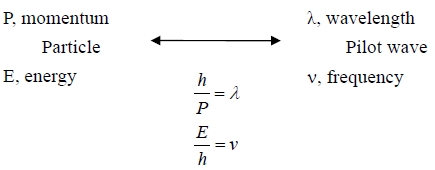
→ - ℏ²/2mA=(a/4α)[2sinαa/(cosαa -coska)]=(a/2α)[sinαa/(cosαa -coska)] → - ℏ²α/maA=sinαa/(cosαa -coska) → coska=cosαa+(maA/ℏ²α)sinαa=cosαa+(P/αa)sinαa → coska=cosαa+(P/αa)sinαa P=ma²A/ℏ² De Broglie’s postulate: The motion of a particle is governed by the propagation of its associated pilot waves. Relationship between them,
pilot wave的特性: ω=νλ=(E/h)∙(h/P)=E/P在某一瞬間, t=t0 可以偵測pilot wave的波形,有關粒子在空間的運動 pilot wave = a group of waves, and group velocity, g=粒子運動的速度 pilot wave function, ψ(x,t)=sin2π(x/λ-νt)=sin2π(kx-νt), k=1/λ if ψ=0, 2π(kx-νt)=nπ n=0, 1, 2,… ⸫ xₙ=n/k+νt/k 波速, ω=dxₙ/dt=ν/k=νλ 代表粒子運動是一群pilot wave相加重疊洏成,變成一群pilot waves. 考慮兩個pilot wave相加的情況: ψ(x,t)=ψ₁(x,t)+ψ₂(x,t) ψ₁(x,t)=sin2π(kx-νt), ψ₂(x,t)=sin2π[(k+dk)x-(ν+dν)t], i.e. sinA+sinB=2cos½(A-B)sin½(A+B) → ψ(x,t)=2cos2π(dkx/2-dνt/2)sin2π[(2k+dk)x/2-(2ν+dν)t/2] ≈ 2cos2π(dkx/2-dνt/2)sin2π(kx-νt) if dk<<k, dv<<v 個別pilot wave波速可以第二項求得ω=ν/k=νλ group wave 的速度, g由第一項求得g=dv/dk=dE/dP 由相對論公式E=mc², P=mv and E²=m²c⁴+P²c²+m₀²c⁴又可證明group wave 的速度等於粒子運動的速度, g=v g=dv/dk=dE/dP=c²P/E=c²mv/mc²=v (⸪ 2EdE=c²2PdP, dE/dP=c²P/E) 又可知ω>g ⸪ dE/dP=c²P/E → g=c²/ω≤c Schrödinger Theorem: 總能, Etotal以古典能量為定義: E=P²/2m+V若成立, 粒子速度是否等於波群速度? ν=E/h=P²/2mh+V/h , k=1/λ=P/h → dv=2PdP/2mh, dk=dP/h ⸫ g=dv/dk=[2PdP/2mh]/(dP/h)=P/m=v 所以Schrödinger theorem:
Def: K=2πk, ω=2πν → P=ℏK, E=ℏω 代入E=P²/2m+V重整可得ℏω=ℏ²K²/2m+V(x,t) 因為微分方程式解為ψ(x,t)須滿足上述條件,我們可以試以ψ(x,t)=sin(Kx-ωt)是否符合ℏω=ℏ²K²/2m+V0的形式 ∂ψ∕∂x=Kcos(Kx-ωt), ∂²ψ∕∂x²=-K²sin(Kx-ωt), ∂ψ∕∂t=-ωcos(Kx-ωt) 套入微分方程式α(∂²ψ∕∂x²)+V0ψ=β(∂ψ∕∂t)看是否符合ℏω=ℏ²K²/2m+V0的形式 → -αK²sin(Kx-ωt)+V0sin(Kx-ωt)=-β ωcos(Kx-ωt)可知ψ(x,t)=sin(Kx-ωt)不合 ψ(x,t)=cos(Kx-ωt)也不合, 因此試以ψ(x,t)=cos(Kx-ωt)+γsin(Kx-ωt) ∂²ψ∕∂x²=-K²cos(Kx-ωt)-γK²sin(Kx-ωt), ∂ψ∕∂t=ωsin(Kx-ωt)-ωγcos(Kx-ωt) 代入微分方程式α(∂²ψ∕∂x²)+V0ψ=β(∂ψ∕∂t) → α[-K²cos(Kx-ωt)-γK²sin(Kx-ωt)]+V0[cos(Kx-ωt)+γsin(Kx-ωt)]=β[ωsin(Kx-ωt)-ωγcos(Kx-ωt)] → (-αK²+V0+βωγ)cos(Kx-ωt)+(-αγK²+γV0-βω)sin(Kx-ωt)=0 ⸫ -αK²+V0+βωγ=0...(a), -αγK²+γV0-βω=0 → -αK²+V0-βω/γ=0...(b) (a)-(b) → βωγ+βω/γ=0, γ²+1=0 γ=±i 代入(a) -αK²+V0=-+iβω 與ℏω=ℏ²K²/2m+V0比較α=- ℏ²/2m, -+iβ=ℏ 因此微分方程式呈現 (-ℏ²/2m)∂²ψ∕∂x²+V0ψ=iℏ(∂ψ∕∂t), 其解為ψ(x,t)=cos(Kx-ωt)+isin(Kx-ωt) 波動函數只有在Schrödinger theorem才存在,因其複數的特徵無法在物理世界去測量 但波動函數和粒子存在的關連,是以波的振幅強度來描述粒子存在的機率密度 born假設 at t=t0 P(x,t)dx=ψψ*dx , ψ=R+iI and ψ*=R-iI ⸫ ψψ*= R²+I² If ψ為(-ℏ²/2m)∂²ψ∕∂x²+V0ψ=iℏ(∂ψ∕∂t)之解 → ψ*就可以成為(-ℏ²/2m)∂²ψ∕∂x²+V0ψ=iℏ(∂ψ∕∂t)…(a)的共軛方程式解 [(-ℏ²/2m)∂²ψ∕∂x²+V0ψ=iℏ(∂ψ∕∂t)]* → [(-ℏ²/2m)∂²ψ∕∂x²]*+(V0ψ)*=[iℏ(∂ψ∕∂t)]* → (-ℏ²/2m)∂²ψ*∕∂x²+V0ψ*=iℏ(∂ψ*∕∂t)…(b) (a)xψ*-(b)xψ → (-ℏ²/2m)[ψ*∂²ψ∕∂x²-ψ∂²ψ*∕∂x²]=iℏ[ψ*∂ψ∕∂t-ψ∂ψ*∕∂t] 化簡(-ℏ²/2m)[ψ*∂²ψ∕∂x²-ψ∂²ψ*∕∂x²]=iℏ[∂ψψ*∕∂t]兩邊積分 → ∫(-ℏ²/2m)∂∕∂x(ψ*∂ψ∕∂x-ψ∂ψ*∕∂x)dx=∫[iℏ(∂ψψ*∕∂t)]dx → (iℏ/2m)(ψ*∂ψ∕∂x-ψ∂ψ*∕∂x)|x₁x₂=∂∕∂t∫x₁x₂ ψψ* dx ex.以ψ(x,t)=exp[i(Kx-ωt)]為例 ψ*(x,t)=e-i(Kx-ωt) → ∂ψ∕∂x=iKψ, ∂ψ*∕∂x=-iKψ* ⸫(iℏ/2m)(ψ*∂ψ∕∂x-ψ∂ψ*∕∂x)|x₁x₂=∂∕∂t∫x₁x₂ ψψ*dx → (iℏ/2m)(2iKψ*ψ)|x₁x₂=∂∕∂t∫x₁x₂ ψ*ψdx → ℏK/m(ψ*ψ)=∂∕∂t∫x₁x₂ ψ*ψdx=v₁-v₂ ⸪ ψ*ψ=1, ℏK/m=P/m=v 對V=V0的例子來說, v也為常數, and ψ*ψ=1對t微分,兩邊0=0 因為∫-∞∞ ψ*ψd=1,對任何t都成立,所以(iℏ/2m)(ψ*∂ψ∕∂x-ψ∂ψ*∕∂x)|x₁x₂永遠為實數的機率通量 不含時Schrödinger equation(偏微分→常微分) if V=V(x) → ψ(x,t)=φ(x)ϕ(t)代入微分方程式 (-ℏ²/2m)∂²φ(x)ϕ(t)∕∂x²+V0φ(x)ϕ(t)=iℏ[∂φ(x)ϕ(t)∕∂t] → (-ℏ²/2m)ϕ(t)∂²φ(x)∕∂x²+V0φ(x)ϕ(t)=iℏ[φ(x)∂ϕ(t)∕∂t] 除以φ(x)ϕ(t) → 1/φ(x)[(-ℏ²/2m)∂²φ(x)∕∂x²+V0]=iℏ/φ(x)[∂ϕ(t)∕∂t] 兩邊變數不同需有共同常數解C才成立 iℏ/φ(x)[∂ϕ(t)∕∂t]=C → ∫dϕ(t)∕ϕ(t)=∫(C/iℏ)dt=-iCt/ℏ → lnϕ(t)=-iCt/ℏ, ϕ(t)=e-iCt/ℏ C/ℏ=ω, C=ℏω=E ⸫ ϕ(t)=e-iEt/ℏ 波函數變成ψ(x,t)=φ(x)exp(-iEt/ℏ) |
|
| ( 知識學習|隨堂筆記 ) |