字體:小 中 大
 |
|
|
|
| 2018/03/05 10:14:16瀏覽100|回應0|推薦0 | |
SchumpeterLong walk to innovation South Africa has been slow to innovate. That may be changingSep 10th 2011 | from the print edition
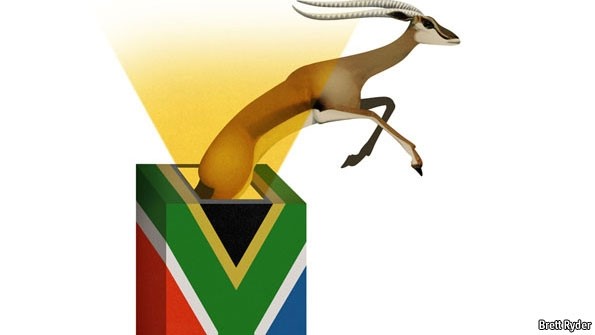
SOUTH AFRICA likes to think of itself as punching above its weight, in business as in everything else. It styles itself as the S in the emerging world’s BRICS club, despite being a fraction of the size of the four original members. It is also home to a striking number of global companies. In the Boston Consulting Group’s list of 40 fast-growing “African champions” with global ambitions, South Africa led with 18 companies followed by Egypt with seven and Morocco with six. The country’s business scene has changed beyond recognition since apartheid was dismantled. In 1994 South Africa was a siege economy dominated by a few huge conglomerates. Today it has opened up, the conglomerates have slimmed and a host of new companies, particularly in mobile technology, have exploded onto the scene. But the country has been slow to contribute to the wave of innovation coming from emerging markets, led by firms adapting their business models to local circumstances and their products to the preferences of frugal consumers. In this section · »Long walk to innovation There are good reasons for this. The wall between the first and third worlds is higher in South Africa than it is in many other countries, topped with razor wire and patrolled by armed security guards. Businesspeople in Sandton, Johannesburg’s rising business district, can live in much the same way as they would in Los Angeles, blind to life in Soweto just 18 miles (30km) away. The governing African National Congress (ANC), with its signature policy of black economic empowerment, is fixated on redistributing wealth rather than creating it. And history weighs heavily on the minds of blacks and whites alike. Most emerging-market countries, even those with horrific pasts like China and Vietnam, have embraced the future. The beloved country dwells on the past to an unhealthy degree. There are signs that this is changing. South Africa is being shaken up by the rise of the emerging world, as its champions invade South Africa and South African champions return the compliment. The Industrial and Commercial Bank of China brought 20% of Standard Bank in 2007, in what was the country’s biggest foreign investment. Indian conglomerates such as Tata and drugs firms such as Ranbaxy are hyperactive in South Africa. South Africa’s FirstRand is bringing its banking skills to India. SABMiller has bought one of Columbia’s largest brewers, Bavaria. This growing “south-south” trade is forcing South African companies to think about costs as never before: Tata’s trucks, which use parts made in India, are 15-20% cheaper than other locally assembled models, South Africa is littered with Chinese wholesalers selling cheap Chinese brands. And it is opening minds to the huge opportunities that lie in the emerging world. South African companies are paying much more attention to the rest of the continent, which some once made a habit of ignoring. MTN controls half of the Nigerian telecoms market, which is doubling in size every year. Shoprite is Africa’s largest food retailer, operating in 18 African countries. South African companies are also discovering the “bottom of the pyramid” in their own country. Several companies have pioneered the art of using cell phones to map the distribution of informal shops (spaza) and truck stops. Blue Label Telecoms, which sells pre-paid tokens, has blazed a trail in forming relationships with tribal chiefs and popular gospel singers to help sell its products. Knowledge of the bottom of the pyramid is now being used to expand in emerging markets. SABMiller produces beer for Uganda using cheap local ingredients rather than expensive imported malt. MTN provides solar-powered phones to fishermen. South Africa is also discovering that it can turn its dual nature—a first-world and a third-world country living side by side—to its advantage. It can act as a broker between the rich world and the emerging world. Caterpillar and Microsoft teamed up with South African companies (Barloworld and Blueworld respectively) to improve their distribution systems into markets they might otherwise not be able to reach. Both sets of partners are learning lessons from this. South African banks are taking Kenya’s mobile-banking system (which uses mobile phones as electronic wallets) and rejigging it for Western consumers who are more worried about security than a lack of access to banks: you can use cell phones to deposit money and to freeze bank accounts. It can also help to solve the continent’s most pressing problem, talent shortages, by acting as a halfway house for members of the African diaspora: African professionals who might think twice about accepting a posting in Lagos might well accept one in Johannesburg. Stagnation and radicalism Yet the mood in the South African business world is as dark as it has been for years. Growth has slowed to 1.3%, in part because of global trends but also because of political uncertainty. Unemployment is more than 25% and not a single net job has been added since the end of apartheid. Inequality is higher than anywhere else in the world. Economic stagnation leads to political radicalism. The ANC Youth League makes ever more aggressive noises against the white minority. Though the ANC leadership is disciplining it, the league talks about nationalising the commanding heights of the economy and weakening land rights. Emerging-market innovation offers the best way to break this growing impasse. The ANC needs to realise that its view of business is decades out of date: many of the world’s most successful companies are prospering precisely because they have learned to cater for people at the bottom of the pile. If both sides think a bit more about innovation and a bit less about reliving past nightmares, South Africa may actually be regarded by investors as a genuine member of the BRICS club. Economist.com/blogs/schumpeter from the print edition | Business Long walk to innovation Sep 9th 2011, 17:49
The day when 2010’s Soccer World Cup was held in South Africa with FIFA is just like yesterday. Although that big game didn’t catch up most of soccer fans’ expectations, the infrastructure and the police station were discussed and could be seen the beginning points of seeing the degree of innovation. We knew South Africas thoughts of these concerns by this game while listening to the ever prevailing "Waving Flag" by Knaan or "Waka Waka - This Time for Africa" by Shakira & Freshlyground.
I heard of this country which would like to strengthen her fundemental education in 2001. When I was just a 15-year-old student in Taipei’s Chien-Kuo Senior High School, I once know that South Africa was one of Taiwan’s competitors in Biology and Math-Science special education arena. This country had been struggling for an innovative power for some time, and let me, involved in Internationl Olympia’s Game, feel her expanding potential. South Africa’s Government indeed pays many attention to this investment in recent years.
However, it is evaluated that South Africa still lacks of innovative figures or business in management or technique like Taiwan Acer’s Shih Zhen-Rong (Stan Shih), Japan Toshiba’s Norio Sasaki, U.S. Microsoft Bill Gates, or then G.E. President Jack Welch. Actual and pessimistic, money doesn’t represent innovative progress. The majority of economic and financial index is not high enough to see this country as prominent BRIC’s. And in certain measure, many researches about newly-growing economy don’t contain South Africa or just use “smaller” alphabet. So I still question some about this article inclined to put this country in optimistic side.
Recommended 5 Report Permalink 第一句when可以省略。柯南和夏奇拉的歌聲好像還在昨日的世界杯足球賽球場上。談到南非在世界經濟上就是和巴西Brazil. 俄羅斯Russia, 印度India和中國China 並列四大一小,BRICs的話題是在2005年起開始為人所重視,2008北京奧運達到一個境界,隨著中國的產業結構升級和資金主與企業的興盛,這五個開發中國家2015年佔了41%的人口及名目GDP22%。對南非的印象是在讀建中時,聽生物科湯炳垣老師提及南非學生的頭腦不輸台灣的,一起逛夜市玩過。千禧年之際就是重視生技產業,利用英語優勢想先培養了基礎人才,不過及至去年南非的產業不穩定,筆者當年仍然認為沒有結構良好產業政策,也沒有半個日本人的一種出色企業領導,(施振榮算筆者認識的佐佐木哲夫先生一半水平有,)生技產業的事就因政局不穩不了了之。 |
|
| ( 心情隨筆|心情日記 ) |