字體:小 中 大
 |
|
|
|
| 2026/06/26 21:01:59瀏覽288|回應0|推薦0 | |
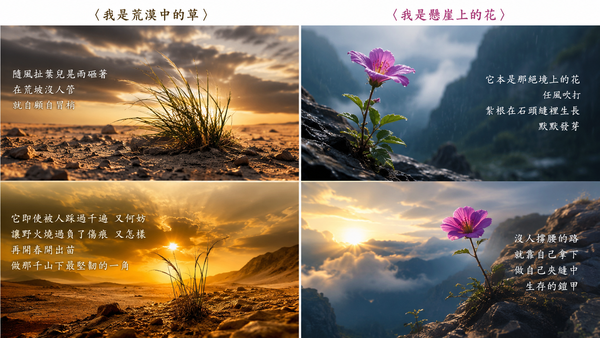
〈The Art of Lyric Writing: An Example of Two Sets of Lyrics for One Melody〉 / Chen Qufei “I Am the Grass in the Desert” / Huang Jingmei It is said that what grows out of the cracks in the rocks is either a flower or grass. Its leaves sway with the wind while the rain beats upon them, and its roots tremble. On the barren slope, with no one to care for it, it simply sends up new shoots on its own. After basking in enough blazing sunlight, it grows ever higher. Even if it has been trampled a thousand times, what does it matter? Even if it has been scorched by wildfire and left covered in scars, so what? No matter where it is, when spring returns, it sprouts again, becoming the toughest corner beneath a thousand mountains. I am the grass in the desert. How could I dare to hope that someone would support me? Half my life I have drifted amid wind and sand. My pain can only be endured by myself. I am the grass in the desert. How could I dare to long for someone's embrace? There is no one left beside me to rely upon. One day, with both my hands empty, I will surrender myself to the wildfire. Even if it has been trampled a thousand times, what does it matter? Even if it has been scorched by wildfire and left covered in scars, so what? No matter where it is, when spring returns, it sprouts again, becoming the toughest corner beneath a thousand mountains. I am the grass in the desert. How could I dare to hope that someone would support me? Half my life I have drifted amid wind and sand. My pain can only be endured by myself. I am the grass in the desert. How could I dare to long for someone's embrace? There is no one left beside me to rely upon. One day, with both my hands empty, I will surrender myself to the wildfire. I am the grass in the desert. How could I dare to hope that someone would support me? Half my life I have drifted amid wind and sand. My pain can only be endured by myself. I am the grass in the desert. How could I dare to long for someone's embrace? There is no one left beside me to rely upon. One day, with both my hands empty, I will surrender myself to the wildfire. “I Am the Flower on the Cliff” It is a flower born upon the edge of despair, standing against the wind and rain. Rooted within the cracks of stone, it grows silently, quietly putting forth its first buds. Rain lashes against its face, yet it can only keep its head held high. The moment sunlight shines upon it, it blooms with unyielding determination. Even if it was born above a thousand-foot precipice, what does it matter? Even if others watch coldly while it stands utterly alone, it is not afraid. On a road where no one offers support, it claims victory through its own strength, becoming the armor that allows itself to survive within the cracks. I am the flower on the cliff. How could I dare to expect anyone to care about me? Half my life I have struggled through wind and rain. Every wound and every pain I swallow by myself. I am the flower on the cliff. How could I dare to hope that anyone would stay? The road has always been one without attachment or dependence. One day, after being tempered through countless trials, I will grow with untamed resilience. Even if it was born above a thousand-foot precipice, what does it matter? Even if others watch coldly while it stands utterly alone, it is not afraid. On a road where no one offers support, it claims victory through its own strength, becoming the armor that allows itself to survive within the cracks. I am the flower on the cliff. How could I dare to expect anyone to care about me? Half my life I have struggled through wind and rain. Every wound and every pain I swallow by myself. I am the flower on the cliff. How could I dare to hope that anyone would stay? The road has always been one without attachment or dependence. One day, after being tempered through countless trials, I will grow with untamed resilience. I am the flower on the cliff. How could I dare to expect anyone to care about me? Half my life I have struggled through wind and rain. Every wound and every pain I swallow by myself. I am the flower on the cliff. How could I dare to hope that anyone would stay? The road has always been one without attachment or dependence. One day, after being tempered through countless trials, I will grow with untamed resilience. Commentary by Chen Qufei The two sets of lyrics, “I Am the Grass in the Desert” and “I Am the Flower on the Cliff,” became hugely popular across Mainland China, Taiwan, and Hong Kong in 2026. Perceptive readers have probably already noticed that the two songs share exactly the same melody. They are, in other words, a pair of twin lyrics blossoming from the same tune. Both sets of lyrics convey an inspiring and uplifting artistic conception. After listening to these songs, one feels not only comforted by the words, but also instantly filled with positive energy. Through personification, the grass and the flower become symbols of people who have risen again from despair, faced adversity courageously, accepted challenges, and made remarkable comebacks after defeat. They fully demonstrate lyricist Huang Jingmei's mastery of imagery and narrative, a level of craftsmanship that vividly illustrates the artistic power of lyric writing. In terms of lyrical structure, both songs follow the same structural pattern: (V1 + V2) + C + V2 + C + C In a popular song, the Verse is responsible for developing the story and setting the background, whereas the Chorus is responsible for releasing emotion and presenting the central theme. Together, they complement one another and build the layered structure of the song. I. Verse: Developing the Story and Building Emotional Tension Core Functions:
II. Chorus: Emotional Release and the Song's Most Memorable Moment Core Functions:
I. A Structuralist Analysis of the Shared Structure of the Two Songs From the perspective of Structuralism, although "I Am the Grass in the Desert" and "I Am the Flower on the Cliff" employ different central images—one being grass and the other flower—their deep structures are completely identical. Both are constructed upon the binary oppositional pattern of adversity → hardship → perseverance → rebirth. In other words, while their surface language differs, their underlying narrative structures share the same system of meaning production. First, the opening verse (Verse 1) of both songs uses a third-person narrative to depict the plants' living environments. Through natural images such as rock crevices, barren slopes, cliffs, howling winds, wildfires, and driving rain, the lyrics construct extremely harsh conditions for survival. These natural scenes are not merely descriptions of landscape; rather, they symbolize life's adversities and establish the structural foundation of the narrative. The second verse (Verse 2) gradually shifts from external description toward inner spirituality. Expressions such as "What does it matter?", "So what?", "I am not afraid," and "I will overcome it by myself" begin to appear. The narrative thus transitions from objective circumstances to subjective determination, completing the structural transformation from external hardship to internal conviction. The chorus uniformly adopts a first-person confession: "I am the grass in the desert." "I am the flower on the cliff." At this point, the imagery is no longer merely botanical. It undergoes a symbolic transformation of identity, becoming the collective embodiment of everyone struggling against adversity in life. Through repeated choruses, the songs create a cyclical and progressively intensifying structure. Repetition deepens the central theme while gradually accumulating emotional power. If the narrative structure is broken down according to its functional progression, it may be summarized as follows: Survival in adversity (desert / cliff) ↓ Natural trials (wind, rain, wildfire, cold indifference) ↓ Life's hardships (loneliness, wounds, having no one to rely upon) ↓ Self-awakening (enduring alone, rising by one's own strength) ↓ Spiritual transcendence (becoming the toughest corner / growing wildly) Therefore, the true structural core of both songs is not the depiction of plants themselves, but rather the construction of a universal myth of human perseverance. Grass and flowers are merely different symbols; what remains constant is the deep structure of self-realization through adversity. II. A Narratological Analysis of Narrative Perspective and Storytelling Atmosphere Viewed from the perspective of Narratology, the most distinctive characteristic of these two songs lies in their skillful alternation between third-person narration and first-person confession, creating a narrative transformation from observer to participant. This greatly enhances the songs' dramatic intensity. At the beginning of each song, the narrator adopts a third-person perspective: "It was originally a flower growing upon the edge of despair..." "Even if it has been trampled a thousand times..." Here, the narrator functions like an omniscient storyteller, objectively describing the destinies of the grass and the flower. This allows listeners to first establish an external visual scene and understand the environment in which the characters exist. However, once the chorus begins, the narrative immediately shifts into the first person: "I am the grass in the desert..." "I am the flower on the cliff..." At this moment, the lyrics complete a shift in focalization. The plants, once merely observed objects, instantly become speaking subjects. Consequently, listeners move from watching a story unfold to entering the inner world of the protagonist, generating a profound emotional identification. This alternation between third-person and first-person narration greatly strengthens the songs' emotional impact and fully personifies their symbolic imagery. Analyzing the story development, both songs exhibit a complete narrative arc:
Although these songs contain no complicated interpersonal relationships, they nevertheless construct life parables with the qualities of a hero's journey through the personification of plants and the transformation of narrative perspective. III. A Rhetorical Analysis of Formal Design and Expressive Techniques From the perspective of Rhetoric, the greatest artistic achievement of these two songs lies in their extensive use of symbolism, personification, repetition, parallelism, contrast, rhetorical questioning, and gradation, endowing the language with both literary elegance and musical beauty. First, the lyrics employ highly mature symbolic rhetoric. The grass symbolizes an ordinary yet resilient life. The flower symbolizes a beautiful yet unyielding soul. The desert, cliff, rock crevices, wildfire, wind and sand, and cold indifference all transcend their literal meanings as natural scenery and become a symbolic system representing life's adversities, social pressures, and existential trials. Through this symbolic network, limited imagery carries unlimited emotional significance. Secondly, the lyrics make extensive use of personification. The grass and flower are no longer mere plants. They possess emotions, convictions, dignity, and willpower. They endure suffering, reject dependence, and encourage themselves, thereby becoming fully developed personalities. In doing so, abstract philosophies of life are transformed into vivid and tangible life stories. Thirdly, the lyrics repeatedly employ parallelism and repetition, such as: "I am the grass in the desert..." "I am the flower on the cliff..." as well as: "How could I dare to hope..." "How could I dare to long for..." "How could I dare to expect..." "How could I dare to wish..." These repeated structures not only conform naturally to the rhythmic patterns of popular music but also reinforce emotional accumulation, making the chorus highly recognizable and memorable. Furthermore, expressions such as "What does it matter?", "So what?", and "I am not afraid" produce the rhetorical effect of rhetorical questioning. Though phrased as questions, they actually emphasize an unwavering inner determination, generating a powerful rhetorical force. The two songs also skillfully employ gradation, gradually elevating the emotional progression from wind and rain to loneliness, pain, and having no one to rely upon, before ultimately ascending to wild growth and becoming the toughest corner, thereby producing a steadily intensifying emotional climax that reaches its greatest impact at the conclusion. Overall, these two songs adopt balanced sentence structures, symmetrical rhythms, and highly repetitive choruses, integrating rhetorical devices, melody, and emotion into a unified artistic whole. As a result, they possess not only literary beauty but also the distinctive artistic qualities of popular lyrics—being memorable, singable, and widely accessible. IV. An Aesthetic Summary of the Artistic Characteristics of the Two Songs Taken as a whole, "I Am the Grass in the Desert" and "I Am the Flower on the Cliff" derive their aesthetic value not merely from their inspirational content, but from their successful integration of natural imagery, life philosophy, narrative structure, and the formal characteristics of popular music, thereby creating a lyrical aesthetic that combines intellectual depth, artistic refinement, and broad appeal. First, both songs exemplify the aesthetics of symbolism. Grass and flowers are not simply natural plants; they become spiritual projections of everyone struggling through adversity. Individual life experiences are elevated into universal human parables, giving the works a powerful capacity for emotional resonance. Secondly, the songs embody a distinct aesthetics of life. Rather than sensationalizing suffering, the lyrics portray life's refinement, transcendence, and spiritual growth through perseverance amid hardship, expressing a positive and uplifting vision of human existence. Furthermore, the songs successfully combine dramatic aesthetics with musical aesthetics. The alternation between third-person narration and first-person confession, the progressive development from verse to chorus, and the cumulative emotional effect produced through repetition together create a complete dramatic rhythm and remarkable emotional intensity. Finally, both songs serve as exemplary models of the aesthetics of lyric writing. Although they share exactly the same melody, each set of lyrics constructs the same spiritual theme through entirely different symbolic imagery. This not only demonstrates the lyricist's exceptional command of musical form and verbal rhythm, but also proves that outstanding song lyrics are far more than subordinate companions to melody. They are independent artistic texts possessing both literary depth and musical charm. For precisely this reason, "I Am the Grass in the Desert" and "I Am the Flower on the Cliff" each blossom with their own distinctive artistic brilliance upon the same melody, together forming a highly successful example of the "one melody, two sets of lyrics" creative form. "I Am the Grass in the Desert"
"I Am the Flower on the Cliff"
|
|
| ( 創作|文學賞析 ) |