字體:小 中 大
 |
|
|
|
| 2026/01/21 20:46:49瀏覽311|回應0|推薦0 | |
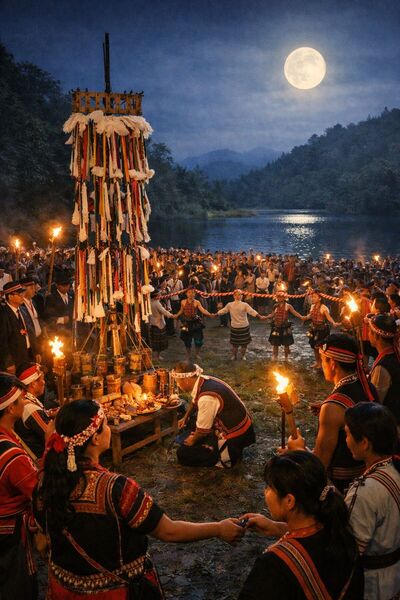
〈Fireflies, Fly On:The Nanzhuang Ri A-Guai Anti-Japanese Uprising〉4 by Chen Ching-Yang Chapter Nine: The Pas-ta’ai (Dwarf Spirit Festival) at Xiangtian Lake This year’s Pas-ta’ai, the Dwarf Spirit Festival, was held on an expanded scale—known as the Grand Festival. The greatest distinction between the Grand Festival and the regular Pas-ta’ai lay in the making of the ritual banner (Sinatun). The ceremonial grounds were set at Xiangtian Lake, and the festival took place on the night of the full moon around the fifteenth day of the tenth lunar month. As early as a month beforehand, the Saisiyat people of Lianxing Village began rehearsing sacred ritual songs that were normally forbidden to sing. One after another, households prepared their surroundings, tying knots of cogon grass—symbols of exorcism—around homes and ritual objects. Two weeks later, the Pas-ta’ai officially commenced. Tribes from near and far responded to the invitation, sending warriors and young women to participate. The ceremonial grounds at Xiangtian Lake became a sea of people—no fewer than four or five thousand—creating a scene both magnificent and awe-inspiring. Officials from the Zhunan District Civil Affairs Office and representatives of Mitsui & Co. were also invited to attend. The second day, Pa’sau (Entertaining the Spirits), formed the core of the entire festival. At dawn, Chief Ri A-guai performed the ritual first, followed by the elders of other clans, since the Ri family bore the responsibility of signaling the spirits with arrows. On the evening of the third day, the people gathered again at the ceremonial grounds, expressing reverence for the dwarf spirits through song and dance. The ritual began with the Kilaki—hip bells symbolizing the dwarf spirits—leading villagers hand in hand into the dance. Eventually, the Kilaki blended into the crowd, dancing among them. At midnight, when the most sorrowful chant, Walowalon—which likens the drowning of the dwarfs to the tragic tale of the Thunder Maiden—was sung, all sounds and movements ceased. Everyone faced east as the chief officiant stood atop a stone mortar, praying and admonishing the people. In past years, the following days were marked by continuous singing and dancing through the night to commemorate the dwarfs. On the morning of the fourth day, a series of martial performances took place. The opening performance was the Warrior Dance. Armed with bamboo swords and spears, rattan armor, and shields, a contingent of sixty-four Atayal warriors from the Lukang community entered the field. Bare-chested, their banded tattoos exposed, they slashed and thrust to the beat of the drums, moving with fierce vigor, sweat pouring down their bodies—an embodiment of strength and beauty. Their formations merged and separated according to the principles of the Five Elements and Eight Trigrams, a system taught by Old Master Lin in the arts of strategic formation. To the untrained eye, it was mere spectacle; only those versed in the art could grasp the subtle transformations and latent power within the shifting ranks. As the drums quickened, the warriors formed groups of three, rolling backward and flipping into spheres, advancing while tossing weapons to one another and changing positions with precision. The audience watched in rapture, erupting into thunderous applause. The Japanese officials and Mitsui representatives, however, frowned in silence, clearly shaken by the disciplined movements and intimidating presence of the unit. When the drums stopped abruptly, the warriors sprang to their feet, sheathed their blades in reverse grip, and stood motionless. Applause roared across the grounds. In the guest seating, all but the shrewd President Miyamoto had turned pale. Apart from Saku Nobuo, none of the Japanese applauded. In the VIP section, President Miyamoto, Manager Ōhashi, Section Chief Itagaki, and Captain Sanbon gathered in hushed conversation. Lowering his voice, Itagaki said, Ōhashi nodded. Captain Sanbon asked, Itagaki continued calmly, Sanbon frowned. “Are you afraid, Captain?” Miyamoto countered. “These people move like ghosts in the mountains. If they revolt, they’ll be far harder to deal with than the Han settlers,” Sanbon replied with a bitter smile. Flicking ash from his cigar, Miyamoto said, Ōhashi asked curiously, Miyamoto inhaled deeply and said gravely, Sanbon nodded. Itagaki asked skeptically, Miyamoto stroked his chin. Ōhashi tried to smooth things over. Miyamoto’s tone hardened. The next performance was the headhunting dance of the Saisiyat Shili-xing community. Forty-nine warriors entered in seven squads, wielding machetes in their right hands and rattan shields in their left, forming the Big Dipper Formation. Though the structure was easy to recognize, its transformations were impossible to discern. Rotations shifted from the ladle’s center to the handle’s tip, then to the star Tianquan, alternating clockwise and counterclockwise—endlessly changing. The warriors danced fiercely, sweat pouring down as the crowd cheered wildly. Saku Nobuo, well trained in Japanese swordsmanship, shouted praise loudly in Chinese—truly a case of “the expert sees the technique, the layman sees the spectacle.” The third performance featured female warriors from the Hakka Erping community, wielding Plum Blossom Twin Swords. The girls formed a three-bud, five-petal formation that shifted rapidly with the drumbeats. Among them was Meilan, her twin blades moving like supple spirit serpents coiling around her fingers—radiant with heroic energy, utterly transformed from her usual gentle demeanor. Nobuo stared in astonishment, forgetting even to applaud. More than a dozen performances followed, presented by communities from Lianxing Village and invited tribes, fully displaying the long-standing martial spirit of the Nanzhuang region. By the end, the Japanese officials and Mitsui representatives felt almost numb, fully aware that this was a deliberate show of strength. At midday, Meilan and several young women served food and wine. The Japanese guests—perhaps frightened into hunger—ate and drank heartily, abandoning all formality. Nobuo raised a bamboo cup and toasted Meilan. President Miyamoto shot him a sharp glare, but Nobuo, in unusually high spirits, ignored it. Meilan accepted the toast without hesitation and drank it in one go, earning applause from the crowd. Nobuo’s heart overflowed with joy. The afternoon Harvest Festival featured joyful songs and dances. Guests were invited to join, though Miyamoto and his companions initially looked awkward. Soon, even the clumsy dancers loosened up, swept along by the rhythmic precision of Saisiyat and Atayal dances. “Shall we dance together, Nobuo?” Meilan asked, extending her hand. “Gladly!” Nobuo replied excitedly. Holding her hand, he quickly found the rhythm, moving with increasing ease and grace. Miyamoto danced only once before retreating to smoke in the corner. Later, Walis Belin, the young chief of the Lukang community, invited Meilan to dance. Their chemistry stirred a twinge of jealousy in Nobuo—unaware that Meilan and Belin had long been regarded as the golden couple of Lianxing Village. On the final day, after the dances ended, ritual reenactments of the Pas-ta’ai’s origins were performed, teaching history, culture, and the virtue of harmony. After the ancestral harvest rites concluded, the Pas-ta’ai officially came to an end. Chapter Ten: The Signing of the Cooperation Agreement As scheduled, Nobuo brought the project proposal and a draft cooperation contract to meet Chief Ri A-guai. The terms had been fiercely negotiated by Nobuo—but he did not know that Miyamoto had already prepared a second version to swap in at the final signing. Nobuo explained each clause in detail. Ri A-guai listened attentively, while Chang-gui raised questions where needed, and Nobuo answered patiently. Ri A-guai said kindly, Nobuo replied modestly, Chang-gui added, Nobuo smiled. “That’s excellent,” Chang-gui said. Before the signing, Nobuo explained that he would return to Japan to procure machinery for sawmills and camphor factories and select construction sites. Ri A-guai instructed, “Understood, Father,” Chang-gui replied. Half a month later, Mitsui & Co. and Lianxing Village formally signed the cooperation agreement—written in Japanese. Ri A-guai detected nothing amiss. Miyamoto extended his hand. Chang-gui replied, “Of course!” Miyamoto smiled brilliantly—like a blooming stinging nettle. Chapter 11: Lianxing Workstation In late December, Nobuo returned from the mainland, and the workstation staff officially moved into Lianxing Village. The location was chosen on the eastern bank of Zhonggang Creek, in Dong Village, which was the gateway of Nanzhuang District’s Danan community, making it convenient for external communications. That day, accompanied by Chōki and Meilan, Nobuo took the Japanese staff of the Lianxing Workstation on a bullock cart tour of the Shilitang Community’s Shitou Mountain Forest and the Donghe Community marketplace and ranch. As the cart climbed the mountain path to the forest, the air was filled with laughter. Nobuo, visibly cheerful, said, “This is truly a joyful moment! How about we sing a song? Chōki-kun?” He then explained in Japanese to his companions, and the Mitsui staff, both men and women, readily agreed. Chōki laughed and waved his hand, saying, “I can’t sing, I only play the pastoral flute. Meilan’s voice is beautiful—Meilan, you sing, and I’ll accompany you on the flute.” Meilan, her big dark eyes sparkling, said, “Alright! I’ll sing that Saisiyat love song, ‘Wild Lily.’” Chōki nodded: “Good! Then we’ll sing that one. I’ll play the flute.” He immediately took a bamboo flute from his bosom. Nobuo clapped his hands and said, “I’m all ears!” The Japanese staff, including Maruo and Ōyama, also applauded. Meilan sang passionately in Saisiyat, and the listeners tapped along to the lively rhythm: "In the secluded valley, the stream murmurs softly—is that your gentle whisper of love? I am the wild lily who loves to dream, my secrets hidden deep in the flower chamber. Even in the deep mountains, can you hear my faint song? You said you would cut a strip of rainbow, its brilliant colors perfect for a new bridal gown. The dazzling sunset will decorate our new home. When you return from hunting, under the clear moonlight, we will drink millet wine together. Then, as the moonlight gently falls upon my hair, my face will flush, for I know that you will muster the courage to propose to me." When she finished, the audience on the cart applauded enthusiastically. Nobuo marveled, “What a beautiful melody! Though I don’t understand the lyrics.” Chōki explained, “Nobuo-kun, this song is sung by a maiden to her lover. She sings of her longing while her lover is out hunting with the hunting party. Her feelings are hidden in her heart, like a lily in a quiet valley. She waits for him to return, and under the gentle moonlight, they will drink millet wine together, and he will gather the courage to propose.” Nobuo, with a hint of sentiment, said, “How I wish I were the lover being awaited in the song, cherished by a beautiful maiden—this is the happiness I dream of.” Meilan, of course, caught his subtle implication, and a blush quickly rose to her cheeks as she shyly lowered her head. The joyful mood was heightened by song and applause. Chōki laughed happily, “Nobuo-kun, you should have someone else sing too. Let’s exchange a few songs.” Nobuo replied loudly, “No problem, I’ll arrange it.” He turned to Keiko Suzuki and said in Japanese, “Keiko, show us your singing skills—sing a love song. Among the company staff, your voice is the best.” Keiko graciously said, “Station Chief, I’ll embarrass myself, but I’ll sing ‘Palace Lanterns’ to liven things up. If it’s not good, don’t make fun of me, okay?” Nobuo clapped and said, “Don’t worry, everyone trusts your voice.” Keiko raised her voice and sang: "One by one, palace lanterns are lit, the night banquet is about to begin. Palace maids apply purple and red makeup, singing and dancing to the melody. This morning’s tear stains are now covered by heavy powder, as if the lanterns are encased by the dark night. The lord treats us as toys; when bored, he extinguishes the flames in our hearts. Once, we dreamed beautiful dreams, intoxicated by spring breezes and dews, like blossoms just opened, cherished by people. When beauty fades with autumn frost, the palace lanterns lose their color and gather dust. Our fate is to be forgotten lanterns in the corners of the palace, no longer burning, leaving only sorrow and damp wick hearts." Keiko’s voice was mournful and lyrical. Chōki sighed, “The melody is melancholy, full of sorrow—it’s heart-wrenching!” Nobuo agreed, “Yes, Chōki-kun. This song expresses the tragic lives of palace maids. In ancient Japan, many palace maids were chosen to serve in the deep palace, serving princes and nobles, but often ended up wasting their youth in misery. So, I feel your lives are far more cheerful and optimistic than ours.” Chōki nodded, “Perhaps. Our people live simply, with few material desires, like the Han saying, ‘Contentment brings happiness.’” Meilan listened attentively, knowing that in public she could only be a loyal observer, watching Chōki and Nobuo laugh and converse. By ten o’clock, the bullock cart reached the forest entrance. The group disembarked and walked into the forest. “Friends of the workstation, this is our Lianxing Village Shilitang Community Forest, covering an area of 800 hectares. Camphor, Phoebe, and Birch are the main tree species, some over a thousand years old, others around two hundred. The forest is home to sambar deer, muntjacs, goats, and dozens of birds such as thrushes and tits,” Chōki explained in detail to the staff, and Nobuo translated his words into Japanese for his colleagues. Nobuo lamented, “This primeval forest is beautiful, but sadly, it will soon be cut down.” Ōyama, standing nearby, agreed, “Indeed, Station Chief Nobuo, it’s a pity that this scenery will disappear. But after logging, the land will be replanted with higher-grade trees like Paulownia, poplar, and mahogany.” Nobuo exhaled in relief, “Then it’s not all destruction; there will be constructive work as well.” The perceptive Keiko said, “But once logged, the forest landscape will be completely changed, and the wildlife here will have to relocate.” Nobuo replied thoughtfully, “The animals will find their way, won’t they?” Ōyama brought the topic back to reality: “Station Chief, recruitment of laborers has already started. Logging, reforestation, and transport teams are being assembled. The log transport routes are preliminarily planned. Once the sawmill and camphor factory are built, everything will be ready to begin operations.” Nobuo instructed, “Ōyama, hire local laborers for the reforestation team whenever possible. They love their homeland and will work more conscientiously.” Ōyama replied, “Yes, Station Chief.” Nobuo continued, “Ōyama, the logging operations are very demanding. You and Kosetsu must cooperate closely. If the workshop encounters any problems beyond your capacity, report to me immediately.” Ōyama responded, “Understood!” “And the logging and transport teams’ work is quite dangerous. Pre-job training and workplace safety must be strictly enforced to minimize accidents caused by human error,” Nobuo repeatedly emphasized. Ōyama answered, “Yes, Station Chief. I’ve planned this carefully. Under guidance from logging experts from the mainland, we’ll implement each step as established. Only when fully prepared will I officially announce the start of work.” Nobuo further reminded, “Logging and transport workers are working hard and risking their lives. They should receive higher wages, and proper arrangements for housing, medical care, insurance, and compensation should be in place to ensure their families are well taken care of.” Ōyama replied, “Yes, Station Chief, your foresight is admirable—I respect that.” Nobuo’s expression relaxed slightly as he said sentimentally, “Leading a group means caring for their hearts, treating them like family, thinking from their perspective.” Ōyama answered, “Yes! I’ll keep that in mind.” Nobuo patted Ōyama’s shoulder approvingly, “You can do well; I did not misjudge you. Show me results—I want to see your performance.” Ōyama, full of confidence, said, “Station Chief, I will give my all and deliver good results.” Chōki, following behind, said to Nobuo, “Nobuo-kun, our people believe every big tree is a gift from heaven and has a guardian spirit.” Nobuo asked curiously, “Really? Too bad they cannot decide their own fate. Chōki-kun, once the forest is logged, how do you plan to deal with the wildlife here?” Chōki replied with a helpless look, “It’s indeed a thorny problem. We can relocate large animals like sambar deer, muntjacs, and goats to the Donghe ranch. As for smaller animals, birds, wild boars, black bears, and clouded leopards, they will likely migrate to nearby forests on their own.” Near noon, the group arrived at the Donghe Community marketplace. The cart reached the village entrance, and the guards sent someone ahead to report their arrival. The group disembarked in single file and entered the bustling market. Nobuo told his colleagues in Japanese, “Colleagues, this marketplace is Lianxing Village’s window for external trade. It’s the largest in the Nanzhuang district and surrounding areas, so take a detailed look.” Zenei Sawazu, looking around in admiration, said, “Station Chief, the streets are very lively. Various daily necessities are displayed in abundance. The scale is no less than the Guansi subprefecture in Hsinchu.” Nobuo smiled, “Yes! The Lianxing management runs things very well—we can learn a lot from them.” Chōki explained, “Nobuo-kun, we’ll have lunch here. The feast will be hosted by Chief Ali and my second brother, Chōfu.” Nobuo bowed politely, “Thank you for your hospitality.” The group strolled between the shops, observing their surroundings. At this moment, Chief Ali Kuma approached, extending both hands warmly, shaking hands and hugging Nobuo and the other gentlemen. The large-framed Ali, with a booming voice, said, “Welcome, welcome! Please come to the hall to rest and enjoy the meal.” Chōki said, “Uncle Ali, thank you for your efforts.” Ali laughed heartily, “No, no, it’s my duty as host—of course, of course.” Chōkō turned to Nobuo and said, “Nobuo-kun, we Saisiyat people are always warm and hospitable. Later, when they offer you a toast, make sure you drink it all at once—you wouldn’t want to be rude!” Nobuo hurriedly waved his hand and laughed, “Oh? I don’t drink much. I’m afraid I’ll get drunk and make a fool of myself.” Chōkō smiled and said, “Don’t worry. Our people like it this way—they think a guest is truly welcomed only when they enjoy themselves fully.” Nobuo replied, “Very well, then. I suppose today I’ve come to broaden my horizons.” Chōkō corrected him gently, “Nobuo-kun, you should say you’ve come to enjoy a feast for your taste buds.” Nobuo laughed, “You’re right, you’re right—a feast for the taste buds indeed.” “Friends, please follow me,” Ali said, leading the way. The group entered the guest hall and took their seats in order. At that moment, Nagatomi Chōfu hurried in from outside. “Sorry, sorry, I’m late,” he kept apologizing. Chōkō said, “Second Brother, you count as half a host too. Since you’re late, you’ll have to start with three large cups of millet wine as a penalty.” Ali agreed, “That’s right. Chōfu, after lunch, everyone will visit your pasture—so you’ll lead the way.” Chōfu wiped the sweat from his forehead with his long sleeves. “No problem. Today everyone should drink to their heart’s content.” Nobuo stood and bowed to Chōfu. “Thank you for taking the trouble in your busy schedule, Chōfu-kun.” Chōfu quickly returned the gesture. “Not at all, not at all.” Meanwhile, three young Japanese women—Nakazawa Koyuki, Suzuki Keiko, and Satomi Asami—were enthusiastically examining a cluster of orchids on the table. Koyuki said, “Judging from the shape of the flowers, these must be orchids.” Asami asked, “But why does each flower stem have only one leaf? Don’t you think that’s strange?” Keiko suggested, “Why not ask Station Chief Nobuo? He’s very knowledgeable and might know the origin of this plant.” Koyuki teasingly mimicked Keiko’s tone, “Station Chief Nobuo, Station Chief Nobuo, we like you so much!” Keiko playfully pinched Koyuki’s elbow. “Koyuki, you’re teasing again.” Koyuki imitated Keiko again. “Station Chief Nobuo, Station Chief Nobuo, your Keiko can pinch people—so fierce!” Nobuo just smiled quietly. Meanwhile, Mislan, who couldn’t understand the conversation between the three Japanese girls, sensed that their playful teasing was probably directed at Nobuo. She turned her face aside, pretending not to notice. Nobuo glanced at her, realizing that the earlier scene had made her a bit unhappy. So he asked, “Mislan, this orchid on the table—do you know what type it is?” Mislan, annoyed, ignored him. Chōfu noticed his younger sister Mislan was upset with Nobuo, so he quickly took over the conversation: “The one-leaf orchid is a wild orchid famous on this island. It usually grows in misty cedar forests or evergreen broadleaf forests in the mountains, along forest edges or on cliff surfaces, often accompanied by moss.” Nobuo admired it. “A wild orchid that can’t be cultivated—truly precious.” The kitchen began serving dishes. The main course was a whole roasted lamb. Other dishes included river shrimp braised in wine, ganoderma-stewed lamb chops, wild boar with chili, stir-fried muntjac with garlic, stir-fried ferns, and stir-fried mountain celery—all local wild delicacies. The Japanese staff stared at the table with wide eyes, eager to dig in. In early January, machinery and equipment arrived in batches, and the Lianxing Village work station was fully mobilized. Throughout January, everyone was busy leveling the ground, constructing factories, and preparing the facilities. By the end of the month, the sawmill and camphor production plant had largely taken shape. From nothing to something, Nobuo and Chōkō were busy every day—supervising construction, installing machinery, recruiting workers, and training employees, each handling different tasks in perfect coordination. By mid-February, preparations were complete, and operations officially began. According to the original agreement, Lianxing Village and the Mitsui Lianxing work station jointly managed the forest, logging area, sawmill, camphor plant, and pastures. Maruo Ōyama oversaw the sawmill, Nakazawa Koyuki served as secretary, accountant, and cashier. Nagase handled the camphor plant, with Suzuki Keiko as secretary, accountant, and cashier. The Donghe community pastures remained under Chōfu’s management, with Satomi Asami as secretary, accountant, and cashier. The logging area was managed by Haruyama Enkyū. In late January, Nobuo took Mislan to inspect the camphor plant. Workers greeted Nobuo enthusiastically. Nagase led them to the office, the administrative hub of the sawmill and camphor plant. Shinza Sawai, Hashimoto Ryūji, Sasaki Shōji, Suzuki Keiko, and Nakazawa Koyuki all stood to welcome them. Nobuo removed his hat and waved. “Sorry to interrupt your work.” Nagase, speaking halting Japanese, said, “Station Chief, you came to visit us in person.” Shinza explained while gesturing, “Station Chief, Ryūji, Shōji, and I are researching ways to improve the solidification and packaging of camphor tablets for longer shelf life.” Nagase smiled. “These are new ideas from the young staff. They’re full of energy. To communicate with my Japanese subordinates, Keiko teaches me Japanese every night, while I teach her Chinese. After a few months, we barely need gestures anymore.” Keiko joked, “Exactly! The station chief has learned Japanese quickly and can even sing Japanese songs. I should thank him for teaching me Chinese—otherwise, as an accountant and cashier, I wouldn’t understand the local workers’ questions at all!” Everyone laughed at their mutual praise. Ryūji, smiling, said, “Station Chief, last month when we paid wages, every worker was so happy—they got five extra days of pay compared to the previous months.” Shinza teased, “You’re not bad either—Ryūji, six extra days of pay!” Ryūji laughed, “Yes! Now I can save up to buy a goat after three months, something I couldn’t have done before.” He added, “By the way, Sawai wants to plant vegetables and fruits near the kitchen and keep a few goats so we can have fresh goat’s milk every morning.” Nobuo nodded approvingly. “Sawai, that’s a practical idea.” Sawai smiled shyly. “I have no choice—my younger brother is still in high school, and my father’s tuberculosis requires long-term care. So I have to be frugal.” Nobuo patted him on the shoulder. “It must be hard for you, carrying the family’s finances on your shoulders.” Shōji kindly said, “Station Chief, ever since you announced the new bonus system, the workers have been extra motivated. Especially the distillation workers—they earned even more than Sawai and I in January.” Nobuo smiled. “Distillation work is harder. They deserve extra bonuses to support their families. Shōji, since you’re still single, your financial burden is lighter.” Nagase asked, “Shall we have lunch here, Nobuo?” Nobuo agreed, “Yes, otherwise we’d be eating after returning to the work station.” Nagase turned to Mislan. “Sister, want to show your skills? Here’s your chance.” Mislan happily replied, “Sure! I hope Keiko and Sawai will like it.” Nobuo said, “No problem. They’re all young and like to try new flavors.” Keiko and Koyuki helped in the kitchen, with Mislan assigning tasks: Keiko washed vegetables, Koyuki cleaned fish and cut meat. Within 45 minutes, they had prepared a full feast. Meanwhile, Haruyama Enkyū and Maruo Ōyama returned from the logging area, sweating profusely. “Station Chief, when did you arrive?” Enkyū asked. Nobuo said, “About an hour ago. How’s the logging going?” Enkyū wiped his face. “Don’t worry, Station Chief. I have experienced local logging masters with me—nothing will go wrong.” Nobuo smiled, “Now you understand why I hired them at high salaries, right?” Koyuki handed a wet towel to Ōyama to wipe his sweat. Enkyū laughed, “I understood your intention from the start. Logging is dangerous work and requires practical experience. I’ve learned a lot from these masters.” Nobuo nodded, “You specialize in forestry and soil conservation. These masters complement your lack of logging experience.” Enkyū grinned, “Exactly, Station Chief.” Nobuo patted Enkyū’s shoulder. “Good. Rest for a bit; it’s almost time to eat.” Ōyama pointed at the dishes skeptically. “Looking at this feast, it doesn’t look like Nagase’s wife cooked it, does it?” Koyuki gave a thumbs-up. “Ōyama Director, not bad—you’ve got a good eye.” Ōyama counted the dishes. “Taro and pork rib soup, grass carp with bean paste, stir-fried salted pork with garlic, and braised pork with preserved vegetables are Taiwanese dishes. The others—stir-fried beef with scallions, garlic oil chicken, mapo tofu, spicy chicken cubes—are typical Chinese dishes. I’m sure this must be the station chief’s handiwork.” Koyuki giggled. “Director, you guessed wrong. It’s the future station chief’s wife who cooked this.” Ōyama looked surprised. “Really? Mislan has learned so quickly!” “Ōyama, you’re wrong again!” Nobuo corrected him. Ōyama scratched his chin. “Again? Really?” Nobuo laughed. “My cooking can’t compare to Mislan’s. A good teacher produces excellent students. She learned Qing Dynasty cuisine from Master Lin in the village. He traveled across over ten provinces in his youth and mastered many regional Qing dishes.” Ōyama exclaimed in disbelief, “Amazing! I thought he was just skilled in martial arts, but his cooking is superb too. I’ll have to study under him one day so I can open a unique restaurant back home.” Nobuo remembered. “I almost forgot—you said your father was a famous Qing Dynasty cuisine chef in Kobe.” Ōyama sat down. “Exactly, which is why I’ve always been interested in regional Qing dishes. Sadly, my father died early and couldn’t teach me.” Koyuki teased, “Ōyama, I think that’s not true—you’ve never denied your own appetite.” Ōyama laughed, “Haha! That’s somewhat true, Koyuki.” Nobuo raised his bamboo chopsticks. “Alright, enough talking—let’s eat, everyone.” Chapter Twelve: The New Year Hunting Trip During the Lunar New Year, the staff at the work station had a ten-day holiday. The Japanese employees, however, had no plans to return home due to the long journey back to the mainland. To help them feel less homesick, Nobuo organized a hunting trip during the holiday, inviting the Japanese staff to join. The entire activity was planned by Chang-Gui, who enlisted the help of the Atayal hunter Beilin. The Japanese employees found the idea of spending the New Year through a hunting trip quite novel, and nearly twenty staff members participated. Bows, arrows, and rifles were provided by Beilin. The group first went to the Deer Reserve Community for a two-day training in archery, rifle use, as well as stalking and tracking skills. The Japanese employees were amazed at the skills of the Atayal instructors. These hunters were exceptionally alert; their proficiency with guns and bows allowed them to determine the location of prey just by sound. On the third day, at dawn, Beilin, Chang-Gui, Meilan, and the Atayal warriors set off with Nobuo and the Japanese employees. Everyone wore the traditional red, white, and black hunting attire of the Atayal, with leg bindings. A total of thirty-five people set off along the mountain trails toward the Garisan region. By 9 a.m., they reached a high plateau, set up camp, and divided into five groups. Beilin, along with community members Waranai and Chaidar, led Maruo Daisan, Shinzai Zeichi, Nakazato Koyuki, and Watanabe Michiko northeast into the dense forest. Soon, Waranai discovered two sets of hoof prints, followed by droppings. In slightly clumsy Chinese, Koyuki asked, “What do you think these are?” With the air of an experienced hunter, Waranai replied, “Judging from the tracks, it’s a pair of sika deer—a mother and her fawn. The droppings are still wet, so they can’t be far.” His Chinese was also rough, but Koyuki understood. Following Waranai, Koyuki entered a ginkgo grove. “Shh, step lightly—sika deer are easily frightened!” Waranai gestured, and Koyuki crouched low, trailing behind him. Pointing at the grass under a tree ahead, he whispered, “There, over there!” “Really? It’s a mother and her fawn! You’re amazing!” Koyuki whispered excitedly. “You load the powder for me, and I’ll shoot the bigger one.” Shaking his head, Waranai said, “No, you cannot shoot a mother deer with a fawn.” “Why not? Are we just going to let them go?” Koyuki asked. Waranai explained, “If you kill the mother, the fawn that hasn’t weaned will starve to death.” Koyuki sighed, “What a pity!” “Over there, on that tree, is a white-faced flying squirrel. You can shoot that one,” Waranai said, pointing to a large birch tree on the right, handing Koyuki the loaded rifle. Taking the rifle nervously, Koyuki asked, “Where is it?” Pointing, Waranai said, “To the right of the mother deer.” Koyuki’s hands trembled as she aimed, “I see it, I see it!” Waranai quietly instructed, “Aim for its legs. That way, the shot will hit its belly.” Koyuki focused, “Got it.” Bang! The flying squirrel fell, and the mother and fawn fled in fright. Koyuki danced with excitement, “I hit it! I hit it!” Waranai quickly retrieved the squirrel from the grass, but its belly was already mangled. Koyuki looked in disbelief, “Wow! So scary! Can we still cook it like this?” Waranai picked up the squirrel and said, “Yes. Remove the lead from the belly, pluck the fur, clean out the insides, and it’s ready to cook.” He put it in a rattan basket on his back. “We Atayal usually shoot flying squirrels with bows, but that takes a long time to master. Next time, I’ll show you with a bow.” From a distance came cheers—Beilin’s group had caught something as well. Indeed, it was a wild boar shot by Beilin with an arrow—hence no gunshots were heard. Watanabe Michiko recalled, “Amazing! The wild boars saw us but weren’t afraid—they charged right at us!” Shinzai Zeichi scratched his head awkwardly, “I was so scared I climbed the nearest tree to hide.” Daisan teased, “Zeichi’s courage is smaller than a sparrow’s.” Koyuki proudly said, “We caught a flying squirrel too! Look!” and held it up high. “Shall we head back and regroup?” Beilin asked, carrying the boar. Returning to camp, all other groups had come back, each with varying success. Most notably, Chang-Gui, Nobuo, Meilan, Suzuko Keiko, and Hashimoto Ryuuji’s group brought back a basket of lively stream fish. Everyone was curious. The lead Atayal warriors, Ulu and Guru brothers, had taken them to a small mountain stream filled with trout. They switched to fishing using gear provided by the brothers and fished for an hour. Nobuo laughed, “Fishing is more fun. After lunch, I suggest we go swimming in that stream—it has a waterfall and a cold spring!” Koyuki’s eyes lit up, “Really? Fantastic! I haven’t swum since arriving in Taiwan.” At lunch, to save time, they casually shared a pot of mixed meat soup with wild boar, flying squirrel, deer, snake, and trout, along with wild foxtail grass and Jin Xianlian herbs. Daisan commented, “Indescribably delicious.” Zeichi said, “The broth is excellent. I’ve had five big bowls, and I want another five at dinner.” Koyuki said, “It’d be perfect if we didn’t have to spit out the bones.” Nobuo said, “The flavor is extraordinary—a true culinary delight.” In the afternoon, a gentle breeze blew as the young men and women excitedly reached the wild stream. The boys, wearing only loincloths, jumped into the water. The girls split into two groups, some under the small waterfall, others near the cold spring. “This place is paradise!” Nobuo exclaimed, admiring the scenery of the valley. Meilan splashed water with her legs beside him. Playfully, Meilan said, “Nobuo, let’s build two huts here and live. How about that?” Half-joking, Nobuo replied, “Alright! Meilan, if you agree to marry me right now, we’ll stay and never return!” “Who said I’d marry you?” Meilan’s cheeks flushed, her shy eyes fixed on the sparkling stream. Chang-Gui teased, “Ha! Nobuo, you still have work to do.” Meanwhile, Koyuki and Beilin chatted happily. “Koyuki asked Beilin, ‘I heard from Waranai that you’re the tribe’s top marksman. How do you do it?’” Her eyes shone with admiration. Beilin smiled, “No secret—just practice every day, reviewing each shot for mistakes to improve.” “What have you shot?” Koyuki asked curiously. “Everything in the mountains—anything that crawls, runs, jumps, or flies, except humans,” Beilin said. “Except humans? You mean—” Koyuki frowned. “I’ve never shot humans. We Atayal are a peaceful people,” Beilin reassured her. Koyuki asked skeptically, “Did you never have enemies in the mountains?” Beilin shrugged casually, “No, we get along well with all neighboring tribes. Minor conflicts happen, but we never solve them with violence.” Koyuki remarked, “Japanese men clearly couldn’t do that—they’re so strange, especially soldiers, always shouting for fights. Annoying!” Beilin gestured, “That’s their job. Our men hunt, farm, and build for their families.” Koyuki asked, “Beilin, who do you think is prettier, Meilan or me?” Scratching his neck, Beilin grinned, “You’re cute, Meilan is beautiful.” Koyuki pressed, “So is it cute-beautiful, or just beautiful?” Beilin honestly replied, “Both are beautiful. I can’t choose.” Nearby, Keiko and Asami played in the cold spring. Asami splashed water on herself, pouting, “Nobuo and Meilan act like a couple in love.” Keiko sighed deeply, “You can’t force matters of the heart.” Asami asked, “But you’ve always liked Nobuo?” Keiko lowered her head, resigned, “Yes.” “Have you ever told him?” Keiko’s expression was sorrowful, “I’m too shy to take the initiative.” “As if it matters, love is meant to be pursued,” Asami said, lying partly in the water with only her head above the surface. Keiko splashed water, “It’s too late to say now…” “As long as Nobuo isn’t married, it’s never too late. You still have a chance,” Asami encouraged. Keiko’s eyes reflected a hint of melancholy, “Nobuo isn’t the type to flit from one person to another.” The next day, the group moved to the Deer Reserve Mountain. They weren’t busy hunting this time, since yesterday’s half-day catch was enough to feed them for two or three days. The mountain scenery was magnificent, and they strolled along the forest trails, chatting and laughing in a relaxed manner. Along the way, Meilan taught the girls about various plants—flowers, herbs, and wild vegetables. Each girl collected some wild greens, as they planned a small cooking competition at noon. Standing in the grass, Keiko seemed to notice something and asked, “What is this plant? The leaves are octagonal.” She examined the plant carefully. Meilan replied in halting Japanese, “That’s star anise lily. It’s poisonous and not for internal use, but if crushed and applied externally, it can serve as an antidote for snake or insect bites.” She leaned closer and added, “Wherever star anise lily grows, poisonous snakes often appear, so be careful.” Keiko quickly glanced around to ensure no snakes were nearby, then said, “Earlier we picked some foxtail grass and Jin Xianlian. You’ll have to teach me how to cook medicinal dishes with them later.” Meilan smiled warmly, “No problem. These herbs are common in our mountains. They can be used in cooking to nourish and strengthen the body. If you want to learn, I’ll teach you each one when we return.” Keiko thanked her sincerely, “Really? Meilan, I have to thank you in advance.” “Come and look,” Beilin said, pointing to a stream at the foot of the mountain. “This stream is called Luhu Stream. The stream where we played yesterday is the upper reaches of Fengmei Stream. The one behind us is the source of Wenshui Stream, which flows downstream into Houlong Stream and empties into the sea in Miaoli.” Nobuo asked, “This mountain must be the highest around here, right?” Beilin said, “Yes. That slightly lower peak to the left is Mount Garisan, where we hunted yesterday.” Nobuo remarked thoughtfully, “Climbing to the summit makes one feel so small. Life is less than a hundred years—what are we even fighting over?”
|
|
| ( 創作|連載小說 ) |