字體:小 中 大
 |
|
|
|
| 2026/01/21 19:49:32瀏覽270|回應0|推薦0 | |
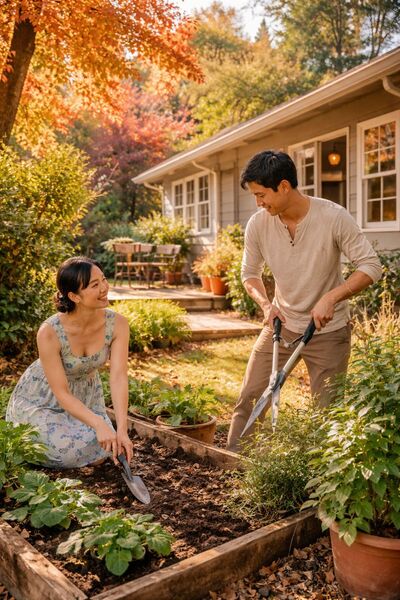
〈A Love Letter from Lhasa〉8 by Chen Ching-Yang Chapter 15 – Annie and Huaimin Return to Berkeley 01 Annie and Huaimin started tidying the house. Huaimin trimmed the garden with large scissors, Annie cleaned floors and windows. Huaimin mowed the lawn while Annie cultivated a small farm plot. By evening, Annie heated Meilan’s hunter’s rice parcels in the oven and brewed two large cups of coffee. Fresh from a shower and wrapped in a towel, Huaimin joined Annie in the small dining room, enjoying the food and rich Alishan coffee. Annie said: “Your mom packed a lot in these parcels! There’s stir-fried wild boar, chestnuts, salted egg yolks, and shredded radish.” Huaimin smiled: “That’s my mom’s love!” “Having a mom is wonderful.” Annie glanced at her mother’s photo on the windowsill, feeling a pang of sadness. Huaimin gently comforted her: “Annie, you still have a mom in Alishan!” Annie smiled again: “Yes! I have a mom who’s an amazing cook!” Huaimin said: “Next spring, we’ll leave. Too bad we won’t get to plant millet or barley.” Annie replied: “It’s not too late! Winter is mild here. Didn’t you notice I’ve already prepared the plot?” Huaimin smiled: “I thought you were preparing for strawberries.” Annie: “We can plant strawberries later, but we’ll wait another two months when it’s cooler.” 02 “My grandmother Zhuoma was a woman of extraordinary willpower.” “Oh? You mentioned she was from Tibet.” “Yes. During WWII, she studied at the Southwest United University in Chengdu, where she met my grandfather, a Flying Tigers officer. Have you heard of the Flying Tigers?” “Yes, General Chennault and Madame Chen Xiangmei—they are well-known in Taiwan.” Annie continued: “After the war, my grandparents returned to Lhasa. When the communists advanced to the Yangtze, my grandfather was called to serve again, and they moved to Nanjing. He flew many missions until Shanghai fell. They retreated with the Nationalist government to Taiwan. Years later, my grandfather died in a reconnaissance mission. My grandmother, pregnant, moved alone to California, worked as a library assistant at Berkeley, raised my father Zahi, and earned her PhD while teaching in the arts.” Huaimin admired: “Your grandmother was remarkable—a strong woman of her era.” “Zhuoma is like an epic historical novel. In contrast, my mother Grace was like a sad lyric poem…” Annie’s eyes welled with tears. “Oh! What happened to your mother?” Huaimin asked gently. Annie shook her head: “I don’t want to talk about her. She’s a shadow in my heart.” “Alright, I won’t ask,” Huaimin respected her wishes. They walked to Grace’s grave. Huaimin noticed the dates on the tombstone and thought: “So Annie’s mother passed away last year; no wonder she avoids the topic.” Annie offered flowers and prayed silently. Huaimin joined her silently, grateful for Grace’s upbringing of Annie, recognizing the virtues of a good wife and mother in her. 03 Li carefully observed the tall, sunlit young man. “He’s as handsome as your father, Zahi, when he was young!” Li said. Then: “Annie, you have a good eye.” Annie smiled: “Spending half a year with my father, I saw he’s a true scholar. Huaimin is more of an artsy type, straightforward and sincere.” Huaimin, hearing this for the first time, scratched his head and smiled: “Actually, I’m not that naive!” Annie teased: “I never said you were naive!” “Ha! You two have good chemistry,” Li smiled, seeing their playful banter. “Uncle, I may change my dissertation topic. I’ll show you soon.” “No rush. Take your time. I’ll see you this evening at the department and treat you to a meal.” “No need, Uncle. Come to our house; I’ll let Huaimin show off his hometown cooking!” “Perfect! I’ll be your guest. I’ll take the bus later.” Li smiled and left. Annie noticed Huaimin staring blankly, like a wooden statue. “Are you okay, Huaimin?” she asked. “Why didn’t you ask me first before inviting your uncle over?” “Testing your adaptability!” Annie said casually. Huaimin frowned: “I can cook, but are those ingredients available here? Wild boar, free-range chicken, creek fish…” “Don’t worry. We have mountain pepper, cumin, and Aiyu seeds at home. Later, we’ll buy similar ingredients at the supermarket and cook together. My uncle isn’t picky.” Huaimin smiled wryly: “Alright…” “Let’s buy chestnuts, salted eggs, and dried radish to make hunter’s rice parcels.” “We’ll need shell ginger leaves to wrap them!” “Don’t worry, we have plenty in the backyard,” Annie said. “Also, let’s get glutinous rice and bananas. I love your handmade banana mochi.” “But we don’t have a mortar and pestle!” “Then we’ll check a few stores! I’ve seen Native Americans use them; we can find some.” Huaimin shook his head helplessly: “You really give me strange challenges!” 04 “Salted pork needs to be seasoned with Magao!” Huai-min, unwilling to give in, replied, “Then why not buy lamb chops next time? Seasoning like this is just a mismatch—it doesn’t follow the traditional cooking methods of our Tsou people!” “Fine! Next time we’ll get fresh lamb chops and pork belly strips. You can marinate the pork belly, and we’ll each showcase our own skills,” Annie relented slightly. “Then this salted crispy shrimp can’t have cumin at all!” Huai-min insisted firmly. Huai-min immediately corrected her: “Not just that. My mom uses several seasonings. Let me see… scallions, garlic cloves, chili, white pepper, plus salt and two spoons of rice wine.” Annie teased, “Ha! You’re such a mama’s boy!” Annie said, “Next time I’ll cook some Tibetan-style river shrimp for you to try!” Huai-min smiled: “But that’s for fish, not for cooking!” Annie pouted playfully, “You’re really ridiculous! Huai-min, did I ever say we’re making Tsou-style salted crispy shrimp? Should I rewind and play back what I just said?” 05 “I’ve never tasted these dishes in Chinatown. Especially these millet dumplings—the filling is somewhat like northern Chinese zongzi, but with a hint of lemon aroma.” Li Jianhua recalled: “Tsou? I’ve heard of them. They live on Taiwan’s Alishan. Over a decade ago, I visited Taiwan for a conference, and local friends took me to Alishan to see the cherry blossoms! I remember several varieties were in full bloom.” Huai-min curiously asked: “Have you ever heard of the Dabang and Tefuye communities?” Huai-min immediately felt a connection: “That hall is called a Cuba by the Tsou. My hometown is in Dabang, right behind the Cuba, with a row of stone slab houses.” “Incredible!” Huai-min exclaimed. “Professor might have actually been to my house! Tourists visit it all the time.” “It’s a pity I never went to Tibet,” Li Jianhua said. “I’ve been to many places in mainland China, as far as Ili and Tacheng in Xinjiang, but never Tibet.” Li Jianhua suggested: “Annie, you could also consider staying here to teach, and conduct research in Tibet as a visiting scholar.” Li Jianhua analyzed: “With your outstanding performance in the department, plus your grandmother’s connections, you might have a chance to stay at Berkeley. Many senior professors here were once her students.” Chapter 16: The Couple’s New Life in Berkeley 01 “Huai-min, after you finish your studies, we’ll return to Tibet together.” “Tomorrow I’ll go with you to the market and park. I remember there’s a designated street performer area nearby.” 02 After leaving, Huai-min said in the car: “The cultural bureau staff said that applicants must have US citizenship or permanent residency… which I don’t have.” “Also, after I get my degree, I want to start a family, so we need to save for childcare.” 03 A delivery truck arrived with two wooden boxes, one large and one small. Annie signed the delivery note as the couriers carried the boxes inside. She opened the small box first, revealing colored pencils, charcoal, watercolors, and oil paints. The large box contained framed colorful portraits and sketches on the top layer. She arranged them on the floor to admire. The bottom layer held two Buddhist paintings. Annie carefully examined the portrait of Songtsen Gampo. “The spirit really resembles Gesang… or rather, Huai-min…” she murmured. Then, holding the portrait of Princess Wencheng, she compared it with her reflection: “This must be reincarnation. There’s no other reasonable explanation.” After a while, Annie thought these two portraits could serve as wedding photos—but should they hang in the living room or bedroom? She hesitated: “I’ll discuss it with Huai-min when he gets back.” At that moment, Huai-min arrived home on his bicycle, carrying a small briefcase. Through the large window, Annie watched him park the bike. He entered the house and noticed the art supplies spread on the floor. “Your shipment arrived!” Annie said, holding Princess Wencheng’s portrait. Annie smiled: “He was giving you hints. Just follow them—we need his help.” Returning to the portraits, Annie asked, “Where should we hang the Princess Wencheng and Songtsen Gampo paintings—in the living room or bedroom?” 04 Annie reminded him, “From tonight on, you’ll be sleeping with me!” They reached the parking lot and got into their RV. The RV left the courthouse and headed back toward the university town. Annie parked in a street-side spot, and the couple walked hand in hand to the nearest bridal shop. Smiling, Annie said, “A year ago, I never imagined I’d be getting married this year!” They entered the bridal shop, tried on outfits, and chose a dress and suit. The shop arranged a photographer and a makeup artist to take their salon photos. Hand in hand, they left the bridal shop and walked back to the parked RV. Huai-min smiled: “Now it really feels like we’re married!” 05 Annie said with affection, “From today on, we are husband and wife, supporting each other for life. I toast to my husband!” They drank their ceremonial cross-cup wine. Huai-min spoke sincerely: “Annie, I actually have no ambition—none at all. I’m nothing like Songtsen Gampo.” Huai-min smiled: “I can imagine. My upbringing was the opposite—I did chores, participated in school clubs, athletics, camping, and many dynamic activities. But painting was always my passion and spiritual refuge.” Annie wondered aloud: “How did two people with such opposite temperaments end up together?” Annie asked calmly: “Why didn’t you tell me this until today?”
|
|
| ( 創作|連載小說 ) |