字體:小 中 大
 |
|
|
|
| 2016/06/11 16:33:54瀏覽425|回應0|推薦0 | |
Chapter 5 Mise-En-Scene - Mise-en-scene (Wikipedia) (staging or putting on an action or scene) Mise-en-scène (French pronunciation: [mizɑ̃sɛn] "placing on stage") is an expression used to describe the design aspects of a theatre or film production, which essentially means "visual theme" or "telling a story"—both in visually artful ways through storyboarding, cinematography and stage design, and in poetically artful ways through direction. It is also commonly used to refer to multiple single scenes within the film to represent the film. - open frame -> realistic film closed frame -> antirealistic film http://as.vanderbilt.edu/koepnick/EuropeanCinema_s05/materials/resources/filmform1.htm
- Italian neorealism (Wikipedia) Italian neorealism (Italian: Neorealismo), also known as the Golden Age of Italian Cinema, is a national film movement characterized by stories set amongst the poor and the working class, filmed on location, frequently using non-professional actors. Italian neorealism films mostly contend with the difficult economic and moral conditions of post-World War II Italy, representing changes in the Italian psyche and conditions of everyday life, including poverty, oppression, injustice and desperation.
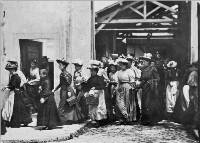
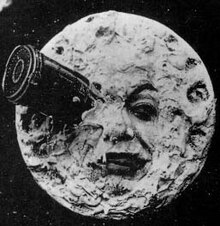
- 2 foundamental styles of design : realistic (Lumiere brothers) ; fantastic (Georges Melies) Lumiere brothers' first film : Workers Leaving The Lumière Factory in Lyon
Georges Melies A Trip to the Moon
- dystopia (Wikipedia) A dystopia is a community or society that is undesirable or frightening.[2][3] It is translated as "not-good place", an antonym of utopia, a term that was coined by Sir Thomas More and figures as the title of his most well-known work, "Utopia."
- expressionism (Wikipedia) (articulate human feeling and emotion through design elements)
Chapter 6 Cinematography - zooming (Wikipedia) Zooming in filmmaking and television production refers to the technique of changing the focal length of a zoom lens (and hence the angle of view) during a shot – this technique is also called a zoom. The technique allows a change from close-up to wide shot (or vice versa) during a shot, giving a cinematographic degree of freedom. - tilt shot (Wikipedia) Tilting is a cinematographic technique in which the camera stays in a fixed position but rotates up/down in a vertical plane. - low-angle shot (Wikipedia)
- high-angle shot (Wikipedia)
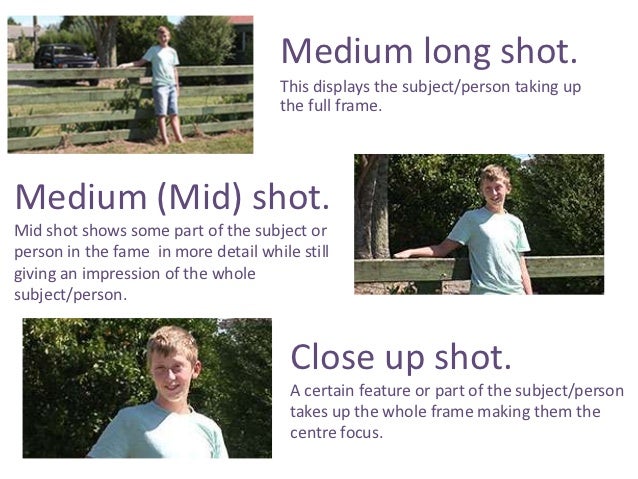
- long shot (Wikipedia) In photography, filmmaking and video production, a long shot (sometimes referred to as a wide shot) is a shot in which the human body or some other relevant object is significantly embedded in the surrounding environment.
- medium shot (Wikipedia) In film, a medium shot, mid shot (MS), or waist shot is a camera angle shot from a medium distance.
|
|
| ( 不分類|不分類 ) |