字體:小 中 大
 |
|
|
|
| 2016/06/13 14:24:59瀏覽116|回應0|推薦0 | |
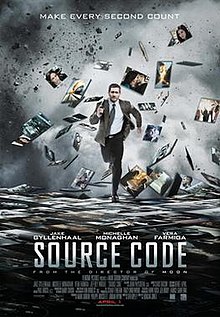
- Source Code (Wikipedia) Source Code is a 2011 French-American science fiction film directed by Duncan Jones, written by Ben Ripley, and starring Jake Gyllenhaal, Michelle Monaghan, and Vera Farmiga. The film had its world premiere on March 11, 2011 at South by Southwest,[4] and was released by Summit Entertainment on April 1, 2011 in North America and Europe.
- Edge of Tomorrow (Wikipedia) Edge of Tomorrow (alternatively known by its tagline Live. Die. Repeat. and marketed as such on home release[4])[nb 1] is a 2014 American science fiction action film starring Tom Cruise and Emily Blunt. Doug Liman directed the film based on a screenplay adapted from the 2004 Japanese light novel All You Need Is Kill by Hiroshi Sakurazaka. The film takes place in a future where Earth is invaded by an alien race. Cruise plays Bill Cage, a public relations officer with no combat experience, who is ordered by his superior to film the first wave of a crucial landing operation against the aliens. Though Cage is killed in combat, he finds himself in a time loop that sends him back to the day preceding the battle every time he dies. Cage teams up with Special Forces warrior Rita Vrataski (Blunt) in seeking a way to defeat the extraterrestrials.
- About Time (Wikipedia) About Time is a 2013 British romantic comedy-drama film about a young man with the special ability to time travel who tries to change his past in order to improve his future.[4] The film was written and directed by Richard Curtis,[5][6] and stars Domhnall Gleeson, Rachel McAdams and Bill Nighy. It was released in the United Kingdom on 4 September 2013.
- Why is dystopian fiction still so popular?
- Utopian and dystopian fiction (Wikipedia) The utopia and its derivative, the dystopia, are genres of literature that explore social and political structures. Utopian fiction portrays a setting that agrees with the author's ethos and is portrayed as having various attributes that readers often find to be characteristic of that which they would like to implement in reality, or utopia, as the setting for a novel.Dystopian fiction--commonly referred to as dystopic fiction--(sometimes combined with, but distinct from apocalyptic literature) is the opposite: the portrayal of a setting that completely disagrees with the author's ethos and is portrayed as having various attributes that readers often find to be characteristic of that which they would like to avoid in reality, or dystopia.[1] Many novels combine both, often as a metaphor for the different directions humanity can take in its choices, ending up with one of two possible futures. Both utopias and dystopias are commonly found in science fiction and other speculative fiction genres, and arguably are by definition a type of speculative fiction. |
|
| ( 不分類|不分類 ) |