Song Title: Broiges Tanz (Hebrew: ברוגז טאנץ) Lyrics: Olga Kulbitsky Composer: Chassidic (Traditional Folk Song) Singer: Folk singers are numerous; the folk dance version is sung by Geula Gill. Dance Title: Same as the song title. Choreographed by: Jewish Traditional Dance Chinese Dance Title: 猶太情人舞
This dance is deeply rooted in Jewish cultural traditions. Teacher Frog will begin by using a photo and simple story of an 80-year-old Jewish grandparent living in the United States as an introduction, allowing those already familiar with the dance to gain a deeper understanding of its meaning and express its essence. For those who havent yet learned this dance or any international folk dance, this example will help them learn more about traditional cultures from around the world.
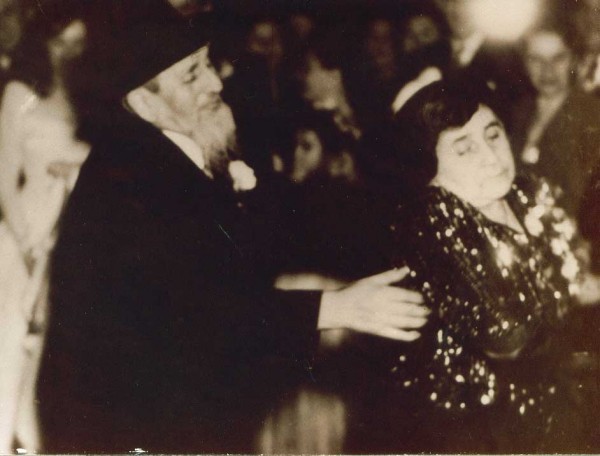
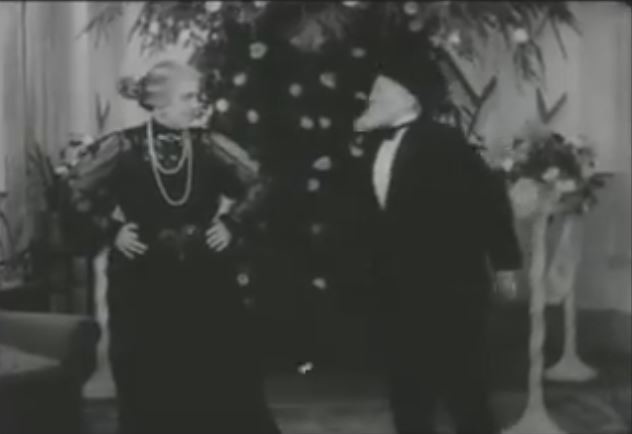
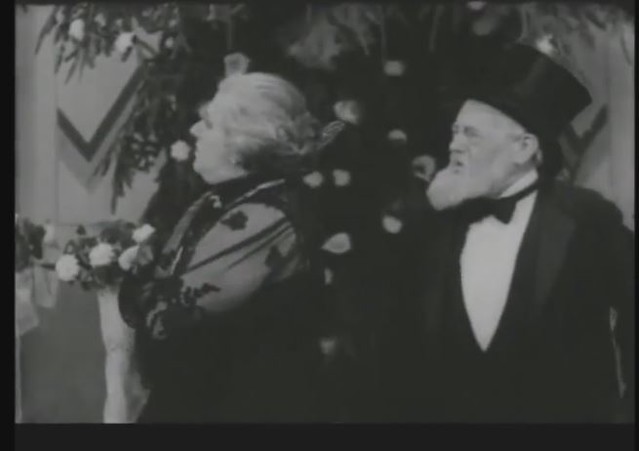
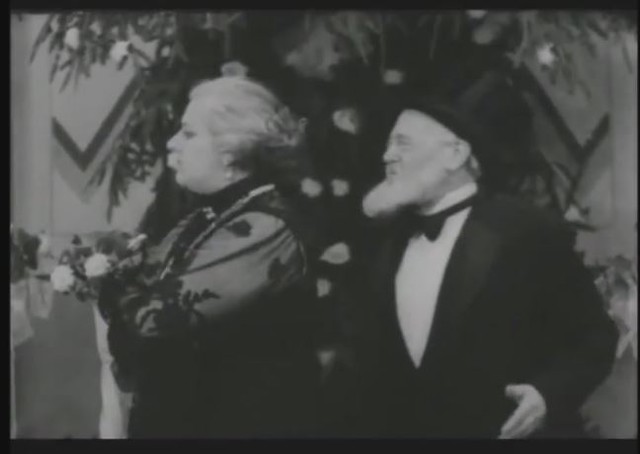
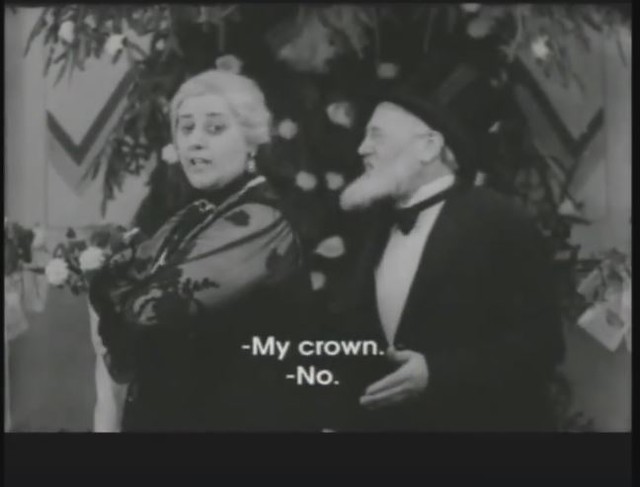
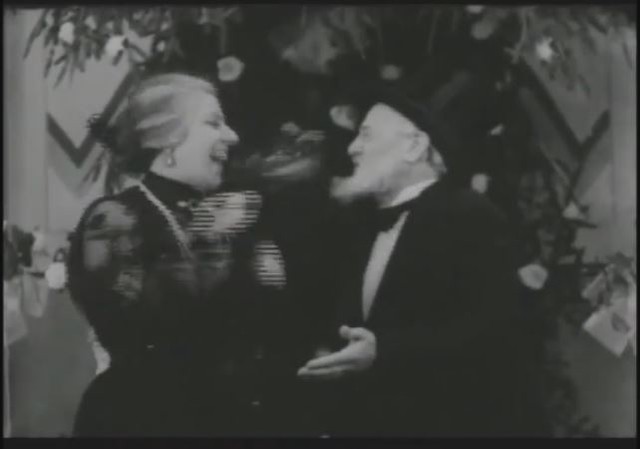
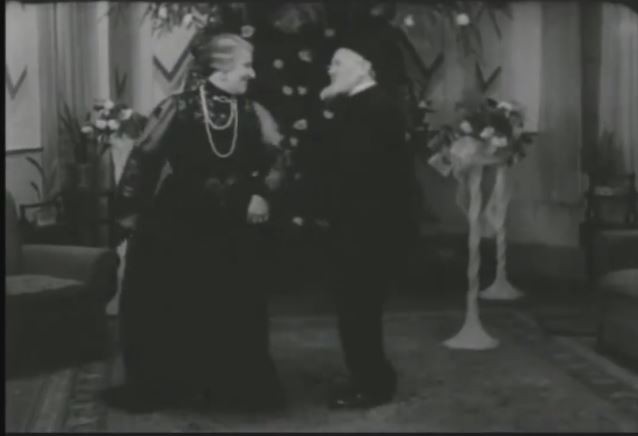
Please look at this photo: Image source: M. Schiller, Helen"s Yiddish Dance Page. What an adorable grandparent! Their expressions are so vivid and interesting. You might be surprised to learn that they are dancing!
This photo was taken in the United States in the 1950s. The grandparents in the photo are Esther and Abraham. The Stiers are Jewish people from Russia. The photo was taken at a relatives wedding, where they performed a "Yiddy Dance." The grandmother, Esther, pretends to be angry and ignores the grandfather, Abraham. The grandfather tries his best to please her and appease her. Sometimes, the grandfather secretly hides the grandchildren, making sure the grandmother cant find them, but she always manages to find them and secretly "rescue" them. At the end of the dance, the grandfather leads the grandmother around the stage and gives her a big hug to conclude the performance.
Image source: Helen"s Yiddish Dance Page
This is a very traditional Jewish cultural custom and dance. The dance name, Broiges Tanz, is the Romanized spelling of Yiddish. Broiges is also spelled Broyges or Broygez, which is equivalent to "anger" in English; Tanz means dance, so together its "Dance of Anger."
Image source: Helen"s Yiddish Dance Page
Since were discussing Yiddish, some dance enthusiasts know that both Yiddish and Hebrew are Jewish languages. So, what are the differences between them? Here, Teacher Frog will quickly and concisely explain the differences between Yiddish and Hebrew. Hebrew is the ritual language of Judaism since the 2nd century AD, and it is the only ancient language on Earth to have been successfully resurrected. It belongs to the Semitic language family, and modern Israel still lists Hebrew as an official language. Yiddish, on the other hand, is the language spoken by Jews in Central and Eastern Europe, belonging to the Germanic language family. This dance originates from Eastern European Jews, hence the dance title is written in Yiddish. Before Hitlers extermination of Jews during World War II, Yiddish-speaking Jews were scattered throughout Central and Eastern European countries, such as Poland, Czech Republic, Germany, and Lithuania. Ukraine, Hungary, Romania, Russia, and other countries in the region.
Image source: Helen"s Yiddish Dance Page
Image source: Helen"s Yiddish Dance Page
Image source: Helen"s Yiddish Dance Page
Returning to this dance, it originates from Jewish culture in the Yiddish-speaking region of Eastern Europe. Beginning in the late 19th century, it is a wisdom passed down from Jewish elders, a dance of life and death, teaching newlyweds how to live together. Two individuals from different backgrounds form a family. In the daily grind of married life, friction and conflict are inevitable. Mutual tolerance and understanding are essential for a lasting and fulfilling marriage.
Image source: Helen"s Yiddish Dance Page
Image source: Helen"s Yiddish Dance Page
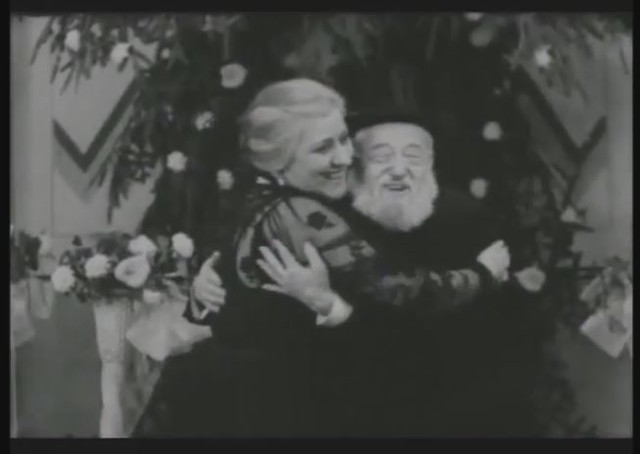
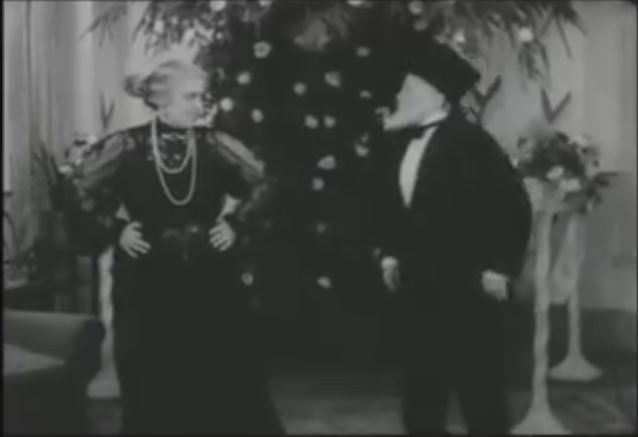
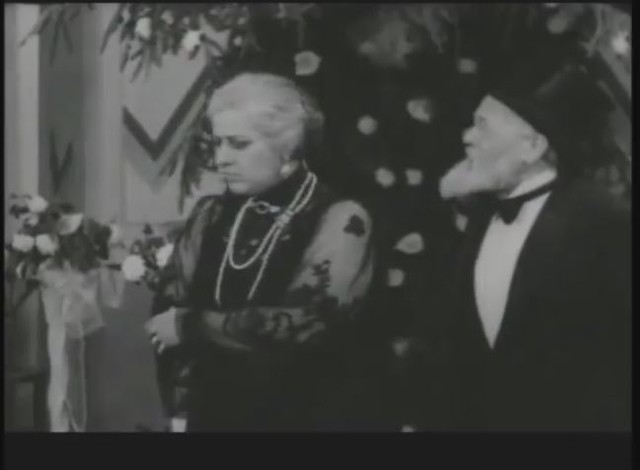
The Yiddish Dance isnt a single, fixed routine; the specific details and content vary slightly from region to region. However, the core message and cultural spirit remain largely the same: two female elders from different families—the mother-in-law and mother-in-law—one feigns displeasure over trivial matters, while the other tries to appease and apologize. They eventually embrace and reconcile. This dance is typically performed at weddings, and as mentioned earlier, the future mother-in-law and mother-in-law are played by two women. Nowadays, however, its also sometimes performed by a man and a woman, the grandfather and grandmother.
Image source: Helen"s Yiddish Dance Page
Image source: Helen"s Yiddish Dance Page
The boss hosts an angry dance at a real wedding:
Image source: ganeydn channel from Youtube
This song is an ancient Yiddish ballad over a century old. Teacher Frog couldnt find the original year or author, so well use "anonymous" for now (this refers to our folk dance version; other versions exist earlier). The earliest recording Teacher Frog could find is a version held in the library of the University of Wisconsin-Madison, recorded in 1921. (Teacher Frogs note: Information from the Australian-Israeli website states that the lyrics were written by Olga Kulbitsky, but this needs further verification and research. There is indeed a famous dance teacher in the American dance world named Olga Kulbitsky, who has taught folk dances from around the world, including Dande, Cowboy Trio, Irish Laundry, Firefighter, Hylansatishi, Israeli Hula, Greek Kalamatinos, Minuet, Portland Fantasy, Tango Mix, etc., many of the folk dances we often danced in the 1950s/60s. I dont know if the Olga mentioned on the Australian-Israeli website...) Is Kulbitsky the same Olga Kulbitsky we know? Olga Kulbitsky was born on July 16, 1914, in New York City, USA, to Russian immigrant parents. Given Olga Kulbitskys age, this song likely existed before her birth, so its unlikely she wrote the lyrics. Could she have added them later? (Teacher Frog hasnt found further evidence for this, so it remains to be investigated.)
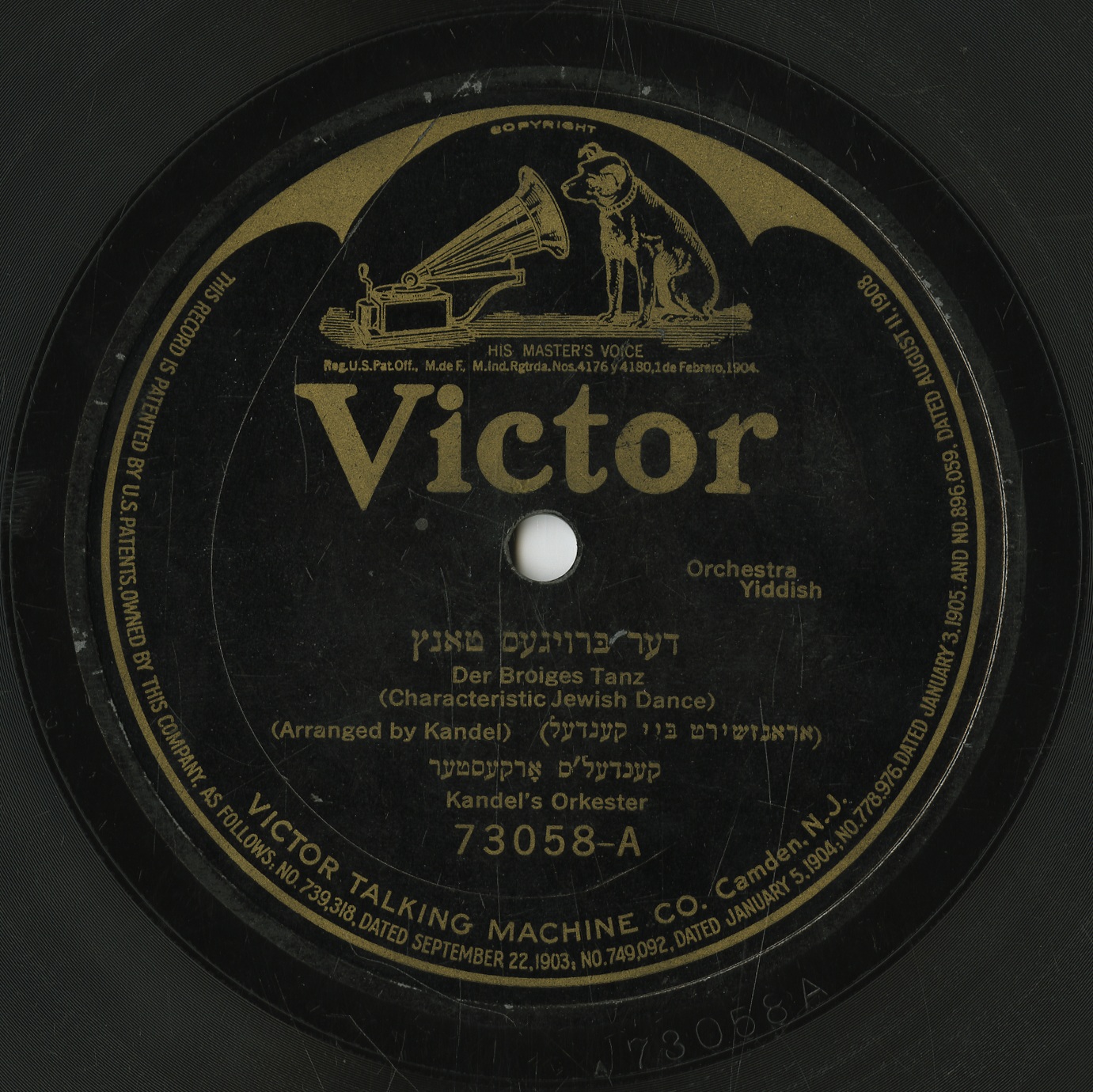
Harry Kandels... formed by Harry Kandel on May 6, 1921. The Orchestra released a 78 rpm 7-inch miniature record, track A1: (Actually, because the record is small, both A and B sides only contain one song. Hehe~)
Image source: University of Wisconsin-Madison Digital Library: https://search.library.wisc.edu/
Now, please enjoy this version of the song from a century ago:
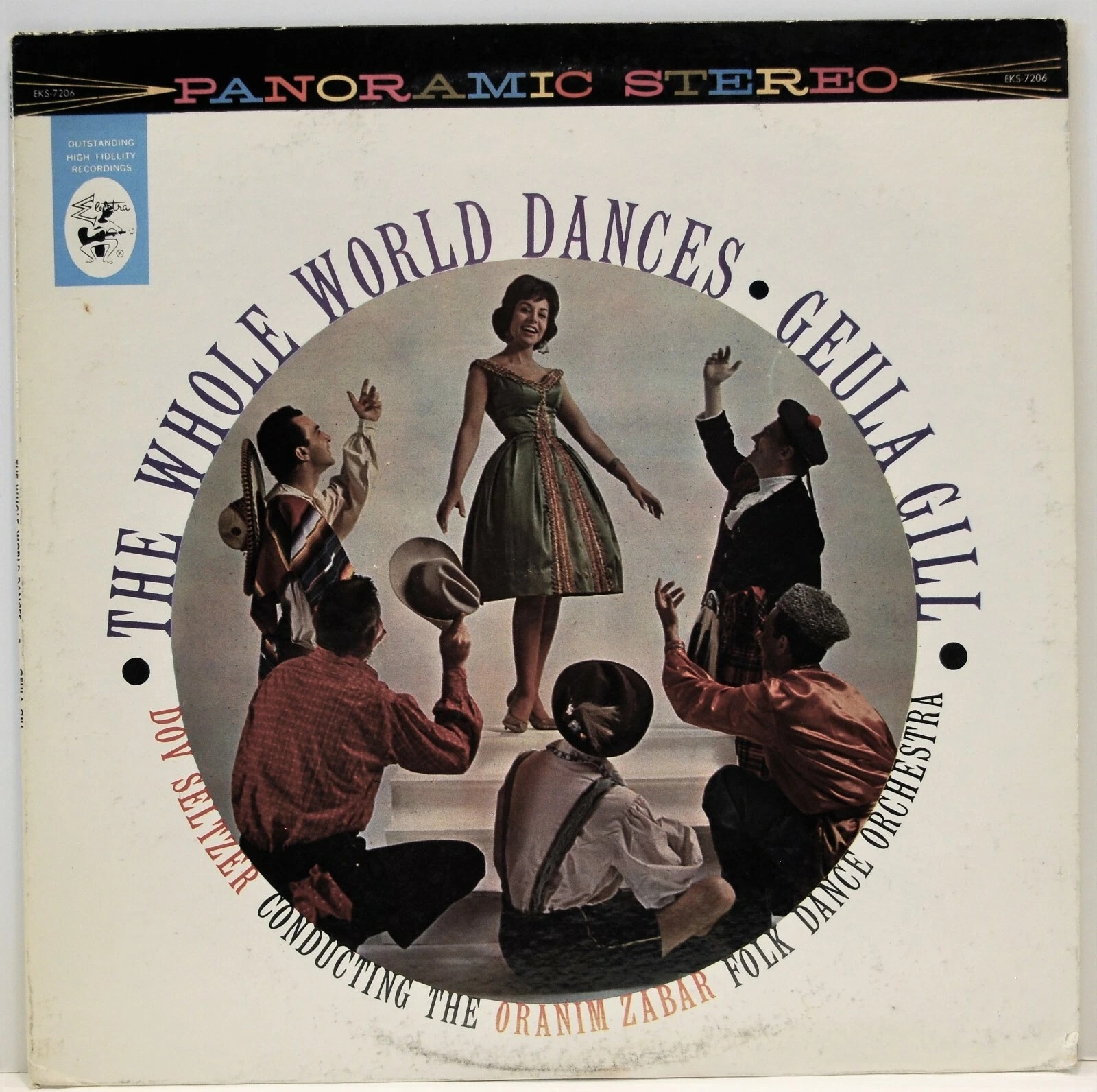
Next, well introduce the vocal version of the folk dance version. The music used in our folk dance community is from the 1961 album "The Whole World Dances" by Geula Gill, an Israeli artist.
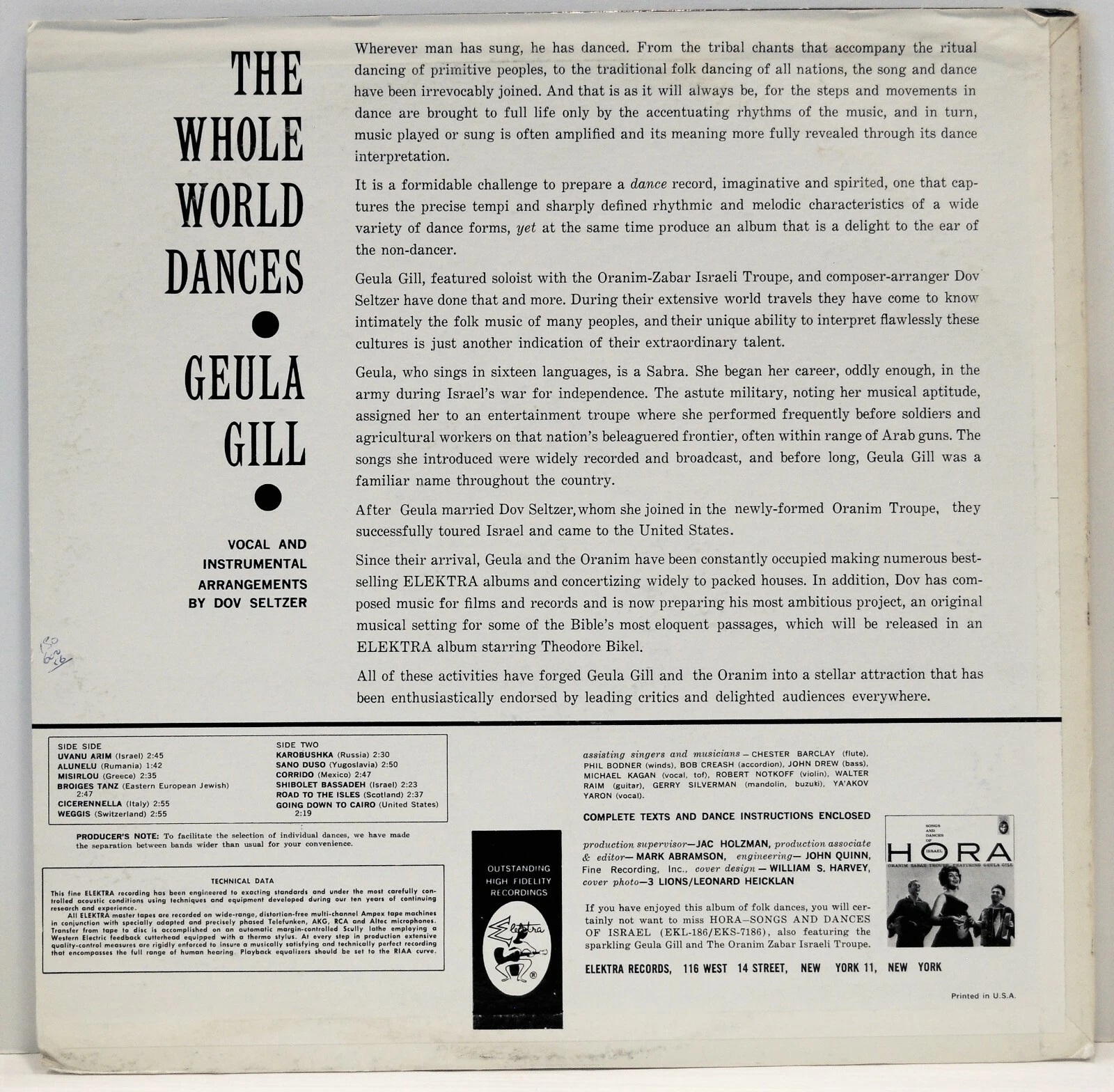
The Whole World Dances Album Cover:
The Whole World Dances Album Back Cover:
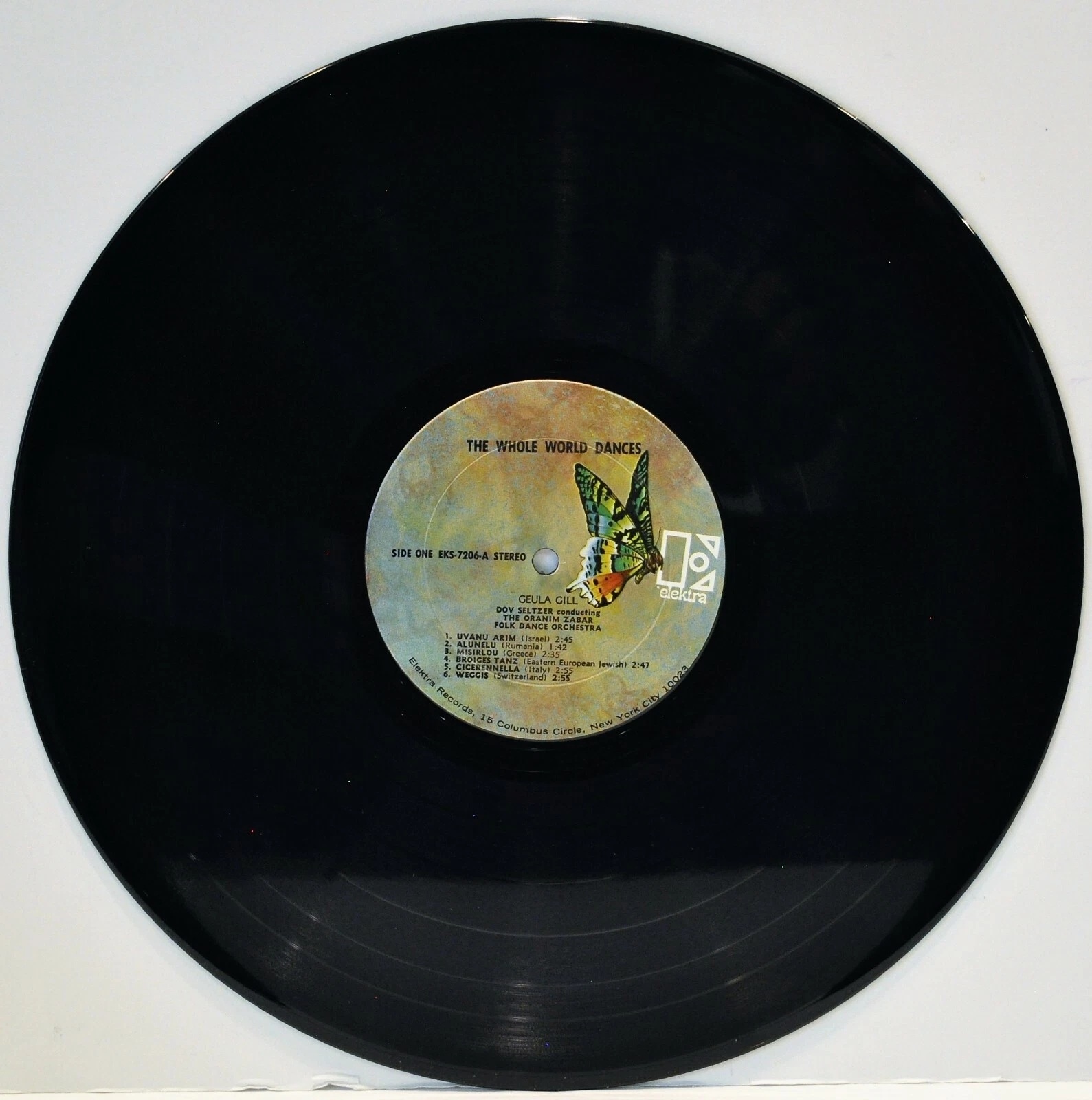
The Whole World Dances Album - Side A:
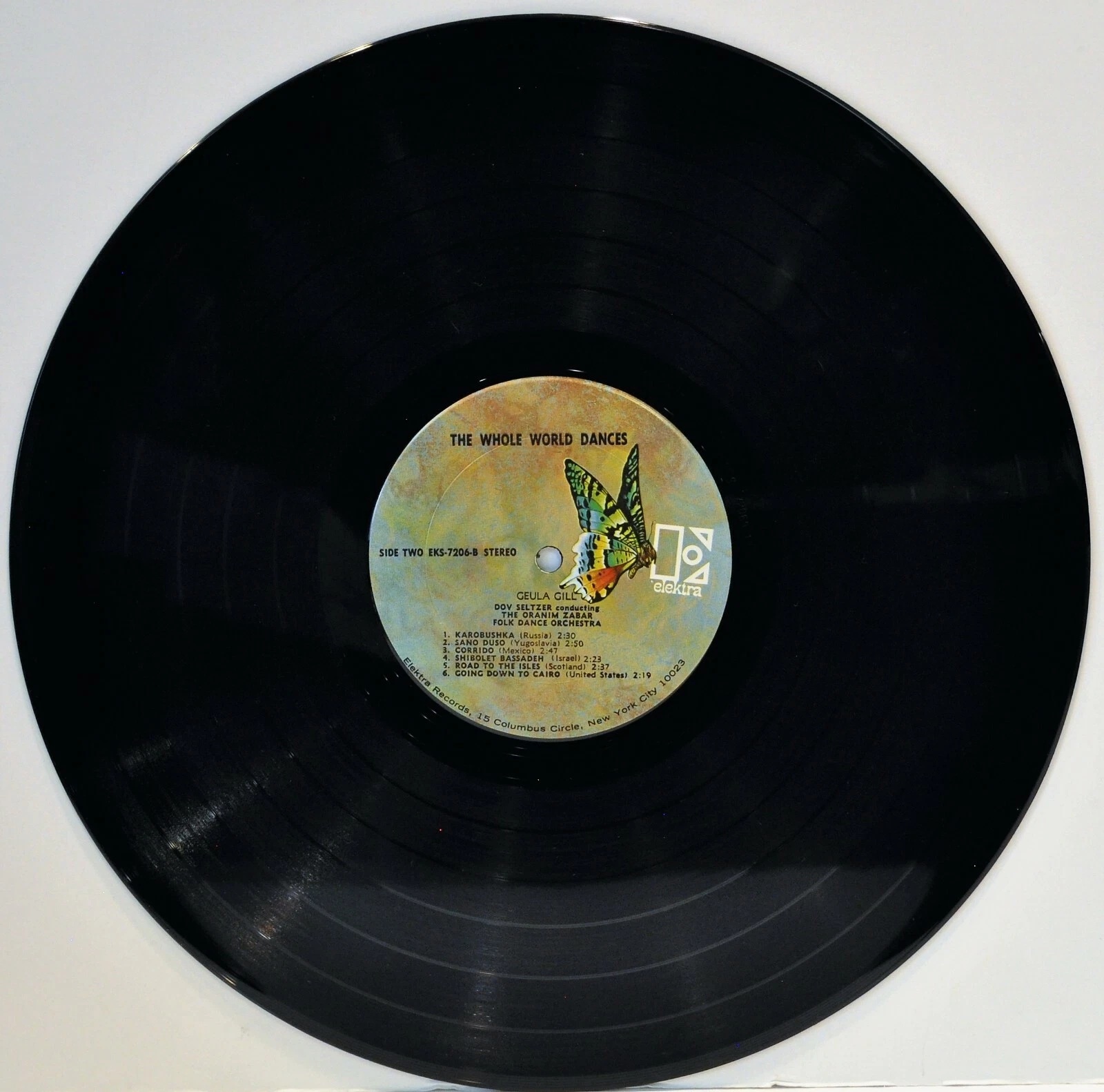
The Whole World Dances Album - Side B:
This album contains 12 songs from 10 different countries, and all of them feature folk dances (according to records, Geula Gill has released songs in 16 different languages!)
Side B: 07. Karobushka (Russia) 08. Sano Duso (Yugoslavia) 09. Corrido (Mexico) 10. Shibolet Bassadeh (Israel) 11. Road To The Isles (Scotland) 12. Going Down To Cairo (USA)
Since Geula Gill is still living in the United States at the age of 95, the music copyright cannot be publicly released. Here, Teacher Frog only translates the lyrics for dance enthusiasts reference; the original music cannot be posted.
Transliterated Lyrics: 1. Bist du mit mir broiges? Veys ich nit farvos, Geyst arum a gantzn tog Aropgelozt di noz.
Efsher vilst du visn Az ich hob dich lib? Lomir beyde ariberforn Tzu dem gutn yid.
2. Tzu a gutn yidn A pidyen im opgebn, Zol er far untz Got betn Oyf a gut lebn
Un az mir veln kumen Tzurik fun gutn yid, Veln mir beyde ariberforn In Zelve oyfn yarid.
3. Dort vel ich dir koyfn A zeyger mit a keit, Un a sheine groyse shtik Zaydns oyf a kleyd.
To zy she mer nit broiges, Un greyt oyfgich tzum tish! Un zets zich mit mir esn, Bakumst bu mir a kish!
Lyrics translated in Chinese: 1. 我不知你為何生氣 為何成日徘徊 愁容滿面 是否要我誓言愛你 然後去晉見主耶穌
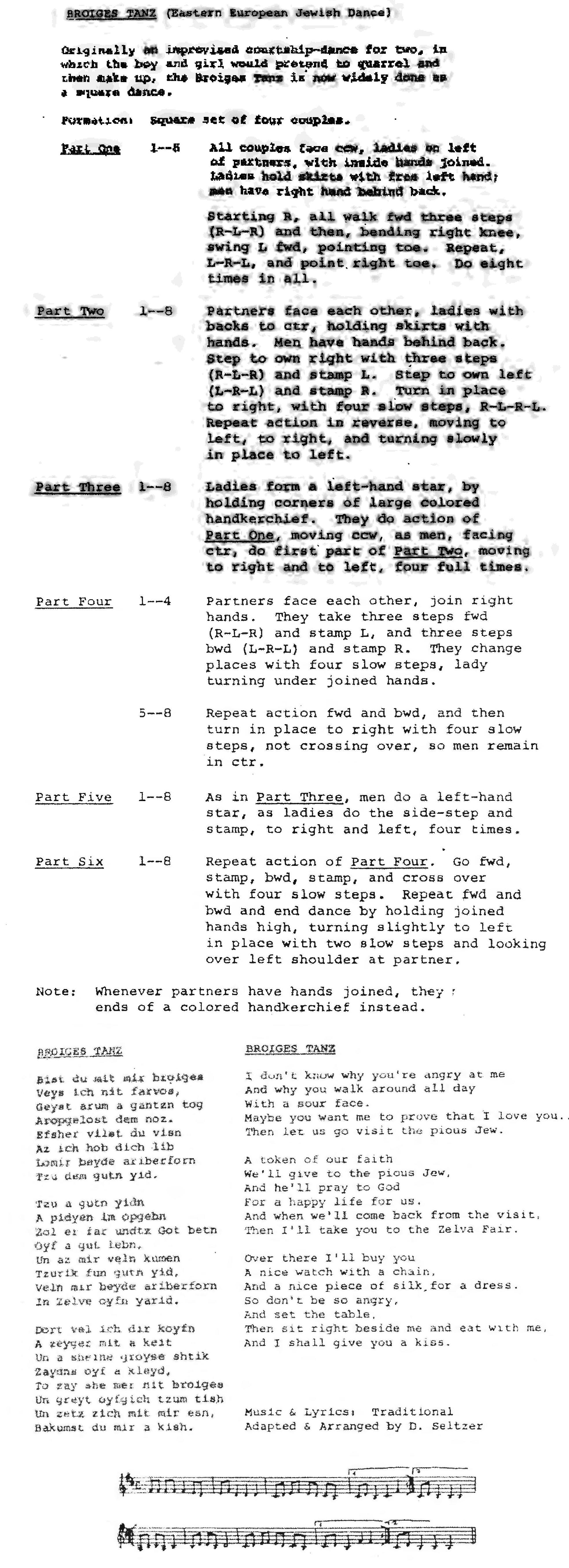
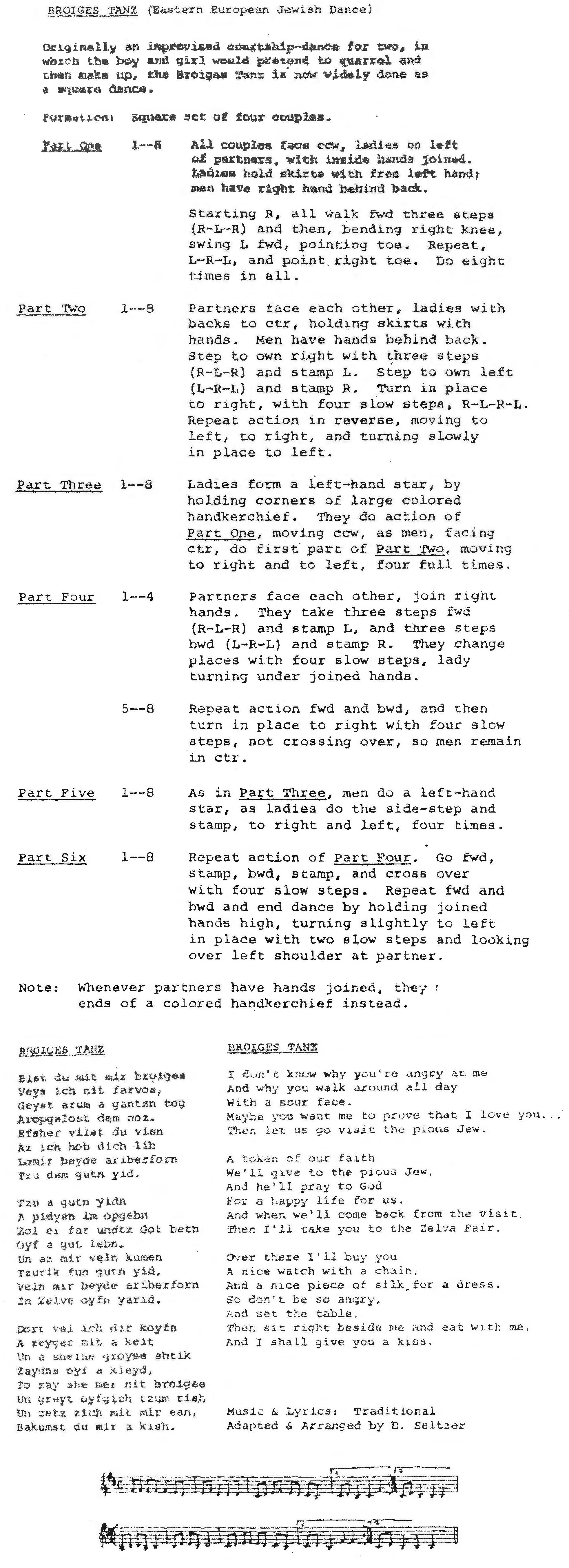
Next, regarding the dance section, Teacher Frog found the original manuscript of the dance introductory text translated by Teacher Chang Ching-San:
This original dance introductory text is quite old and somewhat blurry. Teacher Frog has optimized it to see if it becomes clearer… It looks better like this:
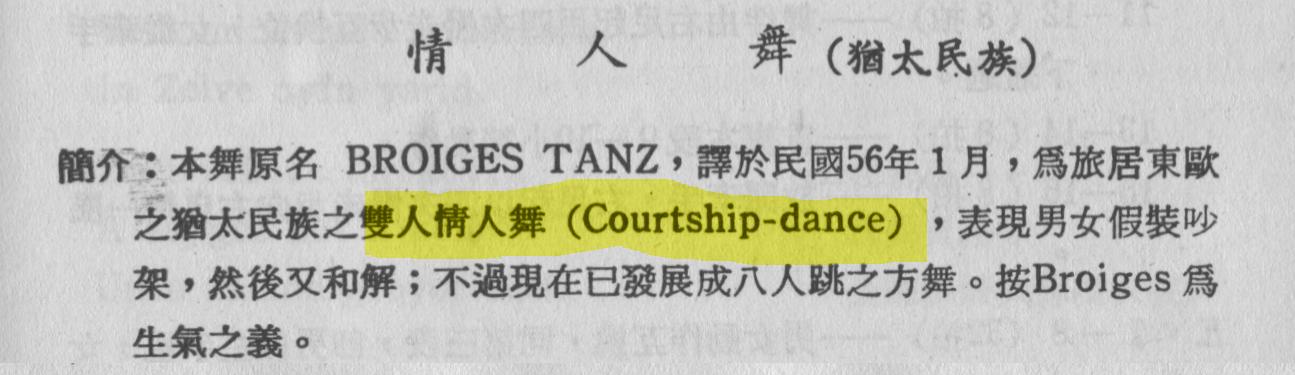
Here, Teacher Frog has marked a proper noun, which is also a keyword:
Dancers, did you see it clearly? The marked word is "improved" Courtship-dance. Teacher Frog wont explain the terminology here; lets first look at how the Chinese dance introduction describes it:
Okay, everyone can understand the Chinese. Teacher Chang Ching-San translateds Courtship-dance as "Couples Lover Dance."
Here, Teacher Frog will correct both the original dance routine (English) and the Chinese dance routine, as both of them are written incorrectly.
First, regarding the original English dance sequence: "improvised" means improvised, "courtship" means courtship, and "courtship-dance" is the specific term for courtship dance. Courtship dance refers to ritualistic dances performed in the human or animal world to attract the attention of the opposite sex through physical movements, thereby attracting potential mates and finding partners. Putting these three words together, it means this Jewish lovers dance is an improvised courtship dance. (This part can be found in Teacher Frogs course: Introduction to Folk Dance Series, Chapter 1 https://blog.udn.com/frankflin01/177522801, starting at 32 seconds in the video.)
The Chinese translation of "court-dance" as "lovers dance" is even stranger. First, as mentioned before, "court-dance" is called a courtship dance, not a lovers dance. Second, there doesnt seem to be a specific term for "lovers dance" in English dance terminology. "Couple" is a closer fit. This is a dance, a duet, but its a dance performed by a man and a woman together, not necessarily a romantic relationship. However, romantic dances do exist both in China and abroad. For example, in Israel, there are dances for grape harvesting, etc. arent these all romantic dances? So why isnt there a category called "romantic dance"? This is indeed a good question; even I, Teacher Frog, hadnt thought of it before. Lets leave it to our dance enthusiasts to continue exploring.
Now, lets return to the question: if this dance isnt classified as a courtship dance, then what type of dance should it be? As mentioned earlier, this dance is popular at Jewish weddings in the Yiddish-speaking region of Eastern Europe, usually performed by two female elders from different families-the grooms mother and the brides mother (known as Mekhutoneste in Yiddish tradition) in an impromptu performance. I believe this dance leans towards ritual dance, so classifying it as a ritual dance is appropriate. The proper term for ritual dance is Ritual. Dance, in this context, refers to a dance performed in a ritual, such as a religious ceremony, celebration, or special event, like the Native American rainmaking dance, water dance, or farm dance weve danced. This Jewish lovers dance is a specific dance performed at weddings, which fits the definition of "dance in a celebration or special event." Therefore, Teacher Frog will classify this dance as a ritual dance, not a lovers dance as stated in the Chinese dance preface, nor a courtship dance as mentioned in the original preface.
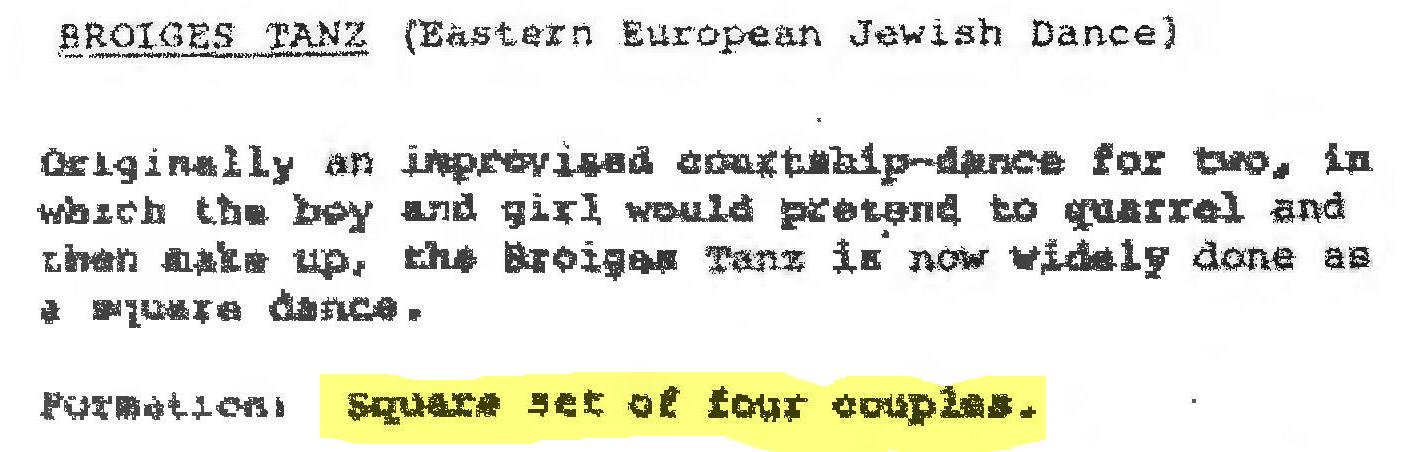
Furthermore: Teacher Frog finds it inappropriate that the original preface states this dance "is now widely done as a square dance," and that the Chinese preface describes it as an "eight-person square dance." "Square dance" is a proper noun referring to American square dances, which have their own defined form. This dance simply involves the dancers standing on the four sides of a square, which is completely unrelated to "square dance." Teacher Frog suggests that when teaching this dance, the preparatory formation should be described using the "formation" description from the English preface: a square set of four. Couples. Four couples form a square. To put it simply, Teacher Frogs teaching style is to call it "Square Dance," not "Square Dance" or "Cube Dance."
Square set of four couples:
Let Teacher Frog remind you again: As introduced earlier, in the old European shtetl tradition, this dance was originally a wedding dance usually performed by the grooms mother and the brides mother (Mekhutoneste) to break the ice between two families.
However, the precious 1950s photograph provided by M. Schiller proves that it evolved into an improvisational dance performed by elder couples, such as the grandparents Esther and Abraham Stier, at family weddings.
Therefore, it is a significant mistake for past documentations to classify it as a "Courtship Dance." Whether performed by two mothers-in-law or an elder couple, its core purpose is a symbolic "Marriage Reconciliation Ceremony," which means it must be classified as a "Ritual Dance."
Finally, the boss (it’s me, Teacher Frog!) treat reference demonstration video provided by teacher Hsu: Please note that the basic steps: 1, 2, 3, point are written as "pointing toe" in the original English dance sequence. "Toe" refers to the toe point; the Chinese dance sequence also uses "straighten forward point," but many dancers and groups use "sweep" instead, which is inconsistent with the original sequence. It is recommended to change it back to "point."
References: 1. The National Library of Israel 2. Helen’s Yiddish Dance Page: Dances of the Jews of Eastern Europe by Helen Winkler 3. Folk Dance Footnotes Website: https://folkdancefootnotes.org/ 4. Swiss Yiddish Website: https://borzy.info 5. Family History Museum: https://www.museumoffamilyhistory.com 6. University of Wisconsin Library: https://search.library.wisc.edu/ 7. National Folk Organization (NFO) Website: https://nfo-usa.org/dance-descriptions/ 8.Yiddish Dance website:https://www.yiddishdance.com/


 字體:小 中 大