Song Title: Ini vitui ni feata, moi (Original text: Îni viţui nă feată, moi; Romanian translation: Am Văzut o Fată, Măi; meaning: I saw a girl.) Singer: Nelu Ianca Dance Name: Îni Viţui (or transliterated: Ini Vitui; or Dutch Joc aroman; strangely, only Taiwan calls it Aroman Dialect) Chinese Dance Name: 亞羅曼之音 Promoted by: Nicolass Hilferink, 1992 (Note 1)
This is a dance that is quite worth introducing, because now the total population of people speaking the Aromanian language worldwide might only be around 250,000 (statistically as of 1997), showing how rare it is.
First, let’s introduce what Aromanian is. The original text for Aromanian is Aromană, also known as Vlachs, which refers to Latin American descendants who migrated to Southern Europe.
These descendants of Latin America are scattered throughout the southern Balkan Peninsula and surrounding countries, such as northern and central Greece, southern Albania, Macedonia, southwestern Bulgaria, Serbia, and the Dobrudja region of Romania.
The existence of Aromanians in Europe can be traced back to the Roman Empire era, and even to the Byzantine Empire era.
Since the Balkan Peninsula is known as the powder keg of Europe, the historical evolution over nearly 2000 years from the Byzantine Empire in the first century AD to the present day is truly difficult to explain clearly here.
Folk dance friends only need to remember a general idea: Aromanians are the descendants of Latin ancestry scattered among various countries in the southern Balkan Peninsula.
They have proliferated for over 2000 years to the present day, and their population is only a few hundred thousand people.
Distribution map of Aromanians scattered across the southern Balkan Peninsula: (Red dotted part) http://upload.wikimedia.org/wikipedia/commons/f/f0/Map-balkans-vlachs.png Image source: English Wikipedia
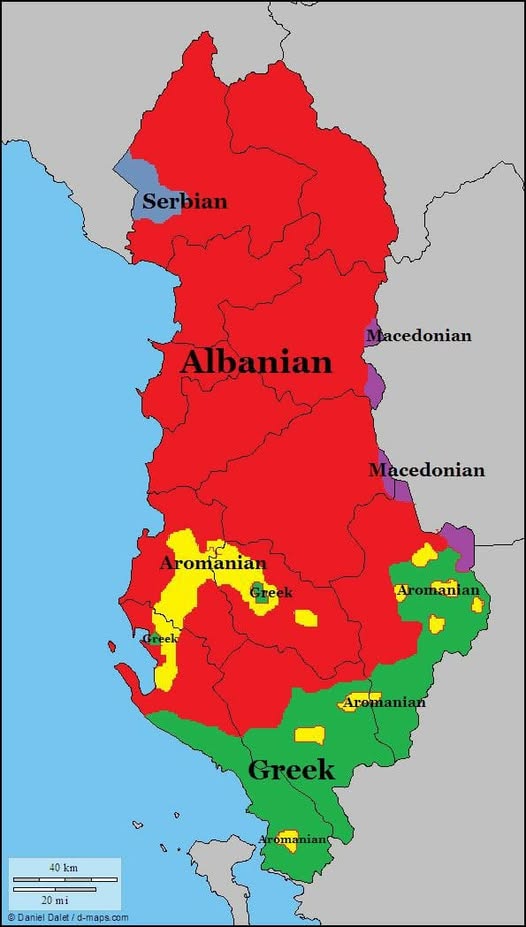
Distribution map of Aromanians within the borders of Albania: (Yellow dotted part) Image source: World Languages Facebook
Distribution map of Aromanians within the borders of Macedonia: (Green dotted part) Image source: English Wikipedia
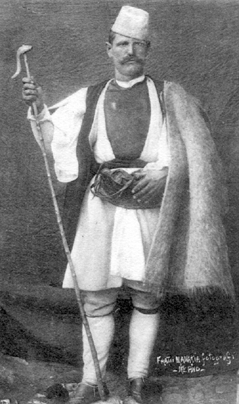
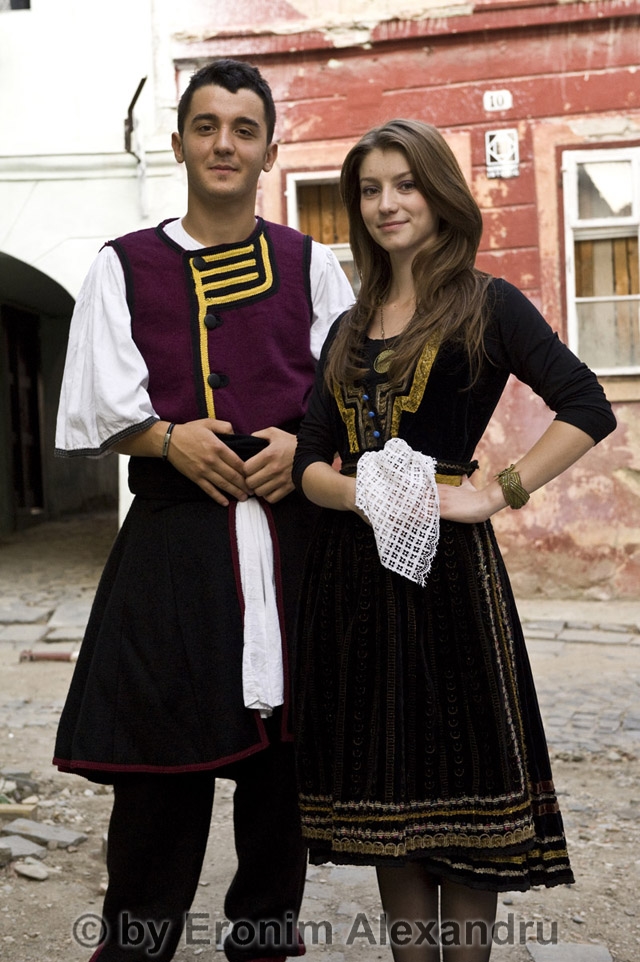
Aromanian traditional costumes: Image source: English Wikipedia
Image source: https://ifunny.co/
Image source: by Eronim Alexandru
Aromanian flag:
The original song title of this dance is: Îni viţui nă feată, moi. It is in the Aromanian language, and its translation into Romanian is: Am Văzut o Fată, Măi. The meaning is: I met a girl.
The content of the lyrics talks about a young fellow seeing a beautiful girl, with feelings of admiration spontaneously arising from his heart, followed by vivid descriptions of the subsequent inner emotional changes.(moi is equivalent to the English "hey" or "well", which is an interjection and carries no special meaning here.)
I don’t know why the English name of this dance in Taiwan is called "Aroman Dialect", which is different from all other countries.
My guess is that when the song title was originally translated into English, since they didn’t understand the Aromanian language, they might have used "Aromanian Song" as the name.
Then we translated it from English into Chinese using a more elegant name, so it came to be called: "Song of Aroman". These are all just Teacher Frog’s conjectures and do not represent any official opinion.
The original dance name is Îni Viţui (this is in the Aromanian language, meaning "I see"; romanized as: Ini Vitui; it is also called Joc aroman, meaning the dance of Aromanians. "Joc" means dance in the Romanian language), originating from the Dobrudja region in southeastern Romania, and was introduced to Taiwan by Teacher Nicolaas Hilferink in August 1996.
Dobrudja is adjacent to the Black Sea coast, located in southeastern Romania, with a small portion located in northeastern Bulgaria.
The fact that the same Dobrudja region is divided between two different countries shows how politically chaotic this area has truly been from ancient times to the present.
Geographical location of Dobrudja: (The brown area is within Romania; the yellow area is within Bulgaria, governed under different countries. The blue area on the right is the Black Sea.)
Here it needs to be explained that in the year 1925, King Ferdinand of Romania granted land in the Dobrudja region to the Aromanians for settlement, along with various privileges, which attracted many Aromanians to migrate here; consequently, 25% of the residents in this region became Aromanians. Aromanian culture, music, and dance are highly developed here, and this dance comes from this very region.
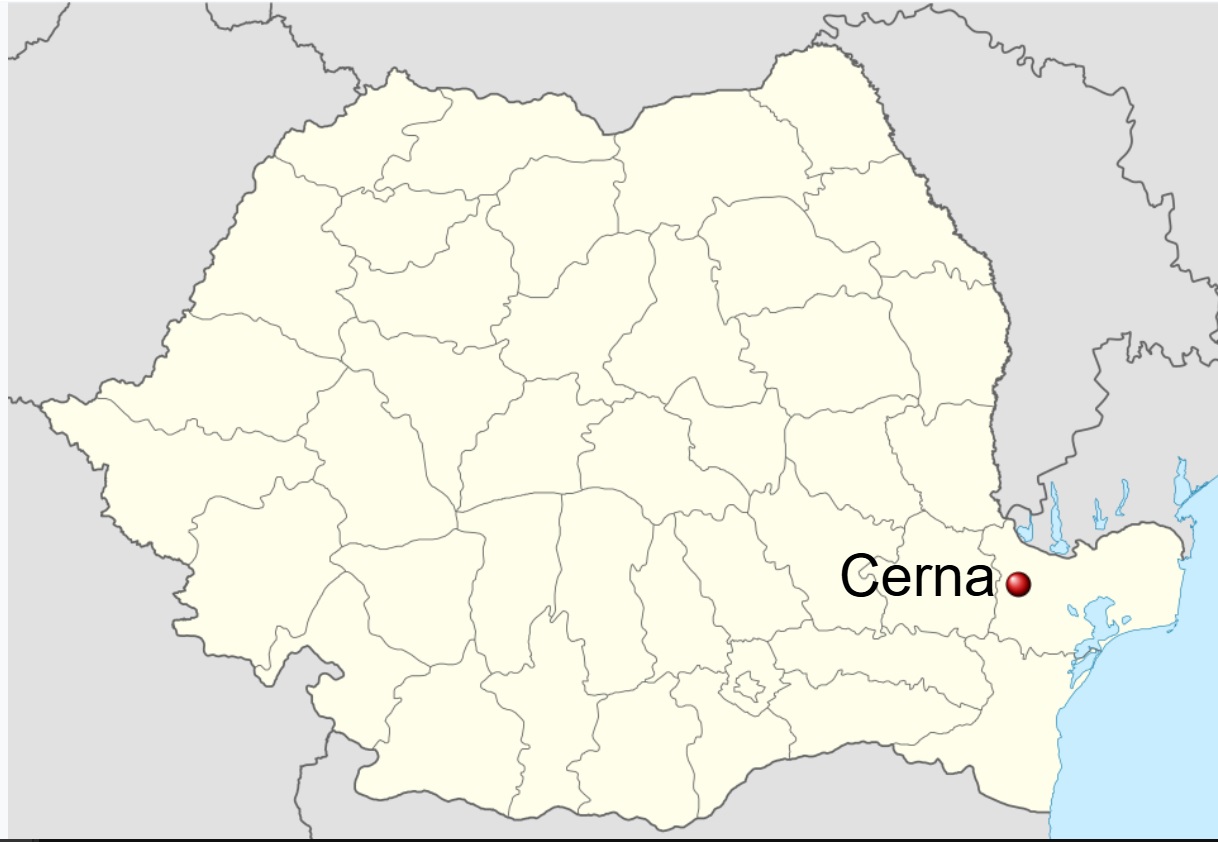
(Note 1): Why call him a "promoter" rather than a "choreographer"? Because this dance was learned by Teacher Nicolaas Hilferink from the local people in Dobrudja, Romania in the year 1989, and was taught at the Idyllwild Folk Dance Camp in the year 1992. (To be more precise, the place where Teacher Nicolaas Hilferink went to learn this dance in Romania was Cerna Town, Tulcea County, Northern Dobrudja Province.
Location map of Cerna Town:
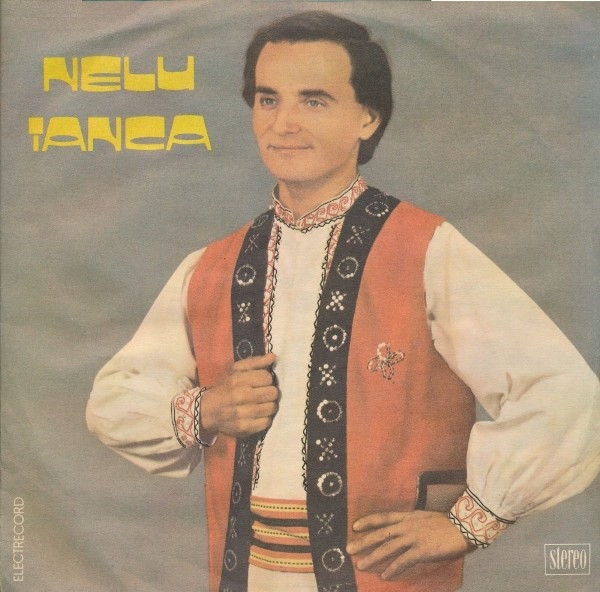
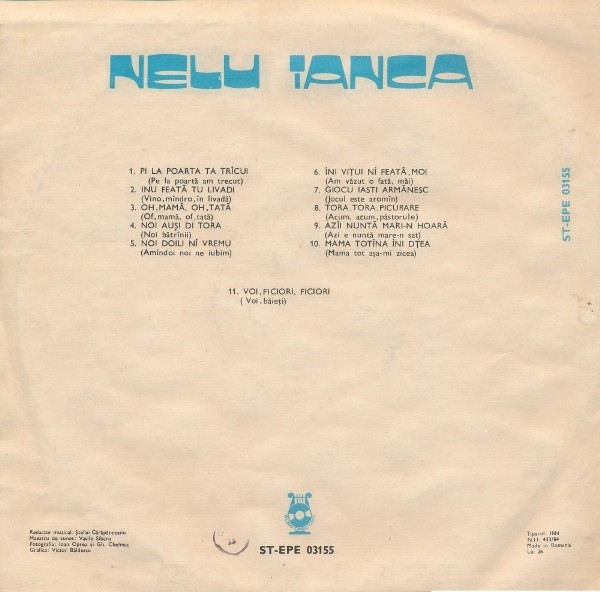
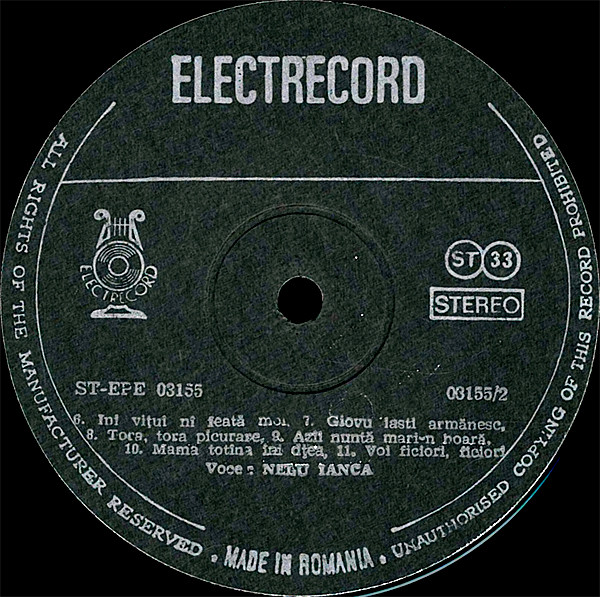
This song was sung by Nelu Ianca in the 197x period, and the record album title is simply called "Nelu Ianca".
Nelu Ianca Record_Cover:
Nelu Ianca Record_Back Cover:
Nelu Ianca Record_Side B:(Ini vitui ni feata, moi is the 6th track, which is the first track on Side B)
The original Aromanian lyrics are no longer traceable, but a Romanian translated version of the lyrics translated by Teacher Gheorghe Grameni and his wife Chirata Calagiu was found on the internet:
Romanian Translated Lyrics: 1. Imi vidzvi ni feati. Moi Ti-avera multi mari Ocliul mlni imi bigai Ti-azi nu-am iv vreari. (2S)
Chorus. Si-ai lai lai lai la. la. la. La Ti-avea multi,mari Sai lal lai lal la. la. la, la Osivdaii mari
2. Di cind mini u viozui Bana imi pari greau Si-uni inima ti-avui Si disfeati in dam (2S)
Chorus. Si-ai lai lai lai la. la. la. La Ti-avea multi,marl Sai lal lai lal la. la. la, la Osivdaii mari
3. Cind fudzim di-acasi. moiPloai si furtuni Si-cind agiunsla vruta mea ti-feati dzua buni (2S)
Chorus. Si-ai lai lai lai la. la. la. La Ti-avea multi,marl Sai lal lai lal la. la. la, la Osivdaii mari
4. Cind fudzin di-acasi. Moi Ploai si aricoari Si-cind agiuns la vruta mea Isi multu soare. (2S)
Chorus. Si-ai lai lai lai a. la. la. La Ti-avea multi,marl Sai lal lai lal la. la. la, la Osivdaii mari (2S)
(Teacher Frogs Note: "(2S)" in the text indicates repeating the section twice, derived from the classical music notation for Strophe/Segno, equivalent to "(2X)".)
The English translation from Romanian found on the internet was done by Professor P. Solca: 1. I saw a girl, Moi So lovely (she was) I looked at her (a long time) And now she is my beloved. (2S)
Chorus. Si-ai lai lai lai la. la. la. la So lovely Si-ai lai lai lai la. la. la. la Oh what a great love.
2. Since I saw her (first) My life seems harder (to me) And my heart has Broken in two (2S)
Chorus. Si-ai lai lai lai la. la. la. la So lovely Si-ai lai lai lai la. la. la. la Oh what a great love.
3. When I leave home. Moi There s rain and storm But when I arrive at my beloveds The weather changes. (2S)
Chorus. Si-ai lai lai lai la. la. la. la So lovely Si-ai lai lai lai la. la. la. la Oh what a great love.
4. When I leave home Its rainy and cold But when I arrive at by beloveds The sun comes out. (2S)
Chorus. Si-ai lai lai lai la. la. la. la So lovely Si-ai lai lai lai la. la. la. la Oh what a great love. (2S)
Chinese translation of the lyrics: 1. 嘿! 我看到一個女孩 她長得好可愛唷 我一直凝視著她 她是我的最愛 (2S)
Next, welcome folk dance friends to enjoy the original music of this dance:
Although many people do not classify Romania as a Balkan Peninsula country, because it is immediately adjacent to the northern side of the Balkan Peninsula, due to geographical relations, their cultures and music still influence each other.In terms of musical rhythm, the asymmetrical meters of the Balkans are famous, and Romania also has similar rhythms; for example, the rhythm of this dance can be divided into two kinds of tempo: slow and fast, but the slow beat is not twice the fast beat, but 1.5 times.
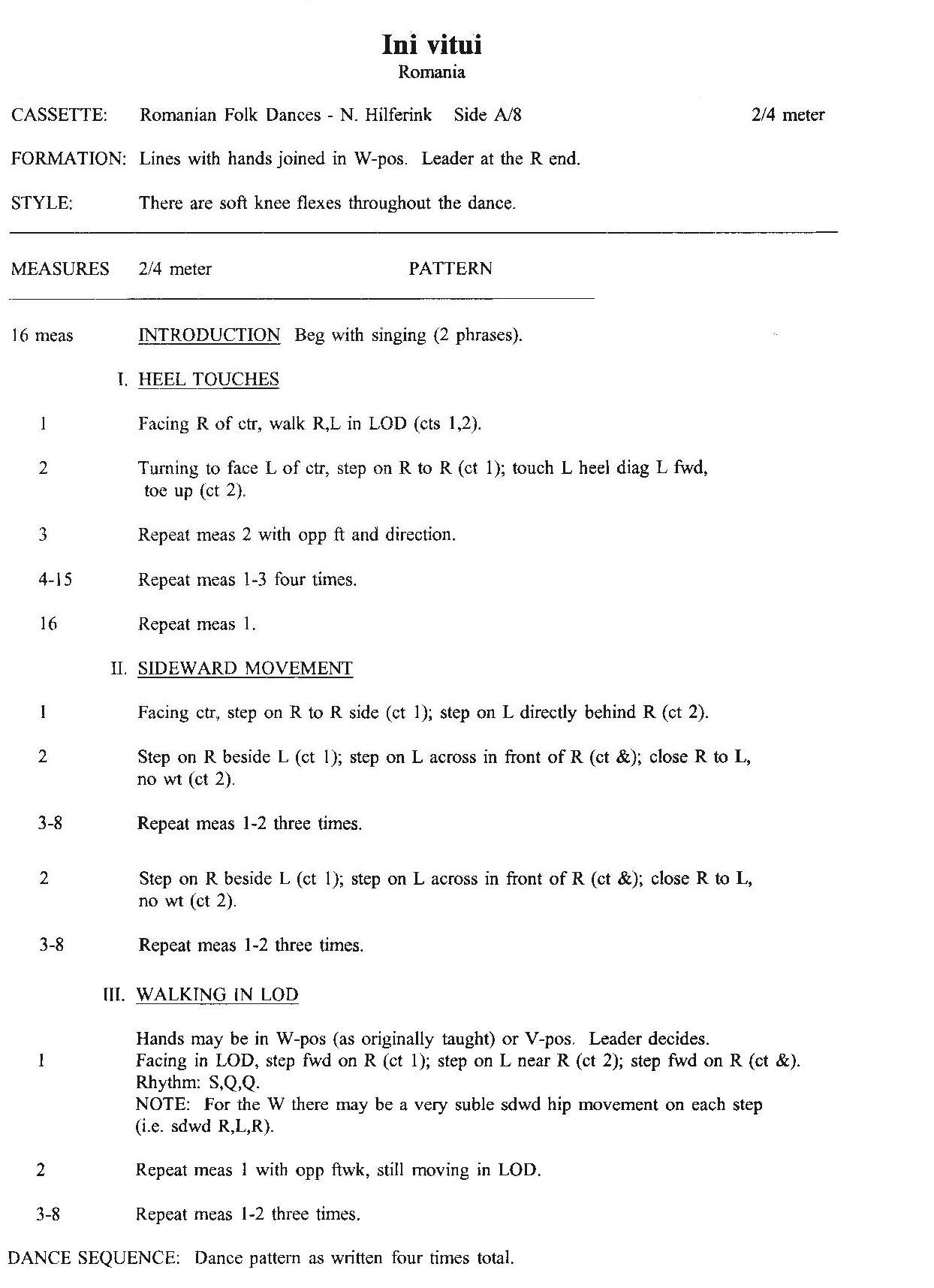
The boss (it’s me, Teacher Frog) treats you with the original English dance routine:
Teacher Frog’s Note 1: The 4th and 6th beats of the first section are heel taps, not walking steps, nor closing steps.A certain well-known foreign club that everyone is familiar with danced it incorrectly, so Teacher Frog did not select their demonstration video here for dance friends’ reference.
Teacher Frog’s Note 2: In the third section (or the interlude, if you prefer), when moving toward the LOD in slow, fast, fast (SQQ), the women’s hips can sway slightly left and right with the footsteps. (That is what the original dance routine says: "For the W there may be a very suble (Teacher Frog remind you its a typo from "subtle") sdwd hip movement on each step (i.e. sdwd R,L,R)".) (Teacher Frog’s explanation: W=Women; sdwd=sideward; R,L,R=right,left,right)
Finally, the boss treats you with the reference demonstration video from the Dutch friend club Danskant:
Reference: 1.Romanian Wikipedia 2.American Folk Dance Website: Folk Dance Musings 3.American Stockton Folk Dance Camp: 1998 Camp Manual


 字體:小 中 大