字體:小 中 大
 |
|
|
|
| 2026/06/30 20:13:00瀏覽242|回應1|推薦0 | |
新詩入選作品評析
001
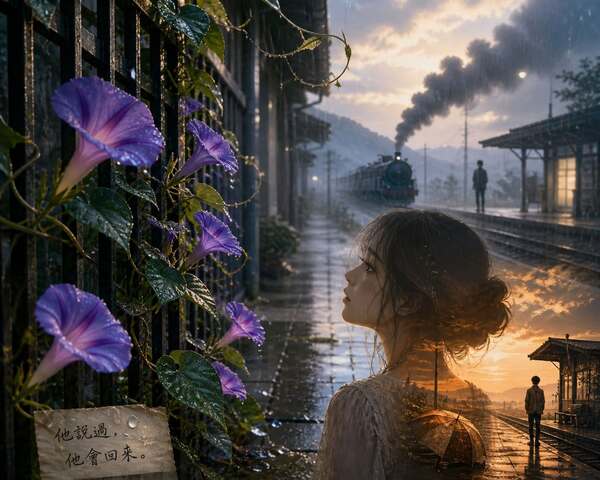
〈春雨中的牽牛花〉/鄭子如 〝詠物詩〞
牽牛花伏在鐵門旁
像一個守夜的人
她用細瘦的手臂
一圈一圈纏住欄杆
彷彿害怕誰再度離去
風在屋簷下低聲說話
像翻動一封舊信
她抬起紫色的小喇叭
朝灰暗的天空呼喊
一聲,又一聲
雨水沿著藤蔓滑落
像字跡漫開的情書
寄往很遠很遠的地方
黑煙慢慢爬上天空
像一條失眠的河
我經過時
她忽然回頭看我
眼裡藏著一座黃昏
那裡有小小的車站
有生鏽的雨傘
有少年站在月台盡頭
於是她一年一年地長
從春天長到窗臺
把等待開成滿身的花
直到最後一滴春雨
替她說出不敢說的話
一、主題論述
〈春雨中的牽牛花〉表面為詠物,實質則是一首以物寄情的抒情敘事詩,其核心主題在於「等待中的愛與時間的延宕」。詩中牽牛花並非單純植物,而是被象徵化的情感主體,承載一段被擱置的承諾與未竟的情感。春雨的反覆降落構成時間流動的節奏,將「等待」轉化為一種持續的存在狀態。從敘事學角度觀之,此詩屬於「延遲完成的敘事結構」:情節並未真正推進至結果,而是停留在未完成的懸置之中,使主題不在於相逢,而在於等待本身的綿延與消耗。
---
二、故事大意勾勒
若將詩中隱含的意象還原為敘事線索,可以辨識出一則簡約而完整的故事:一名女子(被轉化為牽牛花)曾在某個車站與少年離別,對方留下「會回來」的承諾,於是她開始漫長的等待。春雨觸發記憶,舊信與車站意象回溯過去,而「我」的出現則提供一個外在觀察視角,使讀者得以進入她的內在世界。隨著時間推移,「一年一年地長」不僅是植物的生長,更是等待的具象化;結尾「最後一滴春雨替她說出不敢說的話」,則暗示這段情感始終未能被直接言說,只能由自然代為完成。整體而言,這是一個以「缺席」為核心的愛情敘事,其情節由記憶拼貼而成,而非線性發展。
---
三、修辭表現技巧分析
本詩在修辭運用上呈現高度整合的藝術結構。首先,擬人與象徵構成骨架:牽牛花被轉化為「守夜的人」,完成物我互換,使情感得以寄託於物。其次,連續明喻形成意象鏈(如舊信、情書、失眠的河),不僅豐富畫面,也推動情緒層層深化。再者,通感運用尤為精妙,例如「風在屋簷下低聲說話/像翻動一封舊信」,將聽覺轉化為觸覺與視覺,使記憶具象化。進一步而言,「眼裡藏著一座黃昏」則屬於空間隱喻,將內在心理轉化為可進入的場景,具有明顯的小說敘事特質。最後,「一年一年地長」與「從春天長到窗臺」運用了時間壓縮與空間延展的手法,使抽象的等待轉化為可視的生長過程,呈現出修辭與敘事的高度融合。
---
四、美感評析
此詩的美感建立在一種「濕潤而未完成」的氛圍之中。春雨、濕巷、滑落的水痕與漫開的字跡,共同構成一種朦朧、暈染的視覺與情感場域,使整體呈現出柔化邊界的詩性質地。同時,詩中情節始終停留在未解狀態——人未歸、話未說、情未盡——形成典型的「未完成美學」,讓讀者在空白中自行補全意義。此外,物我交融的抒情結構,使主體逐漸隱退,情感則擴散於自然之中,最終由「春雨」代為言說,達成一種含蓄而深遠的表達效果。整體而言,此詩以細膩的意象編織與節制的情感張力,展現出一種靜謐而持久的審美力量。
001 When the spring rain falls, The entire alley is wet. The morning train passes by the foot of the mountain. He once said he would come back. I. Discussion of the Theme On the surface, “Morning Glory in the Spring Rain” is a poem celebrating an object, yet in essence it is a lyrical narrative poem that expresses emotion through the depiction of that object. Its central theme is love sustained through waiting and the prolongation of time. The morning glory is not merely a plant; it becomes a symbolized emotional subject, carrying an unfulfilled promise and an unfinished love. The recurring spring rain establishes the rhythm of times passage, transforming waiting into an enduring state of existence. From the perspective of narratology, this poem exemplifies a narrative structure of deferred completion: the plot never truly advances toward a resolution but remains suspended in an unfinished state, making the true subject not reunion itself but the endless continuation and emotional cost of waiting. II. Outline of the Story If the imagery embedded within the poem is reconstructed into narrative clues, a simple yet complete story emerges. A young woman—transformed symbolically into the morning glory—once parted from a young man at a railway station. Before leaving, he promised, "I will come back." From that moment, she began her long wait. The spring rain awakens her memories, while the images of the old letter and the railway station recall the past. The appearance of the speaker, "I," provides an external point of observation, allowing readers to enter her inner world. As time passes, "growing year after year" signifies not only the physical growth of the vine but also the embodiment of her prolonged waiting. The concluding line, "the last drop of spring rain speaks the words she never dared to say," suggests that her feelings were never openly expressed and could only be voiced through nature itself. Overall, this is a love story centered upon absence, whose narrative is assembled through fragments of memory rather than through linear progression. III. Analysis of Rhetorical Techniques This poem demonstrates a highly integrated artistic structure through its rhetorical craftsmanship. First, personification and symbolism form its structural foundation. The morning glory is transformed into "a person keeping the night watch," creating an interchange between object and self that allows emotion to reside within the flower. Secondly, a continuous series of similes establishes an interconnected chain of imagery—such as the old letter, the love letter, and the sleepless river—which not only enriches the visual landscape but also deepens the emotional atmosphere layer by layer. Furthermore, the poem employs synesthesia with remarkable subtlety. For example, "The wind whispers beneath the eaves, like turning over an old letter" transforms auditory perception into tactile and visual sensations, rendering memory tangible. Likewise, "In her eyes is hidden a twilight" functions as a spatial metaphor, converting an internal psychological state into an inhabitable landscape, thereby exhibiting distinctive qualities of narrative fiction. Finally, the expressions "grows year after year" and "from springtime all the way to the windowsill" employ techniques of temporal compression and spatial expansion, transforming the abstract experience of waiting into a visible process of growth. These devices reveal an exceptional fusion of rhetoric and narrative. IV. Aesthetic Evaluation The aesthetic beauty of this poem is founded upon an atmosphere that is moist, gentle, and deliberately unfinished. Spring rain, the rain-soaked alley, dripping water, and spreading handwriting collectively create a hazy visual and emotional landscape, giving the poem a softened, painterly poetic texture. At the same time, every narrative thread remains unresolved—the beloved never returns, the words remain unspoken, and the emotions are never fully concluded. This produces a classic aesthetics of incompletion, inviting readers to fill the silences with their own interpretations. Moreover, the poems lyrical structure gradually dissolves the distinction between subject and object. The speaking self slowly recedes, while emotion diffuses into the natural world, culminating in the spring rain itself speaking on behalf of the silent heart. This achieves an expression that is restrained, subtle, and profoundly moving. Overall, through its delicate orchestration of imagery and its carefully controlled emotional tension, the poem presents a tranquil yet enduring aesthetic power.
|
|
| ( 創作|文學賞析 ) |