字體:小 中 大
 |
|
|
|
| 2013/11/18 14:41:36瀏覽308|回應0|推薦0 | |
The Ivy Portfolio Review: Part 2Last week we talked about the The Ivy Portfolio
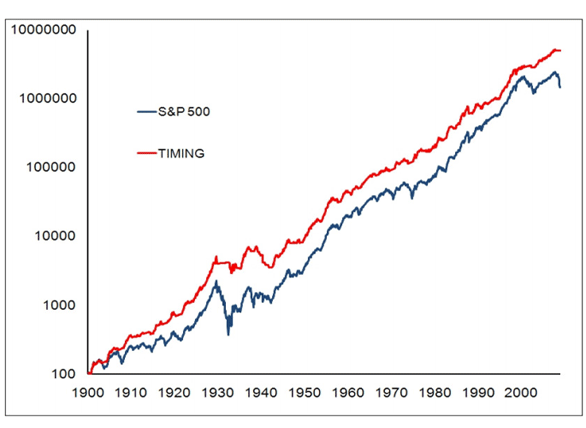
Is it possible to achieve these results? Many people think that market timing systems don’t work, and for the most part they are right. The markets are always changing, and it is very easy to create a system that works today but will fail tomorrow. One of the most important factors in a trading system is the time frame. Daily and intra-day price movement tends to be noisy. When systems are created from this noisy data, they tend to be curve fitted and perform poorly in actual trading. Faber’s system overcomes this formidable hurdle by using monthly data. Monthly data tends to be much smoother. The trends are clear and there is less noise. In addition, the system uses ETF’s for entire market segments, which also tend to be much smoother than individual stocks or commodities. And there is more good news. Not only is the system detailed in the book, but Faber has been kind enough to release her paper on the internet. You can download it: A Quantitative Approach to Tactical Asset Allocation. It is interesting to note that the biggest challenge for a trend following system is whipsaws: sometimes the market moves back and forth without moving significantly in any direction. There are several factors that make this unlikely in the next few years. As markets become more connected, movements tend to be more global and well defined. Another important factor is that people are becoming aware of the massive debt that the U.S. government has racked up. The changes needed to solve this problem will almost certainly cause violent movements in the markets. By reading the paper above, you can get a good idea of the value of The Ivy Portfolio book. Faber’s style is clear, and the content is incredibly useful. The above graph shows a timing model that uses only one asset: the S&P 500. In the book, Faber goes on to describe several variations to this simple system. The one that I found most interesting is called the “Top 2 Rotation Strategy”. It has a backtested annual return of 16% and volatility of 12%. The Sharpe ratio is 0.84. Although backtested results normally do not mean anything, I think that this system has some merit. This is mostly due to that fact that the system uses monthly ETF data, and uses a relative strength approach to dynamic asset allocation. I will be do research into this in the near future, and keep you updated. |
|
| ( 知識學習|商業管理 ) |

 book, and how the Yale and Harvard endowments make consistent high returns. We can get good returns through asset allocation, but the book also describes a very powerful and consistent market timing system. I was really impressed with the simplicity and power of the system, and that will be the subject of today’s post.