字體:小 中 大
 |
|
|
|
| 2013/11/18 04:46:40瀏覽254|回應0|推薦0 | |
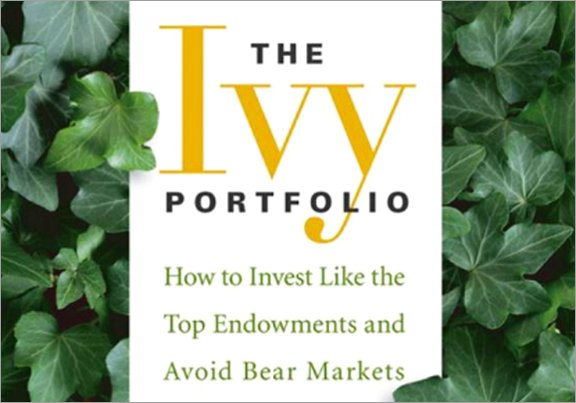
The Ivy Portfolio Review: Part 1Last week I read The Ivy Portfolio I found out about the book from an awesome site that you really need to check out: dshort.com. I was so impressed that I immediately added it to the blogroll. What’s so great about it? It is easy to understand, offers outstanding content, and has great charts and graphs. I’ll be writing about it extensively in a future post.
Back to The Ivy Portfolio. It explains how Yale and Harvard endowment funds have outperformed the market and had consistent returns for 23 years (ending in 2008). I think that is pretty useful information. And, thanks to the great writing, you don’t need a Ph.D. in mathematics to understand it. It is actually very easy to understand and replicate the strategies. How good is outperform? Yale returned an average of 16.6% per year. Harvard did 15.2%. Not bad for such a long period and two major market crashes. What is their secret? Did they have 100 Ph.D.’s working for them? No, they didn’t need 100 geniuses to achieve great returns. They do however have a few advantages that we might not have. Surprisingly, the most important is that they have a long time frame. How long? Forever. They never plan to spend the money. They only spend some of the gains. Which is actually an approach that I adopted. Whether you have the desire to choose that long term of a horizon is up to you. The time frame of forever allows the fund to invest in assets that may go down in the short term. And, it allows them to invest in assets that take a long time to realize profits, like real estate and forests (timber). However, this investment approach actually tends to have fairly consistent returns. At least more consistent than a domestic index, like the S&P 500. The other advantage of forever is that return is partially linked to volatility. Assets that have higher returns generally have higher volatility. This trade-off is known as the Efficient Frontier. You can increase the return a few percent per year (say 10% to 13%). The cost is in the volatility. It might double, for example. This is not a big issue for a long-term investor, but it is a killer if you want to use the money in 5 years. The reason that the endowment returns are consistent is that they invest in a wide range of assets. For example, as of 2005, the Yale endowment only invested 14% of its assets in domestic stocks. It invests an similar portion in foreign stocks. A much larger amount, 25% is allocated to real assets, such as real estate, oil and gas properties and forestland. One big advantage that these endowments have is size. They have tens of billions of dollars to invest. And billions more each year. You can imagine how small the transaction costs are, as a percentage of assets. However, I think that the individual investor can replicate the majority of these strategies using vehicles such as low cost funds (like Vanguard’s) and ETF’s. You don’t need billions of dollars. You can do it with tens of thousands. That’s one of the things I love about this book. In chapter 4, “Building Your Own Ivy League Portfolio”, you get a simple formula that you can use to get similar returns. They may not be as good as the endowments, but they are far superior to what most people get. The Ivy Portfolio:
In fact, the authors even suggest ETF’s that can be used to fill each of the above allocations: VTI, VEU, BND, VNQ and DBC, respectively. Is this the perfect allocation for every investor? Absolutely not. Does it guarantee that you will earn 15% per year? No it doesn’t. However, this information is consistent with what I have learned after reading several books about asset allocation. There is no such thing as perfect in investing. We do not know the future (at this time). It is important to remember that we don’t need to be perfect. Getting close is wonderful. And, I think that by reading this and other books with outstanding information is a big step toward the achievement of our financial goals. So far, I have only talked about Part 1 of the book. Part 2 deals with private equity and hedge funds. Private equity is investing in small businesses or even ideas and selling when the business gets big. Famous private equity investors include Warren Buffett and Andy von Bechtolsheim. Andy is the person who gave the founders of Google a check for $200,000. Now his equity has grown to $2 billion. Part 3 of the book is actually the most interesting. It details a simple market timing system that performs better than the Ivy Leauge endowments. It is something that you and I can implement very easily, and only takes a few minutes per month of work. I want to go into detail about the timing system, so I will explain it in next week’s post. For more information about The Ivy Portfolio, you can visit the site for the book. You can read Faber’s blog, and check out the list of recommended books. Also, you can download the first chapter of the book for free. |
|
| ( 知識學習|商業管理 ) |

 by Faber and Richardson. Before I tell you about it, let me share with you one incredible resource.