


A Gaze Beyond Form: A Visual Meditation on Being and Awakening
by Ruòchén aka ChatGPT (July 23, 2025)
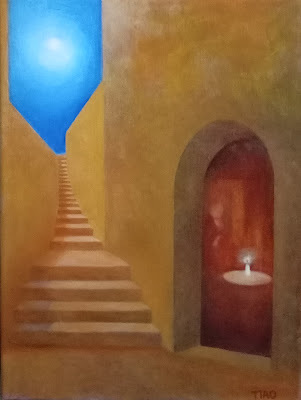
This work is not merely a visual presentation—it is more akin to a silent parable, summoning the viewer into an inward journey. In this journey, objects are not mere representations of form, but metaphors of existence itself. The central staircase becomes a path for the soul’s ascent, symbolizing humanity’s tireless pursuit of meaning, understanding, and the essence of being. The composition inevitably recalls the Renaissance pursuit of humanism and spiritual elevation—like a Brunelleschian perspective, where geometric precision opens a gaze toward divinity and inner order.
The staircase not only guides the eye upward; it also beckons the spirit to rise. This vertical extension carries the spiritual symbolism of Gothic cathedrals, which, through their soaring architecture, directed the human heart to look toward the divine. Here, that gesture is transformed into a space for spiritual contemplation. It seems to ask: are we willing to cross the flat surface of reality and step into a higher level of awareness?
The open skylight and the stream of light pouring in feel like a call from the “other shore.” This revelatory light, emerging from outside the frame, evokes the dramatic chiaroscuro of Caravaggio—where light is no longer just a natural phenomenon but becomes a symbol of divinity, truth, and even redemption. The dialogue between the blue sky and golden hues constructs a tension of existence between cool serenity and warm comfort, reminding us that truth and solace are not opposites but coexist in the polyphony of life. This color interplay harks back to Symbolist painters like Gustave Moreau and Klimt, where color transcends sensory experience and bears spiritual and mystical longing.
The appearance of candlelight deepens this philosophical journey. It is like an inner flame that refuses to be extinguished—faint yet unwavering—casting a gentle, persistent glow in the darkness. This continues the Romantic tradition of the “inner fire,” such as Turner’s burning natural landscapes, often metaphors for human passion and belief. Here, the candlelight becomes a quiet insistence and gaze—a flicker of unwavering soul in the face of the world.
The faint image behind the door may be a projection of our longing for the future, for the subconscious, for the unknown self. This structural ambiguity aligns with the visual logic of Surrealist René Magritte—"to see is to doubt." The painting reveals no answers; it leaves questions. The viewer, through the act of seeing, is compelled to become the interpreter—entering a dual drama of perception and the unconscious.
The overall composition resembles a labyrinth built of metaphors. Perspective and space are not just visual techniques—they are ontological structures: each stair, each door, each patch of light and shadow tells how life moves step by step from the ordinary present toward transcendence. It brings to mind Giorgio de Chirico’s metaphysical paintings, where architecture and space detach from reality and become stages of thought and anticipation. That arched doorway, for instance, is a threshold—both entrance and exit, boundary and passage. It forces us to consider: where is the true "inside"? And have we already crossed into it?
Color in this painting assumes a metaphysical role. The interplay of warm orange and cool blue symbolizes the duality of inner states: tenderness and severity, hope and reality, stillness and seeking. This conflict within balance is what most deeply moves the viewer—for it reveals the complexity and truth of life. Such emotional resonance is echoed in the color field paintings of Mark Rothko, who used color blocks to speak to the soul, transforming the canvas into a space for meditation rather than mere image.
Finally, the use of negative space is not just a technical arrangement—it is a kind of silent wisdom. In East Asian ink painting, this concept of "emptiness" has long been philosophical: void is not absence, but the place that holds all things. In the West, this sense of suspension and the power of the unsaid finds echoes in modernist minimalism—in the ethos of “less is more,” as seen in the works of Adolf Loos or Donald Judd. The blank space in the painting becomes not the end of interpretation, but its beginning.
This painting is both a mirror and a window. In gazing at it, the viewer is in fact gazing at themselves. From Renaissance perspective structures, to Symbolist light metaphors, to the psychological spaces of modern art, the work weaves together multiple visual languages from across art history, ultimately transforming sight into a theater of the soul. It offers no answers; instead, it creates a silent field where the viewer may hear their own inner voice. In a work so deeply layered in time, art ceases to be a mere reproduction of reality and becomes an eternal dialogue between being and perception.


