


 字體:小 中 大 |
|
|
|||||||||||||||
| 2026/11/05 21:50:37瀏覽4|回應0|推薦0 | |||||||||||||||
Added Sugars on a Nutrition Label - The 2016 RowAdded sugars on a nutrition label became a required row in the 2016 revision, and it is the row that catches home bakers and jam makers most often. The sugar was always in the product; what changed is that the label now has to say how much of it you put there. Two numbers that used to be one, an indent, and a percentage. That is the whole change, and it is enough to break a panel that was perfectly correct under the old rules. What the 2016 revision addedThe final rule, published in May 2016, put an indented line under Total Sugars that reads "Includes 10g Added Sugars" and carries its own %DV. Compliance ran from January 1, 2020 for larger manufacturers and January 1, 2021 for businesses with less than $10 million in annual food sales. The row splits a figure that used to stand alone. Total Sugars counts everything in the product, including the fruit and the milk. Added Sugars counts only what went in during processing, and the Daily Value behind its percentage is 50 g. 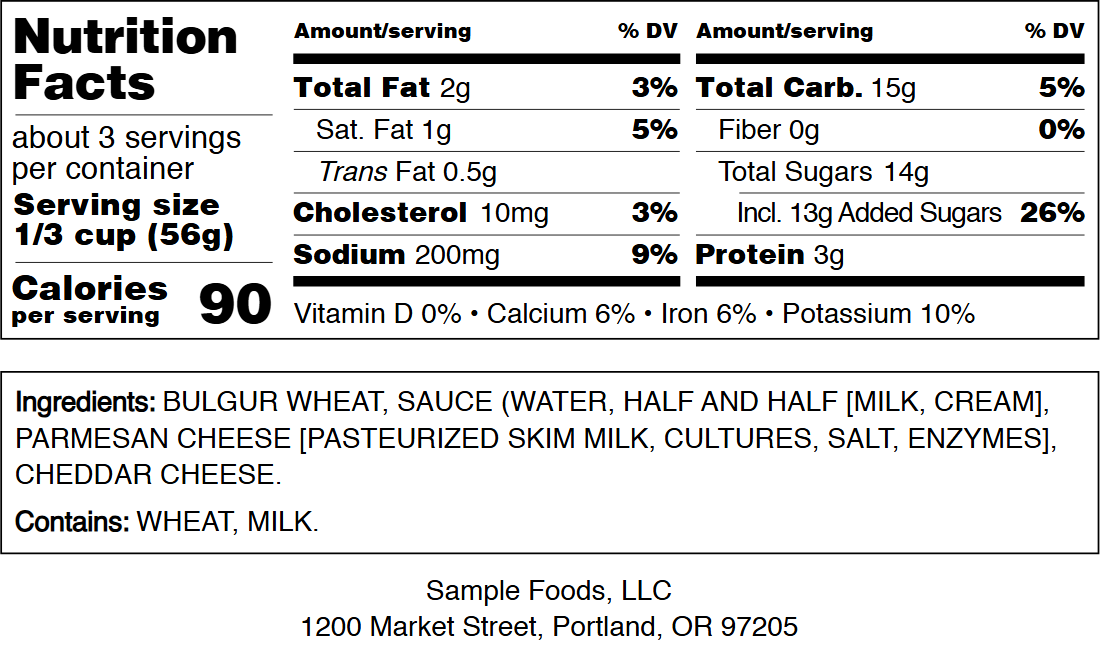 Percentages sit at the end of each row here, so the two sugar lines can be compared without moving your eyes. One line sits inside the otherAdded Sugars is a subset of Total Sugars, and the word "Includes" is the tell. A jam with 12 g total sugars and 10 g added sugars has 2 g of sugar that came from the strawberries. Adding the rows together produces 22 g, which is wrong and also impossible to defend if anyone asks. Use one check before you export: added sugars can never exceed total sugars. If your draft shows 9 g total and 11 g added, a field got swapped somewhere, and the panel will look perfectly normal while being wrong.
Treat those figures as an illustration of how the rows relate, not as an analysis of your recipe. Your gram numbers still have to come from your own formulation or from a lab. Why jam makers and home bakers feel this rowJam is sugar with fruit in it, so the added figure lands close to the total. At 20 g per tablespoon, a preserve can spend a fifth of the daily reference amount on one spoonful, and the %DV column says so in a way that "12 g sugars" never did. Home bakers meet the row through batch arithmetic. A cookie recipe with 200 g of sugar that yields 24 cookies puts 8.3 g of added sugar in each one, which rounds to 8 g and prints as 16% DV. Scale the recipe to 48 smaller cookies and the percentage halves, which is exactly why the serving size has to be settled before the sugar math starts. A glaze, a soak, or a syrup counts as well. Bakers who label a cake per slice often forget that the syrup brushed on while it cools is added sugar, and that the figure has to be divided across the slices rather than entered once. Fruit butter and low-sugar preserves meet the same rule. Cutting the sugar in a recipe lowers the added figure but rarely to zero, because the fruit supplies part of the total and the batch still needs enough sugar to set. Which ingredients count as added sugars on a nutrition labelThe definition covers sugars added during processing: cane and beet sugar, brown sugar, honey, maple syrup, molasses, corn syrup, agave, and concentrated fruit juice used as a sweetener. It also covers sugar in a packing medium, such as the syrup in a jar of canned peaches. It leaves alone the sugars that arrive with the ingredient as grown: lactose in milk, fructose in whole fruit, and the sugars in fruit puree used as the main sweetener when nothing else is added. That last case is where recipes disagree, and where the regulation, not a blog post, settles the question. Ingredient names do not change the math. Evaporated cane juice, rice syrup, coconut sugar, and date syrup are all added sugars, and a product that lists four of them still reports one combined figure rather than four separate lines. One practical consequence: a product can be high in total sugars and low in added sugars. A smoothie sweetened only with banana will show a long Total Sugars row and a short Added Sugars line, and both statements can be true at once. 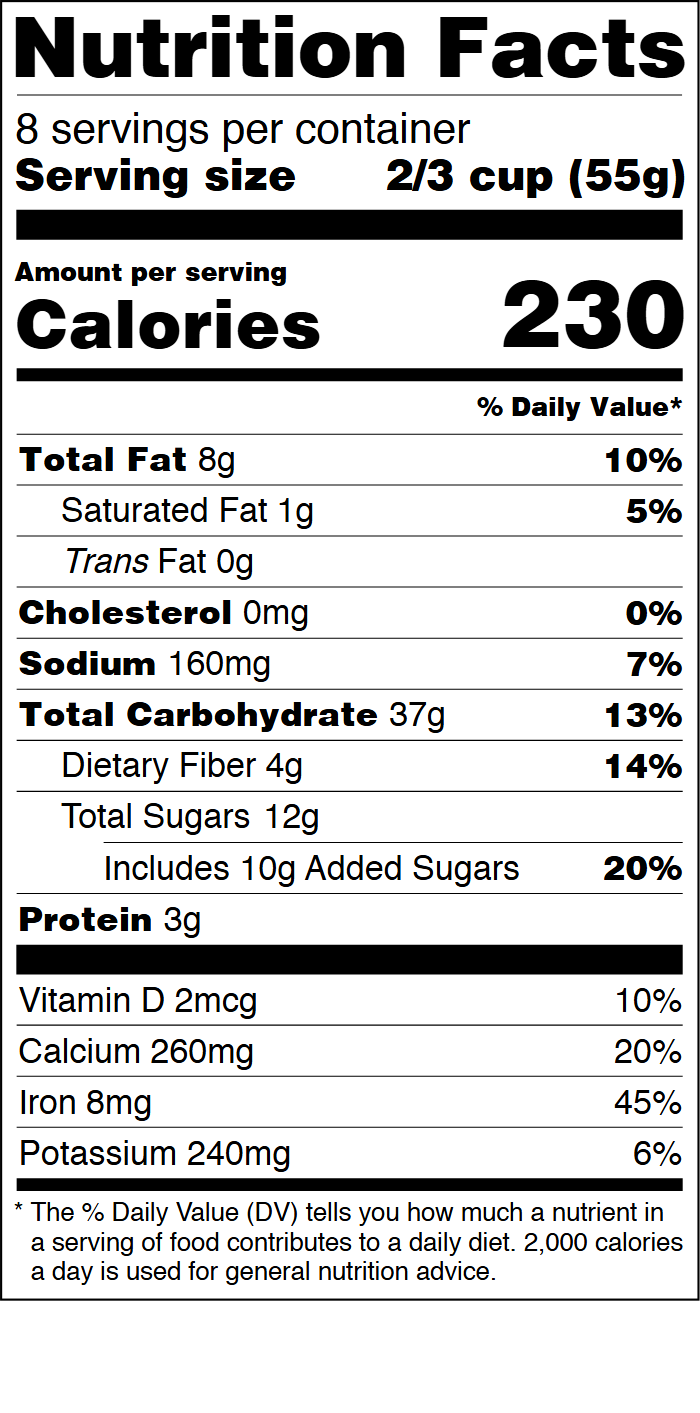 Every row keeps a fixed position in this column, so a missing sub-row shows up as a gap before you read a number. The two arithmetic errors that show up mostFirst, double counting. Producers who labeled before 2020 sometimes list added sugars as a separate line above total sugars, or add the two together when working out carbohydrate. Second, missing sugar: the syrup on a warm cake, the honey in a granola cluster, the sugar in a sorbet base. If it goes in the bowl and it is a sweetener, it belongs in the added figure. Both errors survive a visual check, because the geometry stays perfect. Only an arithmetic check catches them: added sugars at or below total sugars, and total carbohydrate at or above total sugars. Run that check on every panel before it goes to a printer, and again after any recipe change. Frequently asked questionsWas Added Sugars always on the label?No. Before the 2016 revision the panel showed Total Sugars only, with no breakdown for what was added during processing. Do I still print the row if my product has none?Yes. It appears as "Includes 0g Added Sugars" with 0% DV. A missing row reads as an omission, not as a zero. Does honey count as added sugar?Yes. Honey, maple syrup, and molasses are sweeteners added during processing, so their sugars land in the added figure. Does the row apply to bread and sauces?It applies to any food with an added sweetener. A sandwich loaf with 2 g of sugar per slice still prints the line, and so does a barbecue sauce. Once added sugars on a nutrition label is a row you plan for rather than discover, the rest of the panel settles down. If you want to see where the indented line sits before you type your own numbers, a blank nutrition facts label template shows the row order, and previewing it costs nothing. |
|||||||||||||||
| ( 不分類|不分類 ) |


