字體:小 中 大 |
|
|
|
| 2015/12/27 14:06:11瀏覽300|回應0|推薦0 | |
|
西洋文學概論Week12 The content of the course 1.vocabulary
-ics 框限起來有範疇的學問 For example: mathematics
Assemble: 1. To bring or call together into a group or whole. 2. To fit together the parts or pieces of.
Turmoil: (n.) A state of extreme confusion or agitation. Purgation: the act of purging. Exile: expulsion from one's native land by authoritative decree. Enchantress: a magician, sorcerer, enchanter, wizard; sometimes called an enchantress, sorceress, or witch if female. Infidelity /ˌɪnfɪˈdɛlɪtɪ / noun (pl) -ties 1. lack of faith or constancy, esp sexual faithfulness 2. lack of religious faith; disbelief 3. an act or instance of disloyalty
Contra- word-forming element meaning "against, in opposition," from Latin adverb and preposition contra "against" For example: controversy (Old French controversie or directly from Latin controversia, from controversus "turned in an opposite direction, disputed, turned against," from contra- "against")
Catharsis: it is the purification and purgation of emotions—especially pity and fear—through art or any extreme change in emotion that results in renewal and restoration. It is a metaphor originally used by Aristotle in the Poetics, comparing the effects of tragedy on the mind of spectator to the effect of a cathartic on the body. Catharsis is a term in dramatic art that describes the effect of tragedy (or comedy and quite possibly other artistic forms) principally on the audience (although some have speculated on characters in the drama as well).
2.deus ex machina (Latin) ➔textbook p.607 Deus ex machina is a Latin calque from Greek, meaning "god from the machine". The term has evolved to mean a plot device whereby a seemingly unsolvable problem is suddenly and abruptly resolved by the contrived and unexpected intervention of some new event, character, ability or object. Depending on how it is done, it can be intended to move the story forward when the writer has "painted himself into a corner" and sees no other way out, to surprise the audience, to bring the tale to a happy ending, or as a comedic device.
Origin of the expression The term was coined from the conventions of Greek tragedy, where a machine is used to bring actors playing gods onto the stage. The machine could be either a crane (mechane) used to lower actors from above or a riser that brought actors up through a trapdoor. Preparation to pick up the actors was done behind the skene. The idea was introduced by Aeschylus and was used often to resolve the conflict and conclude the drama. Although the device is associated mostly with Greek tragedy, it also appeared in comedies.
3.introduction
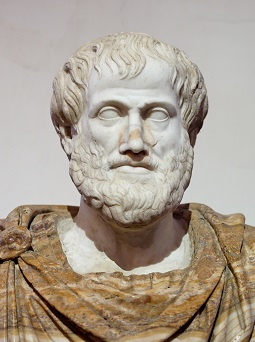
Aristotle
Aristotle was a Greek philosopher and scientist born in the city of Stagira, Chalkidice, on the northern periphery of Classical Greece. At eighteen, he joined Plato's Academy in Athens and remained there until the age of thirty-seven (c. 347 BC). His writings cover many subjects – including physics, biology, zoology, metaphysics, logic, ethics, aesthetics, poetry, theater, music, rhetoric, linguistics, politics and government – and constitute the first comprehensive system of Western philosophy. Shortly after Plato died, Aristotle left Athens and, at the request of Philip of Macedon, tutored Alexander the Great starting from 343 BC. Teaching Alexander the Great gave Aristotle many opportunities and an abundance of supplies. He established a library in the Lyceum which aided in the production of many of his hundreds of books. The fact that Aristotle was a pupil of Plato contributed to his former views of Platonism, but, following Plato's death, Aristotle immersed himself in empirical studies and shifted from Platonism to empiricism. He believed all peoples' concepts and all of their knowledge was ultimately based on perception. Aristotle's views on natural sciences represent the groundwork underlying many of his works.
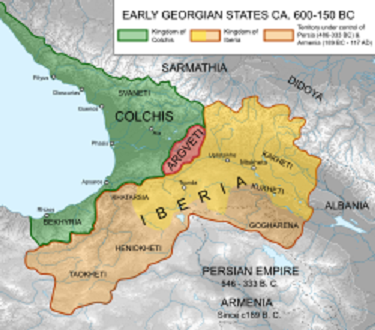
Colchis➔textbook p.745
Colchis was located on the eastern coast of the Black Sea, centered on present-day western Georgia. Around the 1st centuries BC and AD the land south of the Greater Caucasus and north of the Lesser Caucasus was divided between Kolchis in the west, Caucasian Iberia in the center and Caucasian Albania in the east. To the southwest was Armenia and to the southeast Atropatene.
In Greek mythology, Colchis was the home of Aeëtes, Medea, Golden Fleece, fire-breathing bulls Khalkotauroi and the destination of the Argonauts. According to the Greek mythology, Colchis was a fabulously wealthy land situated on the mysterious periphery of the heroic world. Here in the sacred grove of the war god Ares, King Aeëtes hung the Golden Fleece until it was seized by Jason and the Argonauts. Colchis was also the land where the mythological Prometheus was punished by being chained to a mountain while an eagle ate at his liver for revealing to humanity the secret of fire. Amazons also were said to be of Scythian origin from Colchis.
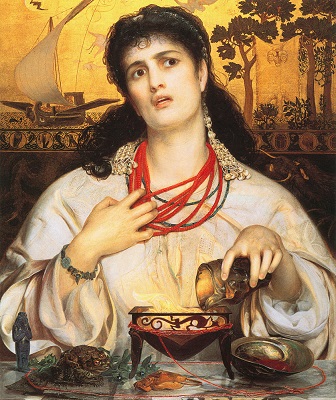
Medea
In Greek mythology, Medea is a sorceress who was the daughter of King Aeëtes of Colchis, niece of Circe, granddaughter of the sun god Helios, and later wife to the hero Jason, with whom she had two children, Mermeros and Pheres. In Euripides's play Medea, Jason leaves Medea when Creon, king of Corinth, offers him his daughter, Glauce. The play tells of Medea avenging her husband's betrayal by killing their children.
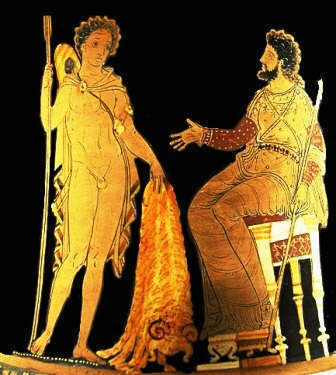
Golden Fleece
In Greek mythology, the Golden Fleece is the fleece of the gold-hair winged ram, which was held in Colchis.The fleece is a symbol of authority and kingship. It figures in the tale of the hero Jason and his band of Argonauts, who set out on a quest for the fleece by order of King Pelias, in order to place Jason rightfully on the throne of Iolcus in Thessaly. Through the help of Medea, they acquire the Golden Fleece. The story is of great antiquity and was current in the time of Homer (eighth century BC). It survives in various forms, among which the details vary.
Jason and Medea(連結)
3. Fido dido
Fido Dido /ˈfaɪdoʊ ˈdaɪdoʊ/ is a cartoon character created by Joanna Ferrone and Sue Rose. They later stenciled Fido on T-shirts with the credo: "Fido is for Fido, Fido is against no one". These T-shirts became very popular in New York. Fido Dido was licensed to PepsiCo in 1987, but the character did not receive much attention or popularity until the early 1990s, when he appeared on numerous products, particularly stationery. Later, he was replaced with Cool Spot as the brand mascot.
Reference website: Fido dido https://www.bing.com/images/search?q=++Fido+Dido&view=detailv2&&id=715CEAEE2856 B87CD0C3B86388E32508078AFBCB&selectedIndex=1&ccid=T95f3adz&simid=607998891 260118409&thid=OIP.M4fde5fdda77349e63008c616afc8c0b1H0&ajaxhist=0 Aristotle https://www.bing.com/images/search?q=++Aristotle&view=detailv2&&id=726701ADB62FB 1D16D14333CF306D74F78E05942&selectedIndex=0&ccid=L%2bjSSKNw&simid=6080194 94223350009&thid=OIP.M2fe8d248a3709723c8c5f850199f95eco0&ajaxhist=0 Colchis https://www.bing.com/images/search?q=Colchis&view=detailv2&&id=4AC0AD2D057FE2D 3912853FFF640BEA7BCEECAF3&selectedIndex=5&ccid=qFgwv3Dn&simid=608036863072 667371&thid=OIP.Ma85830bf70e7048740e30443f6b2c2ddH0&ajaxhist=0 Medea https://www.bing.com/images/search?q=Medea&view=detailv2&&id=FBC42764DEC5DE 1E833ECD12A5A1D084986993D3&selectedIndex=1&ccid=gg0RaVmM&simid=6080561 64653729829&thid=OIP.M820d1169598c185145a28d4737080992H2&ajaxhist=0 Golden Fleece https://www.bing.com/images/search?q=Golden+Fleece&view=detailv2&&id=9D174927EB1 09C792583E2392D65DBE37B6FEB72&selectedIndex=52&ccid=vkkQrWNK&simid=608052 088731468963&thid=OIP.Mbe4910ad634a997a9e67732e9782ebd2H0&ajaxhist=0 |
|
| ( 知識學習|隨堂筆記 ) |