字體:小 中 大 |
|
|
|
| 2015/06/20 01:06:40瀏覽136|回應0|推薦0 | |
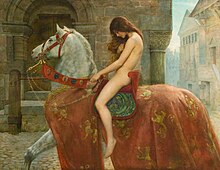
一.延伸補充 1.Lady Godiva Godiva (1040–1067), known as Lady Godiva, was an 11th-century Anglo-Saxon noblewoman who, according to a legend dating back at least to the 13th century, rode naked – only covered in her long hair – through the streets ofCoventry in order to gain a remission of the oppressive taxation imposed by her husband on his tenants. The name "Peeping Tom" for avoyeur originates from later versions of this legend in which a man named Tom had watched her ride and was struck blind or dead.
目的是為了使全成的人民都免稅 2.Peeping Tom The story of "Peeping Tom", who alone among the townsfolk spied on the Lady Godiva's naked ride, probably did not originate in literature, but came about through popular lore in the locality of Coventry. Reference by 17th-century chroniclers has been claimed, but all the published accounts are 18th-century or later.
3.Allegory-As a literary device, an allegory in its most general sense is an extended metaphor. Allegory has been used widely throughout the histories of all forms of art, largely because it readily illustrates complex ideas and concepts in ways that are comprehensible to its viewers, readers, or listeners. 4.Parable-A parable is a succinct, didactic story, in prose or verse, which illustrates one or more instructive lessons or principles. It differs from afable in that fables employ animals, plants, inanimate objects, or forces of nature as characters, whereas parables have human characters. A parable is a type of analogy. 5.Faith and rationality-Faith and rationality are two ideologies that exist in varying degrees of conflict or compatibility. Rationality is based on reason or facts. Faith is belief in inspiration, revelation, orauthority. The word faith usually refers to a belief that is held with lack of, in spite of or against reason or evidence, while another position holds that it can refer to belief based upon a degree of evidential warrant. 6.Utopia(烏托邦)-An utopia (/juːˈtoʊpiə/ yoo-toh-pee-ə) is a community or society possessing highly desirable or near perfect qualities. The word was coined by Sir Thomas More in Greek for his 1516 book Utopia (in Latin), describing a fictional island society in the Atlantic Ocean. The term has been used to describe both intentional communities that attempt to create an ideal society, and imagined societies portrayed in fiction. It has spawned other concepts, most prominently dystopia. 7.Dystopia(反烏托邦)-A dystopia alternatively, cacotopia,kakotopia, or simply anti-utopia) is an imaginary community or society that is undesirable or frightening.It is literally translated as "not-good place", an antonym of utopia. Such societies appear in many artistic works, particularly in stories set in a future. Dystopias are often characterized by dehumanization,totalitarian governments, environmental disaster,or other characteristics associated with a cataclysmic decline in society. Dystopian societies appear in many subgenres of fiction and are often used to draw attention to real-world issues regarding society, environment, politics, economics, religion, psychology,ethics, science, and/or technology, which if unaddressed could potentially lead to such a dystopia-like condition. |
|
| ( 知識學習|隨堂筆記 ) |