字體:小 中 大
 |
|
|
|
| 2015/04/22 12:42:27瀏覽198|回應0|推薦0 | |
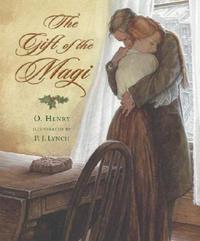
● The Gift of Magi "The Gift of the Magi" is a short story, written by O. Henry (a pen name for William Sydney Porter), about a young married couple and how they deal with the challenge of buying secret Christmas gifts for each other with very little money. As a sentimental story with a moral lesson about gift-giving, it has been a popular one for adaptation, especially for presentation at Christmas time. The plot and its "twist ending" are well-known, and the ending is generally considered an example of comic irony. Summary/
On Christmas Eve, with only $1.87 in hand, and desperate to find a gift for Jim, Della sells her hair for $20 to a nearby hairdresser named Madame Sofronie, and eventually finds a platinum pocket watch fob chain for Jim's watch for $21. Satisfied with the perfect gift for Jim, Della runs home and begins to prepare pork chops for dinner. At 7 o'clock, Della sits at a table near the door, waiting for Jim to come home. Unusually late, Jim walks in and immediately stops short at the sight of Della, who had previously prayed that she was still pretty to Jim. Della then admits to Jim that she sold her hair to buy him his present. Jim gives Della her present – an assortment of expensive hair accessories (referred to as “The Combs”), useless now that her hair is short. Della then shows Jim the chain she bought for him, to which Jim says he sold his watch to get the money to buy her combs. Although Jim and Della are now left with gifts that neither one can use, they realize how far they are willing to go to show their love for each other, and how priceless their love really is. Author/
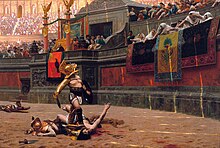
O. Henry's stories frequently have surprise endings. In his day, he was called the American answer to Guy de Maupassant. While both authors wrote plot twist endings, O. Henry stories were considerably more playful. His stories are also known for witty narration. Most of O. Henry's stories are set in his own time, the early 20th century. Many take place in New York City and deal for the most part with ordinary people: clerks, policemen, waitresses, etc. O. Henry's work is wide-ranging, and his characters can be found roaming the cattle-lands of Texas, exploring the art of the con-man, or investigating the tensions of class and wealth in turn-of-the-century New York. O. Henry had an inimitable hand for isolating some element of society and describing it with an incredible economy and grace of language. Some of his best and least-known work is contained in Cabbages and Kings, a series of stories each of which explores some individual aspect of life in a paralytically sleepy Central American town, while advancing some aspect of the larger plot and relating back one to another. . ● Colosseum The Colosseum or Coliseum, also known as the Flavian Amphitheatre (Latin: Amphitheatrum Flavium; Italian: Anfiteatro Flavio or Colosseo) is an elliptical amphitheatre in the centre of the city of Rome, Italy. Built of concrete and stone, it is the largest amphitheatre in the world, and is considered one of the greatest works of architecture and engineering. The Colosseum was used to host gladiatorial shows as well as a variety of other events. Another popular type of show was the animal hunt, or venatio.
. ● William Blake
. ● Vocabulary 1. portrary (verb) to show or describe someone or something in a particular way 1. portrait (noun) a painting, drawing, or photograph of someone,especially of their face only 2. dia- : go through e.g., diagnostic, diameter, diachronic 3. mor- : mortal, death e.g., mortal, immortal, mortality, mortician, mortuary
Memento Mori(Latin) means "Remember that you must die" 4. man- : hand, make, do e.g, manual, manage, manufacture 5. op- /ob- : toward, against, in the way e.g., oppose, occur, offer, obtain 6. plot (noun) LITERATURE a series of related eventsthat make up the main story in a book, film etc. (verb) to make a secret plan with other people todo something bad 6. frame (noun) a structure that forms a border for a picture or mirrorand holds it in place (verb) to make someone seem guilty of a crime when they are not,for example by lying to the police or by producing false evidence 7. rival a person, team, or business that competes with another e.g, Manchester United beat their rivals 3–1. 7. enemy someone who is opposed to someone else and tries to do them harm e.g., He must hide from his enemies while he is weak. A rival is just someone you compete against in a sport or a game. They can be a friend outside of (even during) the competition. An enemy is someone you want to see completely destroyed. You would never see them as a friend in any situation. 7. Keep your friend close and keep your enemy closer 8. illustrate (v.) /ˈɪləstreɪt/ to show what something is like, or to show that something is true e.g., The following examples illustrate our approach to customer service. to show something by using pictures, diagrams, lists of numbersetc e.g., The process is illustrated in Figure 4.6. 9. souvenir (n.) /ˌsuːvəˈnɪə(r)/ something that you buy during a holiday or at a special event to remindyou later of being there e.g., She kept the tickets as a souvenir of the evening. 10. engage (v.) /ɪnˈɡeɪdʒ/ to attract and keep someone’s interest orattention e.g., A good radio script should be able to engage the listener. to start to employ someone or use their services e.g., The company is to engage a new sales director. . ● Rome's Famous Sites Trevi Fountain
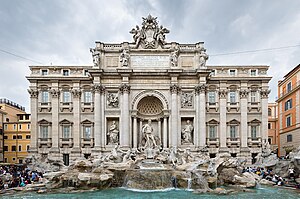
The Trevi Fountain is a fountain in the Trevi district in Rome, Italy, designed by Italian architect Nicola Salvi and completed by Pietro Bracci. Standing 26.3 metres (86 ft) high and 49.15 metres (161.3 ft) wide, it is the largest Baroque fountain in the city and one of the most famous fountains in the world. The fountain has appeared in several notable films, including Federico Fellini's La Dolce Vita, and is a popular tourist attraction. Piazza Navona
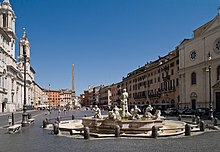
Piazza Navona is a city square in Rome, Italy. It is built on the site of the Stadium of Domitian, built in 1st century AD, and follows the form of the open space of the stadium. The ancient Romans came there to watch the agones ("games"), and hence it was known as "Circus Agonalis" ("competition arena"). It is believed that over time the name changed to in avone to navone and eventually to navona. Pantheon
It is one of the best-preserved of all Ancient Roman buildings. It has been in continuous use throughout its history, and since the 7th century, the Pantheon has been used as a church dedicated to "St. Mary and the Martyrs" (Latin: Santa Maria ad Martyres) but informally known as "Santa Maria Rotonda". The square in front of the Pantheon is called Piazza della Rotonda. Roman Forum
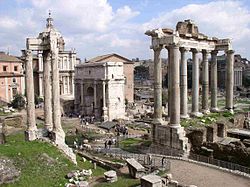
The Roman Forum (Latin: Forum Romanum, Italian: Foro Romano) is a rectangular forum (plaza) surrounded by the ruins of several important ancient government buildings at the center of the city of Rome. Citizens of the ancient city referred to this space, originally a marketplace, as the Forum Magnum, or simply the Forum. Colosseum
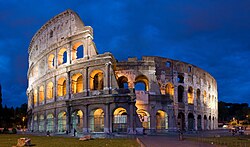
The Colosseum or Coliseum, also known as the Flavian Amphitheatre (Latin: Amphitheatrum Flavium; Italian: Anfiteatro Flavio or Colosseo) is an elliptical amphitheatre in the centre of the city of Rome, Italy. Built of concrete and stone, it is the largest amphitheatre in the world, and is considered one of the greatest works of architecture and engineering. . ● Grendel (novel)
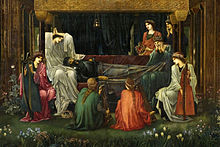
Grendel has become one of Gardner's best known and reviewed works. Several editions of the novel contain pen and ink line drawings of Grendel's head, by Emil Antonucci. Ten years after publication, the novel was adapted into the 1981 animated movie Grendel Grendel Grendel. . Author/ John Champlin Gardner Jr. (July 21, 1933 – September 14, 1982) was an American novelist, essayist, literary critic and university professor. He is perhaps most noted for his novel Grendel, a retelling of the Beowulf myth from the monster's point of view. Beowulf/
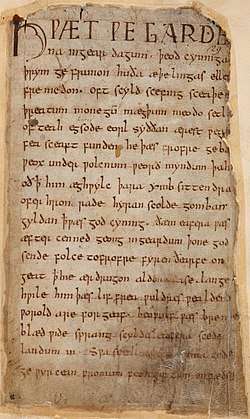
The poem is set in Scandinavia. Beowulf, a hero of the Geats, comes to the aid of Hroðgar, the king of the Danes, whose mead hall in Heorot has been under attack by a monster known as Grendel. After Beowulf slays him, Grendel's mother attacks the hall and is then also defeated. Victorious, Beowulf goes home to Geatland (Götaland in modern Sweden) and later becomes king of the Geats. After a period of fifty years has passed, Beowulf defeats a dragon, but is fatally wounded in the battle. After his death, his attendants bury him in a tumulus, a burial mound, in Geatland. The full poem survives in the manuscript known as the Nowell Codex, located in the British Library. It has no title in the original manuscript, but has become known by the name of the story's protagonist. In 1731, the manuscript was badly damaged by a fire that swept through Ashburnham House in London that had a collection of medieval manuscripts assembled by Sir Robert Bruce Cotton. The poem was not studied until the end of the 18th century, and not published in its entirety until Johan Bülow funded the 1815 Latin translation, prepared by the Icelandic-Danish scholar Grímur Jónsson Thorkelin. After a heated debate with Thorkelin, Bülow offered to support a new translation into Danish by N. F. S. Grundtvig. The result, Bjovulfs Drape (1820), was the first modern language translation of Beowulf. . ● Angry Young Man (憤青) The "angry young men" were a group of mostly working and middle class British playwrights and novelists who became prominent in the 1950s. The group's leading members included John Osborne and Kingsley Amis. The phrase was originally coined by the Royal Court Theatre's press officer to promote John Osborne's 1956 play Look Back in Anger. It is thought to be derived from the autobiography of Leslie Paul, founder of the Woodcraft Folk, whose Angry Young Man was published in 1951. Following the success of the Osborne play, the label "angry young men" was later applied by British media to describe young writers who were characterised by a disillusionment with traditional British society. The term, always imprecise, began to have less meaning over the years as the writers to whom it was originally applied became more divergent, and many of them dismissed the label as useless. Lord of the Flies
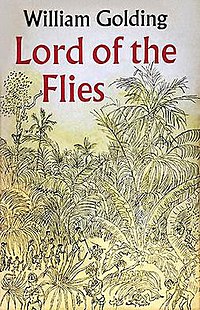
Lord of the Flies is a 1954 dystopian novel by Nobel Prize-winning English author William Golding about a group of British boys stuck on an uninhabited island who try to govern themselves with disastrous results. Its stances on the already controversial subjects of human nature and individual welfare versus the common good earned it position 68 on the American Library Association’s list of the 100 most frequently challenged books of 1990–1999. The novel is a reaction to the youth novel The Coral Island by R. M. Ballantyne. The Catcher in the Rye
The Catcher in the Rye is a 1951 novel by J. D. Salinger. A controversial novel originally published for adults, it has since become popular with adolescent readers for its themes of teenage angst and alienation. It has been translated into almost all of the world's major languages. Around 250,000 copies are sold each year with total sales of more than 65 million books. The novel's protagonist Holden Caulfield has become an icon for teenage rebellion. The novel also deals with complex issues of identity, belonging, loss, connection, and alienation. |
|
| ( 知識學習|隨堂筆記 ) |

 Mr. James Dillingham ("Young Jim") and his wife, Della, are a couple living in a modest apartment. They have only two possessions between them in which they take pride: Della's beautiful long, flowing hair, almost to her knees, and Jim's shiny gold watch, which had belonged to his father and grandfather.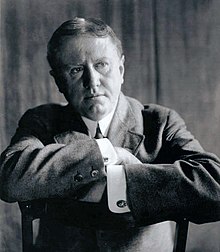

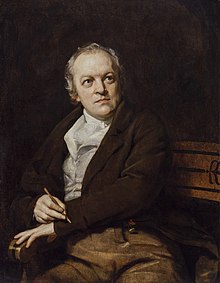 William Blake (28 November 1757 – 12 August 1827) was an English painter, poet and printmaker. Largely unrecognised during his lifetime, Blake is now considered



 Grendel is a 1971 novel by American author