字體:小 中 大 |
|
|
|
| 2014/12/21 13:24:09瀏覽143|回應0|推薦0 | |
* Etymology 1. ad- : forward e.g., advent: the period beginning four Sundays before Christmas and observed by some Christians as a season of prayer and fasting e.g., advantage: something that makes one person orthing more likely to succeed than others e.g., advertisement: a short film on television or short article on radio that is intended topersuade people to buy something 2. en- : to make into, to put into e.g., enslave: to make someone a slave e.g., enmesh: to catch or entangle in or as if in meshes e.g., encrypt: to put information into code . * Advent
An acolyte lighting Advent candles Advent is a season observed in many Western Christian churches as a time of expectant waiting and preparation for the celebration of the Nativity of Jesus at Christmas. The term is an anglicized version of the Latin word adventus, meaning "coming". Latin adventus is the translation of the Greek word parousia, commonly used to refer to the Second Coming of Christ. For Christians, the season of Advent anticipates the coming of Christ from two different perspectives. The season offers the opportunity to share in the ancient longing for the coming of the Messiah, and to be alert for his Second Coming. Advent is the beginning of the Western liturgical year and commences on the fourth Sunday before Christmas, the Sunday nearest to St. Andrew's Day (30 November). Practices associated with Advent include keeping an Advent calendar, lighting an Advent wreath, praying an Advent daily devotional, as well as other ways of preparing for Christmas, such as setting up Christmas decorations. . * Plot
* Chorus A group of characters in Greek tragedy (and in later forms of drama), who comment on the action of a play without participation in it. Their leader is the choragos. Sophocles' Antigone and Oedipus the King both contain an explicit chorus with a choragos. The chorus represents, on stage, the general population of the particular story, in sharp contrast with many of the themes of the ancient Greek plays which tended to be about individual heroes, gods, and goddesses. They were often the same sex as the main character. In Aeschylus' Agamemnon, the chorus comprises the elderly men of Argos, whereas in Euripides' The Bacchae, they are a group of eastern bacchantes, and in Sophocles' Electra, the chorus represents the women of Argos. The parts however were acted by males. In Aeschylus' The Eumenides, however, the chorus takes the part of a host of avenging Furies. . * Nativity of Jesus
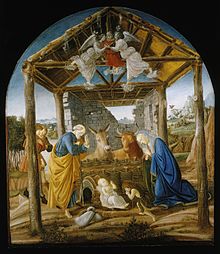
Nativity of Jesus, by Botticelli The Nativity of Jesus, also The Nativity, refers to the accounts of the birth of Jesus, primarily based on the two accounts in the gospels of Luke and Matthew, and secondarily on some apocryphal texts. The canonical gospels of Luke and Matthew both describe Jesus as born in Bethlehem in Judea, to a virgin mother. In the Gospel of Luke account, Joseph and Mary travel from Nazareth to Bethlehem for the census, and Jesus is born there and laid in a manger. Angels proclaim him a savior for all people, and shepherds come to adore him. In the Matthew account, astronomers follow a star to Bethlehem to bring gifts to Jesus, born the King of the Jews. King Herod orders the massacre of all the boys less than two years old in Bethlehem, but the family flees to Egypt and later settles in Nazareth. Many scholars view the two narratives as non-historical and contradictory . * Bethlehem
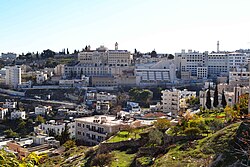
Bethlehem overlook Bethlehem is a Palestinian city located in the central West Bank, about 10 kilometers south of Jerusalem. The New Testament identifies Bethlehem as the birthplace of Jesus. The city is inhabited by one of the oldest Christian communities in the world[citation needed], although the size of the community has shrunk due to emigration. . * It's The Most Wonderful Time Of The Year https://www.youtube.com/watch?v=gFtb3EtjEic 
t's the most wonderful time of the year With the kids jingle belling And everyone telling you "Be of good cheer" It's the most wonderful time of the year It's the hap-happiest season of all With those holiday greetings and gay happy meetings When friends come to call It's the hap- happiest season of all
There'll be parties for hosting Marshmallows for toasting And caroling out in the snow There'll be scary ghost stories And tales of the glories of Christmases long, long ago
It's the most wonderful time of the year There'll be much mistletoeing And hearts will be glowing When love ones are near It's the most wonderful time of the year
There'll be parties for hosting Marshmallows for toasting And caroling out in the snow There'll be scary ghost stories And tales of the glories of Christmases long, long ago
It's the most wonderful time of the year There'll be much mistletoeing And hearts will be glowing When love ones are near It's the most wonderful time It's the most wonderful time It's the most wonderful time It's the most wonderful time of the year . * The Second Coming William Butler Yeats (first published in The Dial, 1920, then included in Michael Robartes and the Dancer, 1921) Turning and turning in the widening gyre . * Dramatic irony This type of irony is the device of giving the spectator an item of information that at least one of the characters in the narrative is unaware of (at least consciously), thus placing the spectator a step ahead of at least one of the characters. Dramatic irony produces dramatic conflict in what one character relies or appears to rely upon, the contrary of which is known by observers (especially the audience; sometimes to other characters within the drama) to be true. In summary, it means that the reader/watcher/listener knows something that one or more of the characters in the piece is not aware of. For example, in Oedipus the King, the audience knows that Oedipus himself is the murderer that he is seeking; Oedipus, Creon and Jocasta do not. . * Deus ex machina Deus ex machina from Latin deus, meaning "a god", ex, meaning "from", and machina, meaning "a device, a scaffolding, an artifice", is a calque from Greek ἀπὸ μηχανῆς θεός (apò mēkhanḗs theós), meaning "god from the machine". The term has evolved into a plot device whereby a seemingly unsolvable problem is suddenly and abruptly resolved by the contrived and unexpected intervention of some new event, character, ability or object. Depending on how it is done, it can be intended to move the story forward when the writer has "painted himself into a corner" and sees no other way out, to surprise the audience, to bring the tale to a happy ending, or as a comedic device. . * Shall I compare thee to a summer’s day? (Sonnet 18)
Shall I compare thee to a summer’s day?
Thou art more lovely and more temperate.
Rough winds do shake the darling buds of May,
And summer’s lease hath all too short a date.
Sometime too hot the eye of heaven shines,
And often is his gold complexion dimmed;
And every fair from fair sometime declines,
By chance, or nature’s changing course, untrimmed;
But thy eternal summer shall not fade,
Nor lose possession of that fair thou ow’st,
Nor shall death brag thou wand’rest in his shade,
When in eternal lines to Time thou grow’st.
     So long as men can breathe, or eyes can see,
     So long lives this, and this gives life to thee.
. * Original sin
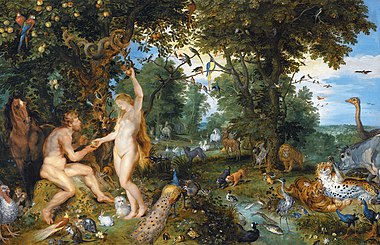
Depiction of the sin of Adam and Eve by Jan Brueghel the Elderand Pieter Paul Rubens Original sin, also called ancestral sin, is the Christian doctrine of humanity's state of sin resulting from the fall of man, stemming from Adam's rebellion in Eden. This condition has been characterized in many ways, ranging from something as insignificant as a slight deficiency, or a tendency toward sin yet without collective guilt, referred to as a "sin nature", to something as drastic as total depravity or automatic guilt of all humans through collective guilt. . * Catholic: a member of the Roman Catholic Church * Protestant: a member of a group of Christian churches that separated from theRoman Catholic Church in the 16th century |
|
| ( 知識學習|隨堂筆記 ) |