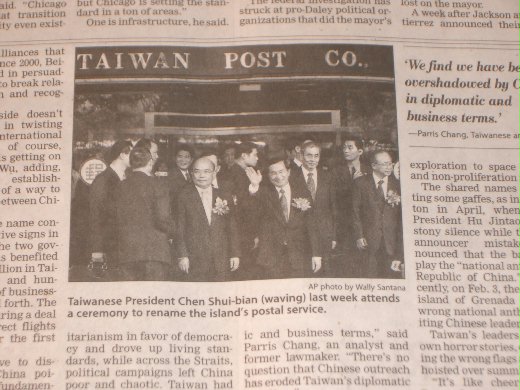
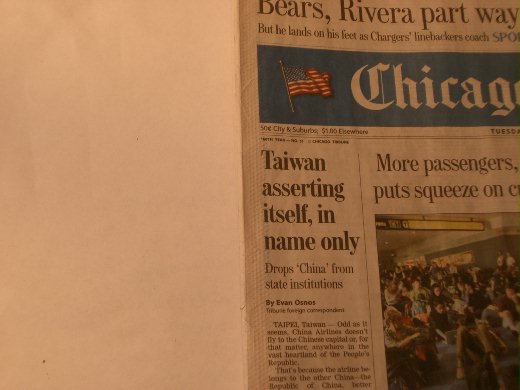
哈哈! 姊姊昨天從宿舍打電話來告訴我台灣上Chicago Tribune的頭版時,我還半信半疑的。沒想到當我找到了報紙,仔細一看,ㄟ 真的耶! 竟然上了頭版了! 雖然不是放在正中間,內容也不完全正面,不過這已經是很難得了。講的是什麼呢? 我讀了一下,大致上就是在講最近公營事業正名的事,當然還有兩岸關係等等。為了留念,在此特地摘錄此新聞,有興趣的朋友們也可以試著讀讀看喔!
P.S.有空我會試著翻譯看看,雖然看起來挺難翻的。
Taiwan asserting itself, in name only
Drops ‘China’ from state institutions
By Evan Osnos Tribune Foreign Correspondent
TAIPEI, Taiwan—Odd as it seems, China Airlines doesn’t fly to the Chinese capital or, or that matter, anywhere in the vast heartland of the People’s Republic.
That’s because the airline belongs to the other China—the Republic of China, better known as Taiwan.
For more than half a century, through decades of gaffes and misdirected phone calls from the outside world, archrival governments in Beijing and Taipei have each retained the name China on state-run businesses and agencies, a cold war over words between the mainland and the self-ruled island it calls a renegade province.
“I, myself, get confused,” said Joseph Wu, head of Taiwan’s Mainland Affair Council.
But the joint custody of the name China is beginning to crumble, a telling sign of how Taiwan’s deepening isolation are further fueling their dangerous feud.
This month, Taiwan’s government abruptly pulled the name China from some key state-run institutions: China Shipbuilding, for instance, became Taiwan International Shipbuilding; the postal service went from Chunghwa Post, which uses a Mandarin word for China, to Taiwan Post.
In the high-stakes standoff across the Taiwan Straits—China has roughly 1,000 missiles pointed at the island, by Taiwan’s count—these name changes are no small matters.
They are part of a broader effort by pro-independence President Chen Shui-bian to promote Taiwanese identity and distance the island from its increasingly powerful neighbor. Chen is also moving to play down Chinese history in textbooks and public monuments and is planning to print stamps in the name of Taiwan rather than China.
The changes have drawn sharp criticism from Beijing, which tolerates Taiwan’s de facto separation but has vowed to attack if the island ever declares formal independence. The changes also drew disapproval from Washington, which fears any moves by Taiwan that could upset peace in Asia.
Reversal of fortunes
Taiwan’s leaders say they have no choice. As China’s stature grows in diplomacy and business, Taiwan’s standing has eroded faster than at any point since 1979, when the U.S. officially switched its recognition to the Beijing government.
Communist Party leaders have proved adept at deploying trade and development aid to win diplomatic alliances that isolate Taiwan. Since 2000, Beigin has succeeded in persuading seven nations to break relations with Taiwan and recognize China.
“The Chinese side doesn’t hesitate anymore in twisting Taiwan’s arm in international participation and, of course, that kind of thing is getting on our nerves, said Wu, adding, “The government establishment had to think o a way to make a distinction between China and Taiwan”
In some ways, the name controversy belies positively signs in relations between the two governments. China has benefited from roughly $100 billion in Taiwanese investment, and hundreds of thousands of businesspeople flow back and forth. The governments are nearing a deal that could allow direct flights between the two for the first time in decades.
But Taiwan’s move to distance itself from China poignantly reflects the fundamental dynamic in Taiwan today: the island’s continued reversal of fortune over the past half-century.
When China’s civil war ended in 1949, Communist forces under Mao Tse-tung had defeated the nationalists. Their leader, Chiang kai-shek, fled to Taiwan along with 2 million mainland Chinese to transplant their Republic and plot their return.
In the five decades that followed, the island shed authoritarianism in favor of democracy and drove up living standards, while across the straits, political campaign left China poor and chaotic. Taiwan had become an Asian Tiger, the proud, urban, high-tech hope of the Chinese-speaking world.
Overtaking a tiger
But in less than a decade, China’s double-digit annual growth and relaxed personal freedoms have revolutionized the world’s most populous country, eclipsing Taiwan and emerging as an Asian power without equal.
“We find we have been overshadowed by China in diplomatic and business terms,” said Parris Chang, an analyst and former lawmaker. “There’s no question that Chinese outreach has eroded Taiwan’s diplomatic standing.”
The name changes have a practical motivation as well. For much of its postwar history, communist China was an ideological and idiosyncratic voice in world affairs, a power symbolized by its monochromatic Mao suits, and there was little confusing it with the business-minded Taiwan. But today Chinese executives and diplomats are in every corner of the globe, involved in everything from oil exploration to space research and non-proliferation talks.
The shared names are abetting some gaffes, as in Washington in April, when Chinese President Hu Jintao stood in stony silence while the official announcer mistakenly announced that the band would play the “national anthem of the Republic of China.” More recently, on Feb. 3, the Caribbean island of Grenada played the wrong anthem for visiting Chinese leaders.
Taiwan’s leaders have their own horror stories, often involving the wrong flags and banners hoisted over summit talks.
“It’s like cheering for the Penn State basketball team when you mean the University of Pennsylvania,” Chang said.
Beyond the name changes, students in Taiwan began using textbooks this year the removed references to “our country” and to the “mainland,” replacing them in many cases with the word “China.”
So far, Chen’s government has pledged not to change the formal name, Republic of China, or its flags, acts that Beijing would consider provocative.
Still, critics of the name changes call them nothing more than political pandering in advance of Taiwan’s presidential election next year. True or not, that accusation is recognition of how a growing sense of Taiwanese identity is shaping Taiwan’s public attitudes.
No confrontations, please
Over the past decade, the number of citizens who consider themselves Taiwanese had nearly doubled to 44 percent, while those who classify themselves as Chinese has dropped from 16 percent to 6 percent, according to surveys by National Chengchi University.
Opponents of the name changes prefer to highlight a different number—the roughly 44 percent of citizens who consider themselves both Taiwanese and Chinese, surveys show. In tat group, moderates hope to find the making of future compromises.
“Taiwan’s people are exhausted by politics, and they want pragmatic solutions,” said Su Chi, a senior lawmaker wit the opposition party, Kuomingtang. To Su, Taiwan is best served by sidestepping confrontation with its enormous neighbor rather than seeking to challenge it head on.
“Don’t poke them in the nose,” he said. “Let’s give them face and let all side get back to getting rich.”


 字體:小 中 大