字體:小 中 大 |
|
|
|
| 2016/12/27 16:31:40瀏覽141|回應0|推薦0 | |
week 14 A. syllabus Aristotle
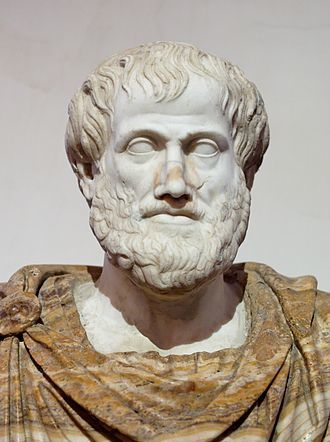
Aristotle was a Greek philosopher and scientist born in the city of Stagira, Chalkidice, on the northern periphery of Classical Greece. His father, Nicomachus, died when Aristotle was a child, whereafter Proxenus of Atarneus became his guardian. At seventeen or eighteen years of age, he joined Plato's Academy in Athens and remained there until the age of thirty-seven (c. 347 BC). His writings cover many subjects – including physics, biology, zoology, metaphysics, logic, ethics, aesthetics, poetry, theater, music, rhetoric, linguistics, politics and government – and constitute the first comprehensive system of Western philosophy. Shortly after Plato died, Aristotle left Athens and, at the request of Philip of Macedon, tutored Alexander the Great beginning in 343 BC.
Aristotle's Poetics is the earliest surviving work of dramatic theory and the first extant philosophical treatise to focus on literary theory. This has been the traditional view for centuries. However, recent work is now challenging whether Aristotle focuses on literary theory per se (given that not one poem exists in the treatise) or whether he focuses instead on dramatic musical theory that only has language as one of the elements. B. Quiz on Gradesaver 1. Which is not something Aristotle says he will address in the Poetics? A. the method in which a poem is divided into parts B. the different kinds of poetry C. the structure necessary for a good poem D. the revision process for poetry 2. What does Aristotle mean by imitation? A. mimicry of sound B. representation of death C. mimicry of language D. representation of life 3. Which is not included in the definition of poetry? A. essay B. comedy C. tragedy D. music 4. Which is not included in poetry's imitation? A. instinct B. language C. harmony D. rhythm 5. What does 'dramitas' mean? A. drama of language B. drama of action C. drama of music D. drama of dancing 6. Tragedy presents men... A. as they ought to be B. as they are C. better than they are D. worse than they are 7. Comedy presents men... A. as they are B. better then they are C. as they ought to be D. worse than they are 8. Epic presents men... A. better than they are B. worse than they are C. as they ought to be D. as they are 9. According to Aristotle, Homer tends to present men... A. better then they are B. as they are C. as they ought to be D. worse then they are 10. Which is not a form of imitative narration? A. first-person 'I' B. third-person narrator C. first-person omniscient 'I' D. second-person narrator ('You') 11. What is one of the reasons poetry emerged? A. the necessity for public entertainment B. the rise of court music C. man's instinct for imitation D. the instinct for dance 12. What does poetry tend to imitate, according to Aristotle? A. dance and music B. epic grief C. 'nature' in all forms D. noble men and 'bad' men 13. What genre began with the imitation of 'meaner men'? A. tragedy B. epic C. comedy D. drama 14. Which genre was at first not taken seriously? A. drama B. comedy C. tragedy D. epic 15. Fill in the blank: All the elements of [x] are found in tragedy, but not all the elements of [x] are found in [x] A. comedy B. drama C. music D. epic 16. Which is not a component of tragedy? A. narrative form B. thought C. plot D. character 17. What by definition is serious, complete, and of a significant magnitude? A. tragedy B. drama C. epic D. comedy 18. What comprises the arrangement of incidents that result from character and thought giving way to action? A. diction B. character C. thought D. plot 19. Complication and denouement are two elements of... A. speech B. thought C. plot D. character 20. What does Aristotle mean by dictoin? A. grief B. rhythmic language C. diction D. song 21. According to Aristotle, what is the most important element of tragedy? A. character B. thought C. comedy D. plot 22. What is the least important element of a tragedy? A. diction B. plot C. spectacle D. song 23. Tragedy relies on... A. pity B. action C. narrative D. character 24. What is the term for a purgation of pity and fear in the audience? A. Spectacle B. Catharsis C. Drama D. Imitation 25. What is the term for the qualities ascribed to a certain men? A. spectacle B. song C. character D. diction C. Quiz on SparkNotes 1. Which of the following is NOT a distinctive feature of poetry? It uses language It uses rhythm It is written in verse It uses harmony 2. Which of the following contains a mix of direct and indirect narrative? Tragedy Comedy Homeric epic Dithyrambic poetry 3. Which of the following is not "art" in the Greek sense of the word? Tragedy A spear A table A peacock's feather 4. Which of the following is NOT a reason for why we like imitations? We learn from imitations Imitations exercise our reason We are not repelled by imitations of things we would normally find repellent There is a sense of safety in not having to deal with reality 5. Which of the following was the last to evolve? Tragedy Dithyramb Epic poetry Invective 6. Which of the following is not one of the "three unities"? Unity of action Unity of character Unity of place Unity of time 7. Which is the only unity that Aristotle insists upon? Unity of action Unity of character Unity of place Unity of time 8. Which of the following is the most important? Character Diction Plot Harmony 9. Which of the following is the least important? Character Plot Thought Spectacle 10. Which of the following is NOT a part of Aristotle's definition of tragedy? It arouses pity and fear It has an unhappy ending It involves mimesis It is performed rather than narrated 11. Which of the following genres has the same plot structure as tragedy? Epic poetry History Biography Episodic storytelling 12. Which of the following has an episodic structure? Biography History Both Neither 13. A complex plot must contain: Peripeteia Anagnorisis Both Either 14. Which of the following is NOT necessary to all tragedies? Exode Commos Parode Episode 15. Which is the best kind of tragic plot? A harmful deed is done knowingly A harmful deed is done in ignorance A harmful deed is avoided knowingly A harmful deed is premeditated in ignorance, but a discovery helps prevent it 16. Which is the worst kind of tragic plot? A harmful deed is done knowingly A harmful deed is done in ignorance A harmful deed is avoided knowingly A harmful deed is premeditated in ignorance, but a discovery helps prevent it 17. Which of the following is NOT a requirement for a tragic hero? The hero must be good The hero must be male The hero's character must be consistent The hero must be of high social status 18. Which is the worst kind of anagnorisis? Recognition by means of signs or marks Recognition prompted by memory Recognition through deductive reasoning Recognition that arises through the structure of the plot 19. Which is the best kind of anagnorisis? Recognition by means of signs or marks Recognition prompted by memory Recognition through deductive reasoning Recognition that arises through the structure of the plot 20. Which of the following is not within the domain of thought? Exciting emotion with a powerful speech Exhibiting shyness through hunched posture Persuading someone by means of logic Blowing a problem out of proportion by means of exaggeration 21. Which of the following is not a metaphor? "That's as likely as a cold day in July" "Juliet is the sun" "I'm a race car in the red" "My love is a red, red rose." 22. Which of the following is not a feature of epic poetry? Unity of plot A noble hero Iambic meter It is narrated 23. Which of the following is NOT true of epic poetry? It's longer than tragedy It can portray more isolated incidents than tragedy It can get away with presenting less probable events than those presented in tragedy It is a more impressive spectacle than watching tragedy 24. Which of the following is not an acceptable reason for including impossible or improbable events in a poem? The poet is portraying things as the ought to be, not as they are The poet is portraying things according to public opinion They are necessary to make the plot work They add to the astonishment and excitement of the story 25. Which of the following is NOT a reason given by Aristotle to prefer tragedy over epic poetry? Exaggerated gestures can add something in performance Tragedy contains music and spectacle There is more unity in tragedy
Tragedy is shorter and more compact |
|
| ( 知識學習|隨堂筆記 ) |