字體:小 中 大 |
|
|
|
| 2017/01/02 14:45:57瀏覽459|回應0|推薦0 | |
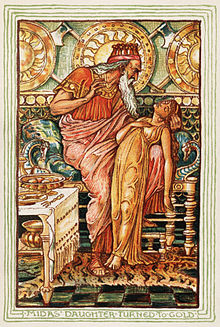
1.Midas
2.Orpheus
3.Tiresias
4.Today's Words 1)ami-: "friend, lover," c. 1300, from Old French amy, ami "friend, lover, beloved; kinsman" (11c.), from Latin amicus
2)re-: word-forming element meaning "back to the original place; again, anew, once more," also with a sense of "undoing," c. 1200, from Old French and directly from Latin re- "again, back, anew, against," "Latin combining form conceivably from Indo-European *wret-, metathetical variant of *wert- "to turn" [Watkins]. Often merely intensive, and in many of the older borrowings from French and Latin the precise sense of re- is lost in secondary senses or weakened beyond recognition. OED writes that it is "impossible to attempt a complete record of all the forms resulting from its use," and adds that "The number of these is practically infinite ...." The Latin prefix became red- before vowels and h- 3)alter-:late 14c., "to change (something), make different in some way," from Old French alterer "to change, alter," from Medieval Latin alterare "to change," from Latin alter "the other (of the two)," from PIE *al- (1) "beyond" + comparative suffix -ter (as in other). Intransitive sense "to become otherwise" first recorded 1580s. Related: Altered; altering. eg. alternative, altercation, alternate
4)de-: active word-forming element in English and in many words inherited from French and Latin, from Latin de "down, down from, from, off; concerning" , also used as a prefix in Latin usually meaning "down, off, away, from among, down from," but also "down to the bottom, totally" hence "completely" (intensive or completive), which is its sense in many English words. As a Latin prefix it also had the function of undoing or reversing a verb's action, and hence it came to be used as a pure privative -- "not, do the opposite of, undo" -- which is its primary function as a living prefix in English, as in defrost (1895), defuse (1943), etc. Compare also dis-. eg. deceleration, demulcent, detergent 5)arch-: also archi-, word-forming element meaning "chief, principal; extreme, ultra; early, primitive," from Latinized form of Greek arkh-, arkhi- "first, chief, primeval," comb. form of arkhos "chief" . eg. archenemy, archfiend, archdiocese p.s. -arch:word-forming element meaning "a ruler," from Greek arkhos "leader, chief, ruler," from arkhe "beginning, origin, first place" . 6)-mortal: "mortal thing or substance," 1520s, from mortal (adj.). Latin mortalis also was used as a noun, "a man, mortal, human being.'' eg. immortal, amortize, mortify
|
|
| ( 知識學習|隨堂筆記 ) |