字體:小 中 大 |
|
|
|
| 2017/01/01 21:43:23瀏覽606|回應0|推薦0 | |
1.Today's Words 1)de-: active word-forming element in English and in many words inherited from French and Latin, from Latin de "down, down from, from, off; concerning" , also used as a prefix in Latin usually meaning "down, off, away, from among, down from," but also "down to the bottom, totally" hence "completely" (intensive or completive), which is its sense in many English words. As a Latin prefix it also had the function of undoing or reversing a verb's action, and hence it came to be used as a pure privative -- "not, do the opposite of, undo" -- which is its primary function as a living prefix in English, as in defrost (1895), defuse (1943), etc. Compare also dis-. eg. deceleration, demulcent, detergent 2)-meter: word-forming element meaning "device or instrument for measuring;" commonly -ometer, occasionally -imeter; from French -mètre, from Greek metron "a measure" eg. psychrometer, anemometer, calorimeter
3)ther-: often thero-, word-forming element meaning "beast," from comb. form of Greek ther "wild beast, beast of prey," from PIE *ghwer- "wild beast" (source also of Latin ferus "wild," ferox "fierce;" see fierce). Also therio-, from Greek therion. eg. Theropoda, thereupon, there 4)thermo-:before vowels therm-, word-forming element meaning "hot, heat, temperature," used in scientific and technical words, from comb. form of Greek thermos "hot, warm," therme "heat" eg. thermochemistry, thermocouple, thermosphere 5)hyper-:word-forming element meaning "over, above, beyond," and often implying "exceedingly, to excess," from Greek hyper (prep. and adv.) "over, beyond, overmuch, above measure," from PIE *uper "over" eg. Hyperion, hypertension, hyperbaton
6)-mortal: "mortal thing or substance," 1520s, from mortal (adj.). Latin mortalis also was used as a noun, "a man, mortal, human being.'' eg. immortal, amortize, mortify
7)in-:element meaning "into, in, on, upon" (also im-, il-, ir- by assimilation of -n- with following consonant), from Latin in- "in". In Old French (and hence in Middle English) this often became en-, which in English had a strong tendency to revert to Latin in-, but not always, which accounts for pairs such as enquire/inquire. There was a native form, which in West Saxon usually appeared as on- (as in Old English onliehtan "to enlighten"), and some of those verbs survived into Middle English (such as inwrite "to inscribe"), but all now seem to be extinct. eg. impermanent, impermissible, irresistance
2.Extra Words 1)hyperbole: "obvious exaggeration in rhetoric," early 15c., from Latin hyperbole, from Greek hyperbole "exaggeration, extravagance," literally "a throwing beyond," from hyper- "beyond" + bole "a throwing, a casting, the stroke of a missile, bolt, beam," from bol-, nominative stem of ballein "to throw" . Rhetorical sense is found in Aristotle and Isocrates. Greek had a verb, hyperballein, "to throw over or beyond."
2)understatement: the act or an instance of understating, or representing in a weak orrestrained way that is not borne out by the facts.
3)malign: "to slander," mid-15c., from earlier more literal sense of "to plot, to contrive" (early 15c.), from Old French malignier "to plot, deceive, pervert," from Late Latin malignare "to do maliciously," from malignus "mean, unkind". Related: Maligned; maligning.
3.Moon River
"Moon River" is a song composed by Henry Mancini with lyrics by Johnny Mercer. It received an Academy Award for Best Original Song for its performance by Audrey Hepburn in the movie Breakfast at Tiffany's (1961). It also won Mancini the 1962 Grammy Award for Record of the Year and won Mancini and Mercer the Grammy Award for Song of the Year. The song has been covered by many other artists. 4.Henry Mancini
Enrico Nicola "Henry" Mancini (April 16, 1924 – June 14, 1994) was an American composer, conductor and arranger, who is best remembered for his film and television scores. Often cited as one of the greatest composers in the history of film,[2][3] he won four Academy Awards, a Golden Globe, and twenty Grammy Awards, plus a posthumous Grammy Lifetime Achievement Award in 1995. 5.Tuberculosis
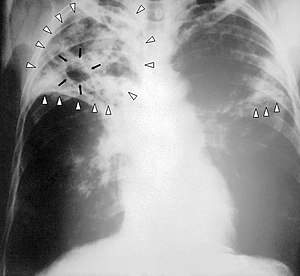
Tuberculosis (TB) is an infectious disease caused by the bacterium Mycobacterium tuberculosis (MTB).Tuberculosis generally affects the lungs, but can also affect other parts of the body. Most infections do not have symptoms; in which case it is known as latent tuberculosis. About 10% of latent infections progress to active disease which, if left untreated, kills about half of those infected. The classic symptoms of active TB are a chronic cough with blood-containing sputum, fever, night sweats, and weight loss. The historical term "consumption" came about due to the weight loss. Infection of other organs can cause a wide range of symptoms.
6.Psalm 23
Psalm 23 (Greek numbering: Psalm 22) is the 23rd psalm in the Old Testament Book of Psalms. The writer describes God as his shepherd. The text is often alluded to in popular media and has been set to music many times.  p.s click to see |
|
| ( 知識學習|隨堂筆記 ) |