字體:小 中 大 |
|
|
|
| 2017/06/07 12:36:10瀏覽180|回應0|推薦0 | |
|
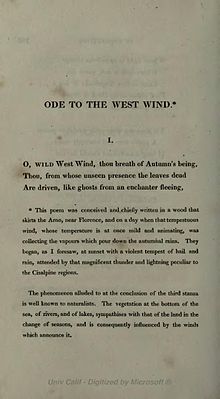
In-class Note: Ode to the West Wind "Ode to the West Wind" is an ode, written by Percy Bysshe Shelley in 1819 near Florence, Italy. It was originally published in 1820 by Charles and Edmund Ollier in London as part of the collection Prometheus Unbound, A Lyrical Drama in Four Acts, With Other Poems. Some have interpreted the poem as the speaker lamenting his inability to directly help those in England owing to his being in Italy. At the same time, the poem expresses the hope that its words will inspire and influence those who read or hear it. Perhaps more than anything else, Shelley wanted his message of reform and revolution spread, and the wind becomes the trope for spreading the word of change through the poet-prophet figure. Some also believe that the poem was written in response to the loss of his son, William (born to Mary Shelley) in 1819. The ensuing pain influenced Shelley. The poem allegorises the role of the poet as the voice of change and revolution. At the time of composing this poem, Shelley without doubt had the Peterloo Massacre of August 1819 in mind. His other poems written at the same time—The Masque of Anarchy, Prometheus Unbound, and "England in 1819"—take up these same themes of political change, revolution, and role of the poet.
Glossary: Ode Richard Cory "Richard Cory" is a narrative poem written by Edwin Arlington Robinson. It was first published in 1897, as part of The Children of the Night, having been completed in July of that year; and it remains one of Robinson's most popular and anthologized poems. The poem describes a person who is wealthy, well educated, mannerly, and admired by the people in his town. Despite all this, he fatally shoots himself in the head. I feel a butterfly in my stomach-flutter One calm summer night-the climax of one’s life Prefix and Suffix: Mort-: Death Malory’s Le Morted Arthur folk King Arthur Ballad-narrative poetry La Belle Dame Sans Merci John Keats Four lines in a group Qua-: four Nine and three quarters 1 dollar=14 sonnet “thy” means “your” in old format literature manna The Tyger-praise John Donne no man is an island Death be hot prod The wit Ema Tompson For-reached comparison A valediction forbidding Mourning-conceit Metaphysical poet John Donne Shawshark The Road Not Taken Ars Poetia Poetry Ode on a Grecian Urn I placed a jar in tennensse Anecdote of the jar |
|
| ( 知識學習|考試升學 ) |